
Idea 1
Redeeming Time through the Life of Jesus
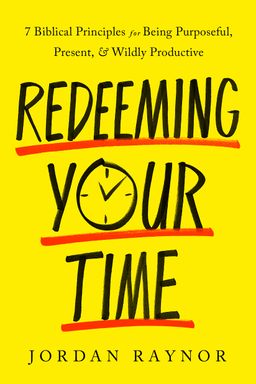
When was the last time you felt truly unrushed? In Redeeming Your Time, Jordan Raynor argues that modern people are drowning in busyness—not necessarily from work itself, but from disordered hearts, noisy minds, and unredeemed calendars. His solution isn’t another time-management hack or productivity app. Instead, Raynor insists that the answer lies in studying the Author of Time Himself: Jesus Christ. What if the Gospels didn’t only reveal how to live righteously but also how to live efficiently, purposefully, and peacefully?
Raynor’s main claim is bold: the way Jesus managed His limited thirty-three years on earth provides a perfect model for how we can order our own. By carefully observing Christ’s rhythms—from how He started His days in solitude, to how He set priorities, handled interruptions, and rested—Raynor suggests we can learn to be not just productive, but wildly productive in service of God’s purposes. Productivity becomes an act of worship, not self-glorification. The book invites you to adopt what Raynor calls a “grace-based productivity” mindset: peace first, then purpose, then practical stewardship of time.
A Different Kind of Productivity Book
Raynor positions his book amid a crowded genre of time-management gurus—David Allen, Cal Newport, Greg McKeown, and others—but he distinguishes himself by connecting spiritual formation with high-performance principles. He notes most books promise that better systems will produce inner peace. In contrast, Christianity teaches the opposite: we already have peace through Christ; our work and systems are simply a worshipful response to that gift. This “grace-based productivity” upends the usual self-help formula. You work from peace, not for it.
To structure his message, Raynor organizes the book around seven biblical principles, each illustrated through Jesus’s life and paired with modern “practices.” Each principle—such as “Start with the Word,” “Let Your Yes Be Yes,” “Dissent from the Kingdom of Noise,” and “Embrace Productive Rest”—translates sacred truth into tangible strategies. It’s part theology, part behavioral science, and part very practical instruction manual.
The Peace before Productivity
In the book’s introduction, Raynor uses the Gospel story of the storm on the sea (Luke 8) to dramatize how most of us live: as if our boats are swamped by waves of work, notifications, and anxiety. The disciples panicked; Jesus slept. The moment Christ calmed the storm becomes a metaphor for Raynor’s central premise. True order and calm in our schedules come only when we first anchor to Christ, “the Prince of Peace.” Every tactic that follows—the lists, the planning systems, the rest cycles—must remain grounded in the security of being loved children of God who work from a place of peace rather than striving for it.
He calls this the shift from works-based productivity to grace-based productivity. The former says, “Once I perform well, I’ll feel peace.” The latter responds, “Because I already have peace in Christ, I can now perform well out of gratitude.” This shift reframes ambition itself: we aren’t trying to ‘get ahead,’ we’re stewarding our days as an offering to God.
From Swamped to Stewardship
Raynor defines “redeeming the time” from Ephesians 5:16—to “buy up” time for God’s purposes. It’s not about squeezing in more tasks or multitasking (which he later condemns as “makeshift omnipresence”). Instead, to redeem time means aligning your minutes with God’s will—to “buy back” even ordinary work as eternal investment. Every email, meeting, or diaper change becomes sacred because every hour belongs to the Lord. Productivity becomes a form of faithfulness.
He structures the rest of the book around how to steward this calling through seven Christ-modeled habits: grounding in Scripture (Start with the Word), honoring commitments (Let Your Yes Be Yes), quieting distractions (Dissent from the Kingdom of Noise), choosing priorities (Prioritize Your Yeses), focusing your presence (Accept Your Unipresence), resting as command (Embrace Productive Rest), and working without hurry (Eliminate All Hurry). Each builds sequentially, forming a life that is both purposefully busy and spiritually unhurried—just like Jesus.
Why This Approach Matters
The modern productivity trap, Raynor warns, is idolizing efficiency. We fill our calendars in pursuit of self-worth and call it “responsibility.” The result: swamped lives with little peace. In contrast, Raynor contends Christians can leverage all the same tools—planning, prioritization, digital minimalism—but for a higher motive. The goal isn’t personal optimization; it’s kingdom advancement. Redeeming time becomes part of redeeming creation itself.
By grounding his system in the example of Christ—a man who balanced crowds and solitude, urgency and patience, purpose and peace—Raynor offers not just another framework but a holistic theology of time. Modern believers, he suggests, are not called to escape busyness but to sanctify it. We do that by seeing time not as a scarce resource we control, but as a sacred gift we steward. Only then can we, like the Savior, move through life calmly in the midst of chaos, accomplishing much without ever being hurried.