
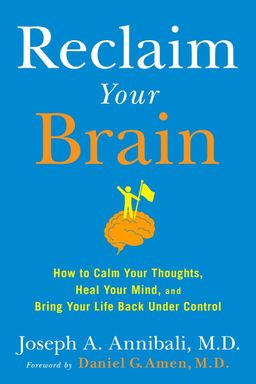
Reclaim Your Brain cover

Reclaim Your Brain

by Joseph A Annibali, MD

Reclaim Your Brain explores the intricate balance of the human mind, offering insights into overcoming anxiety, depression, and addiction. Through mindfulness and cognitive exercises, this book reveals how to regain control and achieve a healthier, more balanced life.

Reclaiming Your Busy Brain

Have you ever felt like your mind just won’t turn off — that you’re constantly juggling too many thoughts, worries, and distractions? In Reclaim Your Brain, psychiatrist Dr. Joseph Annibali argues that a chronically overactive mind — what he calls the “busy brain” — is one of the most pervasive but overlooked problems of modern life. Through decades of clinical experience and brain imaging work with Dr. Daniel Amen’s team, Annibali makes a bold case: that most emotional suffering, from anxiety to depression to addiction, stems from imbalances within the brain itself and the ways the mind relates to it.

Annibali’s central thesis is deceptively simple: if your brain is unbalanced, your mind will struggle. But once you learn to calm, heal, and balance your brain, you can regain control of your thoughts, emotions, and life. This book bridges neuroscience and psychology, showing how biological processes — not moral failings or weak will — underlie the mental chaos many people experience. The good news? Thanks to neuroplasticity, you can literally reshape and strengthen your brain through targeted mental, physical, and relational practices.

Brains in Overdrive

Annibali opens with detailed portraits of patients like Emily, a high-achieving editor whose brain buzzes with anxious static, and Josh, a student whose mind feels like a “freight train.” Through such examples, he reveals how people across all ages and conditions describe similar sensations — racing thoughts, distraction, irritability — often caused by excessive limbic system activity. He explains the interaction between the prefrontal cortex (the rational, executive part of the brain) and the limbic system (the emotional core). When these two areas fall out of balance, we get emotional chaos, compulsive habits, disorganization, or burnout.

This imbalance can arise from many sources: stress, trauma, genetic predisposition, diet, hormonal shifts, physical injuries, and even modern digital overstimulation. The critical point is that mental health isn’t just psychological — it’s deeply biological. “You can’t manage your mind,” Annibali says, “if your brain isn’t working properly.”

Mind Meets Brain

At the heart of the book is Annibali’s integrative model that blends “mind management” (how you think, focus, and respond) with “brain balancing” (supporting biological function). He organizes his program into three major stages: Reining in the Brain, Managing the Mind, and Addressing Specific Issues. First, he takes readers on a tour of core brain structures and how imbalances show up in everyday behavior — for example, an overactive amygdala hijacking your ability to stay calm, or an underactive prefrontal cortex causing poor impulse control.

Then, Annibali moves into the practical strategies: rewiring negative thought loops, practicing mindfulness, and improving relationships to reduce emotional overload. Later sections explore concrete, biological issues — from ADHD and anxiety to depression, trauma, and addiction — offering a roadmap for diagnosing and healing multiple layers of brain dysfunction. Whether he’s describing a depressed Yale student whose brain scans revealed hidden injury, or patients finding relief through meditation, Annibali’s message remains clear: you are not your broken brain, and with the right tools, it can heal.

Why This Matters

Our world today bombards us with endless stimulation — texts, crises, and internal noise — leaving many people perpetually overstimulated yet undercentered. Annibali’s work matters because it redefines these struggles as fixable brain-mind imbalances, not character flaws. By applying advances in neuroscience and mindfulness, he offers a compassionate, actionable path toward calm and clarity. His approach resonates with thinkers like Daniel Siegel (The Mindful Brain), who emphasizes the integration of emotional and rational systems, and Jeffrey Schwartz (You Are Not Your Brain), who uses mindfulness to rewire obsessive thoughts.

Ultimately, Annibali’s vision is both scientific and humanistic. It’s about understanding how biology, emotion, and spirituality intersect to shape your sense of self. As Daniel Amen writes in the foreword, “You are not stuck with the brain you have.” Reclaim Your Brain teaches you how to turn that truth into practical transformation: calming the chatter, strengthening self-control, healing hidden injuries, and reawakening joy. In reclaiming your brain, Annibali suggests, you reclaim your freedom — the ability to manage your emotions, make wise choices, and live a life of balance and purpose.


Balancing the Brain’s Wild Horses

Imagine your emotional life as a team of wild horses and your logical mind as the rider trying to guide them across rough terrain. This vivid analogy, borrowed from Dr. Annibali’s description of the prefrontal cortex (PFC) and the limbic system, captures what it means to balance your brain. When the rational PFC loses control over the emotional limbic system, chaos erupts — impulsivity, anxiety, depression, or irritability.

Inside the Brain’s Operating System

Annibali explains that the brain’s architecture consists of key regions: the frontal lobes (for decision-making), the temporal lobes (for emotion and memory), the basal ganglia (for our emotional “idle speed”), and the amygdala (for threat detection). The PFC, sitting right behind your forehead, is your brain’s “CEO.” It’s responsible for focus, organization, impulse control, and judgment. The limbic system underneath it, in contrast, is ancient — the emotional center that reacts faster than you can think.

When these systems are in harmony, you feel balanced and capable. But when the limbic horses take over, emotional overdrive sets in. Stress, trauma, or fatigue can weaken the PFC’s reins, leading to overactivation in the amygdala or anterior cingulate — resulting in panic, rumination, rage, or paralysis.

When the Brain is Broken

Some busy brains, Annibali warns, can’t be rebalanced simply by positive thinking. He recalls the case of Bill, a Yale student who attempted suicide. Despite psychotherapy and antidepressants, Bill’s despair persisted — until a brain SPECT scan revealed a hidden injury in his left temporal lobe from years of soccer. His brain wasn’t merely unbalanced; it was damaged. Once treated with medication targeting that region, his depression lifted, and he went on to thrive. For Annibali, Bill’s story illustrates a central truth: you can’t manage your mind if your brain is injured.

That’s why the first step to reclaiming the brain is healing any underlying damage — whether from trauma, concussion, toxicity, or metabolic imbalance. Only then can techniques like mindfulness or cognitive reframing succeed. This holistic principle echoes ideas in The Body Keeps the Score by Bessel van der Kolk, where psychological healing depends on restoring physical regulation in the nervous system.

“Hurting brains must be healed before we can manage our minds.” — Joseph Annibali

Regaining Balance

To restore balance, you must learn to strengthen the PFC while calming the limbic system. That means both top-down and bottom-up approaches: mindfulness, journaling, and gratitude to engage thinking and perspective; and physical interventions — sleep, nutrition, exercise, medication if needed — to soothe an overactive emotional brain. Balancing the brain is not about suppressing emotion but integrating it, allowing thought and feeling to coexist constructively. As Annibali concludes, the goal is “to rein in the wild horses without breaking their spirit.”


Conquering the Negativity Loop

Why does your mind so easily focus on what’s wrong rather than what’s right? Annibali argues that this negativity bias isn’t a moral flaw — it’s hardwired. Our ancestors’ survival depended on anticipating threats. Modern worries—missed emails, social rejection—still trigger those ancient alarm systems, even though we’re not fighting sabertooth tigers anymore. In today’s world, our built-in vigilance often becomes destructive rumination.

The Brain’s Bias Toward Fear

Anatomically, negative emotions originate in the right hemisphere and the amygdala. These structures mature earlier than the rational, positive left hemisphere. As a result, many people develop early emotional memories rooted in fear or neglect that keep replaying unconsciously. “The amygdala is a steel trap for threat,” writes Annibali — it never forgets, even when your logical brain has moved on. That’s why early losses or harsh parenting can color adult life with chronic pessimism or self-criticism.

Negativity in Action

The story of Gwen, a 29-year-old who feared no one could love her because she had herpes, illustrates how negative thought loops imprison us. Gwen’s belief — “I am disgusting and unlovable” — made her withdraw from relationships for six years. Through therapy, Annibali helped her realize that her shame was not truth but brain-generated noise. By distancing herself from her thoughts, practicing gratitude, and literally “turning down the mental dial,” she rewired her brain. Eventually, Gwen overcame her fear, disclosed her condition to a partner, and found love.

Retraining a Negative Brain

Annibali offers practical tools to retrain the brain’s error-detection circuits: observe rather than fuse with your thoughts (“You are not your brain”), use humor to defuse inner criticism, practice gratitude daily, step out of the “cold shower of shoulds,” and breathe to calm the body. Neuroscientifically, these actions strengthen the PFC’s inhibitory control over the limbic system — literally changing brain wiring over time (a concept echoed in You Are Not Your Brain by Jeffrey Schwartz). Negativity may be our default, but mindfulness allows the wiser self to take the wheel.


Rewriting the Stories We Live By

Every person tells themselves stories: who they are, why life turned out as it did, what they deserve. Unfortunately, many of these stories are distortions — inherited from childhood pain or misunderstanding. Annibali asserts that learning to rewrite your internal narrative is one of the most powerful ways to reclaim your brain and your life. This process, akin to cognitive-behavioral therapy (CBT), strengthens the prefrontal cortex and weakens the grip of negative limbic emotions.

Carl’s Story: From Defectiveness to Pride

Carl, an accountant with ADHD, improved concentration through medication but still felt inferior — haunted by the story that he was a “lousy student.” Annibali guided him through a structured rewriting exercise: write down the self-critical story, ask “Is it true?”, explore whose business it is, weigh the costs of believing it, and imagine the opposite. Carl eventually realized that he worked harder than most and had achieved much despite ADHD. What once felt like shame became evidence of perseverance. His new story strengthened not only his mood but his neural circuits for self-regulation.

Ana’s Story: Reframing Failure

Another patient, Ana, lost her law job during a recession and concluded, “I’m a failure who wasted years of schooling.” By writing and questioning that narrative — recognizing that an economic downturn isn’t personal — she transformed despair into resilience. A few months later she joined the Department of Justice. The exercise didn’t just change her outlook; it literally reshaped her sense of identity.

Your Brain on Storytelling

Neuroscience supports what Annibali teaches: story rewriting engages the PFC and the hippocampus, integrating emotional right-brain experiences with rational left-brain insight. It’s an act of self-directed neuroplasticity — the mind changing the brain by thought alone. Each time you reinterpret an event or adopt compassion instead of criticism, you’re building new neural maps. In Annibali’s words, “We become what we repeatedly tell ourselves.” By rewriting your story with awareness, you reclaim authorship of your life.


Mindfulness: The Art of Being Present

In a world of multitasking, most people live on autopilot — reacting rather than living. Annibali introduces mindfulness as the antidote to chronic busyness, teaching that calm focus begins with the breath. The aim of mindfulness isn’t to escape life’s chaos but to transform your relationship to it, allowing emotional storms to pass without sweeping you away.

James’s Story: The Overloaded Pastor

James, a minister, father, and community leader, felt torn between endless obligations — school board meetings, remodeling projects, church crises. His body screamed stress: insomnia, heart palpitations, nausea. Amid “decision fatigue,” his brain’s rational control circuits were depleted. Annibali prescribed not a pill but simplification: resigning from extra commitments, practicing slow breathing, and daily meditation. As James regained presence, his body calmed and his connections deepened. His story demonstrates that mindfulness often begins with subtraction — doing less to be more.

Principles of Mindful Living

Annibali outlines six principles: observation (witness thoughts without judgment), the Power of How (focus on process, not outcome), finding quiet (creating stillness), slowing down (deliberate action), breathing (the anchor of awareness), and practice (daily meditation). He recommends simple 10–20 minute routines with a repeated word or phrase. Over time, mindfulness thickens gray matter in attention areas and reduces activity in the amygdala (research from Harvard confirms this). In short, it’s emotional weightlifting for the brain.

(In The Mindful Brain, Daniel Siegel similarly links mindfulness to integration between emotional and rational brain regions, supporting Annibali’s claim that mindfulness rebalances the limbic-PFC relationship.)


Righting Relationships: From Vertical to Horizontal Connection

Human beings are social animals, yet many of our relationships recreate hierarchical or manipulative patterns that keep our brains in fight-or-flight mode. Annibali introduces a powerful framework: vertical vs. horizontal relationships. Vertical relationships are based on domination, control, and fear — one person “above,” the other “below.” Horizontal relationships, built on honesty and equality, promote calm, mutual respect, and brain balance.

The Cost of Vertical Patterns

He shares extreme cases, such as Sera, a successful analyst who was sexually abused as a child. Reenacting her trauma, she repeatedly humiliated men as revenge for her early powerlessness. Through therapy, Sera realized she was trapped in vertical cycles of predator and victim, unable to trust horizontal connection. As she healed — learning mindfulness, empathy, and emotional regulation — she built her first healthy partnership. Her story proves that emotional balance requires relational balance.

Common Vertical Roles

  • Critic/Criticized — endless judgment that erodes confidence.
  • Parent/Child — rescuing or controlling behaviors that stifle growth.
  • Manipulator/Manipulated — subtle coercion disguised as care.
  • Victimizer/Victim — cycles of blame, guilt, and helplessness.

Recognizing these dynamics, Annibali says, is half the battle. The work lies in shifting communication from power to partnership, emphasizing shared values, assertive honesty, and safety. Practicing empathy calms the amygdala of both partners, promoting emotional attunement — something marriage researcher John Gottman also identifies as the bedrock of enduring love.

Righting relationships ultimately mirrors reclaiming your brain: you move from reactive control to mindful connection, from fear-driven defense to mutual growth. In both cases, healing means rediscovering balance — between logic and feeling, self and other.


Healing Through the Body: Trauma and Beyond

Emotional trauma imprints itself not just in memory but in brain and body. Annibali’s chapter on PTSD expands Bessel van der Kolk’s insight from The Body Keeps the Score: trauma shuts down rational brain regions and traps experiences in raw sensory fragments. Healing, therefore, must engage the body as much as the mind.

Big T and Little t

Annibali distinguishes between “Big T” traumas—single catastrophic events like assault or war—and “Little t” traumas—chronic neglect, shame, or emotional deprivation. Both can cause overactivity in the amygdala, anterior cingulate, and right temporal lobe, leading to anxiety, depression, or dissociation. The story of Robin, whose abusive brother regularly dangled her outside a window, shows how even childhood “games” can brand the brain with lifelong fear loops.

Healing Modalities

Annibali recommends a toolkit that combines neuroscience and compassion: Emotional Freedom Techniques (EFT) or “tapping,” which uses acupressure points to release stored fear; EMDR, which reprocesses traumatic memories through rhythmic eye movements; movement therapies like yoga and tai chi to bring awareness back to the body; and animal-assisted therapy to rebuild trust and safety. He describes how veterans with PTSD found calm simply by training service dogs — a mutual regulation of two limbic systems finding peace together.

Ultimately, trauma recovery is relational: safety, empathy, and consistency rebuild shattered trust. Healing happens when the traumatized brain relearns that connection is safe. Through touch, rhythm, breath, and presence, the mind begins to update the body’s memory from terror to peace.


Addiction: Balancing the Brain to Regain Willpower

“Addicts don’t seek to destroy themselves; they seek relief,” Annibali writes. Addiction, he argues, is often an unconscious attempt to self-medicate a brain imbalance. Underactive prefrontal regions crave stimulation; overactive limbic systems crave calm. Drugs, alcohol, gambling, or food temporarily satisfy those needs—but at a devastating long-term cost.

The Biology of Compulsion

Neuroscientist Nora Volkow’s research shows that some people inherit fewer D2 dopamine receptors, making them less sensitive to everyday pleasure. Deprived of dopamine’s reward, they chase synthetic highs. Annibali uses this finding to dismantle the myth of “just say no.” Willpower alone can’t counteract a neurochemical deficit; you must physically rebalance the brain first through nutrition, exercise, sleep, and sometimes medication.

From Self-Medication to Recovery

He recounts cases like Jerrie, a marijuana-dependent analyst who smoked to soothe her depression. Once treated for the underlying mood disorder, her cravings vanished. Similarly, Bart, a gambling addict, learned motivational interviewing—documenting his reasons for change, setting SMARTER goals, and practicing the acronym HALT (avoid being Hungry, Angry, Lonely, Tired). These structured cognitive habits restored his prefrontal control and reduced impulsive behavior. Recovery, Annibali insists, is brain training—strengthening the circuits of restraint and meaning.

The Spiritual Dimension

Twelve-step programs, despite their spiritual roots, align neatly with neuroscience: regular meetings provide social bonding (boosting oxytocin), confession reduces limbic stress, and spiritual surrender quiets the ego’s overcontrol. For Annibali, faith and neuroscience converge in one principle: healing depends on connection—biological, emotional, and spiritual. When you rebuild balance between passion and reason, your brain no longer needs substances to feel whole.


Healing the Injured Brain and Body

Many “psychiatric” problems aren’t psychological at all — they’re medical. In one of the book’s most eye-opening sections, Annibali exposes hidden physical causes behind mental distress: traumatic brain injuries, toxins, hormonal imbalances, infections, or sleep disorders. True healing, he insists, requires seeing the whole body-brain system.

Injuries and Toxins

Annibali uses brain SPECT imaging to reveal invisible injuries others miss. A boy named Harold had violent rages caused by a cyst pressing his temporal lobe; surgery cured him. Another patient, Clark, suffered cognitive collapse from mercury poisoning after years of eating sushi; detox healed his mind. He warns of carbon monoxide exposure, heavy metals, mold, and even excessive marijuana — all of which can flatten prefrontal activity and mimic depression or ADHD.

Sleep, Hormones, and Chronic Illness

A case of sleep apnea nearly cost Robert his job; using a CPAP machine restored his focus. Two thyroid cases — Cynthia (low thyroid) and Edward (overactive thyroid) — show how hormonal imbalance can masquerade as mood disorder. Annibali also devotes particular attention to Lyme disease and Irlen syndrome, describing how infections and visual-processing deficits can overstimulate limbic circuits, causing “busy brain” symptoms until treated.

Restoring a Healthy System

Annibali’s prescription emphasizes evaluation before medication: test for thyroid, deficiencies, toxins, and injuries. Nutrients like fish oil, vitamins D and B12, and magnesium support neural repair, while strategies like exercise, mindfulness, and social connection enhance neuroplastic recovery. Healing the body, he concludes, is healing the brain—a message resonant with integrative medicine pioneers like Dr. Andrew Weil and Daniel Amen.


Beyond Mind and Brain: The Power of Meaning

Annibali closes with a profound reflection: calming the brain is not enough — we must also nourish the spirit. True healing involves connecting to something larger than the self. Spirituality, he clarifies, is not confined to religion but describes an orientation toward purpose, compassion, and contribution. Without meaning, even a well-balanced brain remains restless.

Charles and Madame Gannon

Charles, a former drug abuser with a severely damaged brain, rebuilt his life through Quaker spirituality and community service. His faith provided structure and belonging, compensating for neurological deficits. Similarly, his French tutor, Madame Renelle Gannon, endured hardship during Nazi-occupied France but cultivated peace through daily prayer and meditation. Both illustrate how spiritual purpose can outshine even neurological limitations.

Living with Vision

Annibali invites readers to identify activities that fill their “spiritual well” — meditation, art, nature, volunteering — and to create SMARTER goals for living their values. Drawing on Viktor Frankl’s existential therapy, he asserts that meaning is an antidote to suffering: when you serve others, you transcend the self-absorption that fuels negativity and addiction. The mind finds peace not by controlling life, but by participating in something larger.

In the end, Reclaim Your Brain is as much about awakening the heart as it is about healing the brain. Through neuroscience and compassion, Annibali reminds us that full recovery means wholeness — when biology, mind, and spirit move in harmony, and when we finally find the stillness within the storm.

Dig Deeper

Get personalized prompts to apply these lessons to your life and deepen your understanding.

Go Deeper

Get the Full Experience

Download Insight Books for AI-powered reflections, quizzes, and more.