
Idea 1
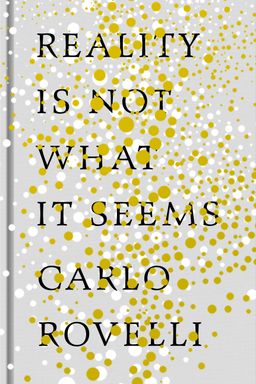
Reality Is Not What It Seems
Have you ever wondered if space and time themselves might just be illusions—patterns woven by deeper, invisible threads of reality? In Reality Is Not What It Seems: The Journey to Quantum Gravity, physicist Carlo Rovelli invites you on an exhilarating journey to rethink everything you thought you knew about the universe. He argues that reality is far more granular, relational, and dynamic than the smooth continuum of space and time taught by classical physics. Rovelli contends that what we perceive as continuous and solid—the flow of time, the stretch of space, even matter itself—is actually a network of quantum events, woven together by information and probability.
At its core, Rovelli’s thesis rests on one breathtaking idea: space and time are not fundamental realities but emergent phenomena. They arise from a deeper fabric built out of quantum gravitational interactions—a world where the smallest bits of reality are not things but processes. He calls this the vision of quantum gravity, specifically his own framework known as loop quantum gravity. This isn’t a mere tweak to existing physics but a re-envisioning of what it means to exist. It bridges Einstein’s sweeping visions of curved spacetime with the probabilistic quanta of Heisenberg and Dirac.
The Grand Continuum from Democritus to Einstein
Rovelli begins by tracing the roots of scientific thought back to ancient Greece—specifically to Democritus’s atomic hypothesis and Anaximander’s rational critique of mythic explanations. He sees these early philosophers as humanity’s first step toward freeing itself from superstition. Just as Thales and Anaximander replaced divine stories with reason and observation, Einstein replaced absolutes of space and time with dynamic curvature. This broad historical arc—from atoms to quanta—culminates in our current challenge: how to understand that space itself, and the time we experience, might be composed of discrete quantum grains.
In this journey, Rovelli weaves together the intellectual revolutions of Newton, Maxwell, Bohr, and Einstein into one coherent narrative. Newton’s rigid universe of predictable objects becomes, through Maxwell and Faraday, a cosmos permeated with vibrating fields. Einstein then bends those fields into the flexible mollusc of spacetime, and Bohr and Heisenberg dissolve matter into probability clouds. Each stage erases the boundaries between substance and process, between object and relation.
The Mystery of Quantum Gravity
The final frontier, quantum gravity, seeks to bridge the last remaining gap: merging Einstein’s curved spacetime (relativity) with the granular quanta (quantum mechanics). The paradox is that each theory works perfectly in its respective domain—relativity governs large scales, quantum theory rules the small—but together they contradict each other. Rovelli’s quest is to show that beneath both lies a quantum spacetime: a granular fabric where geometry itself is quantized. In this world, space is made of atoms of geometry, called “quanta of space,” and time emerges from their interactions. There is no infinite divisibility, no continuous flow, only a dance of tiny loops connecting probabilistic events.
He portrays this quest not simply as a scientific project but as an intellectual adventure akin to the voyages of explorers. Just as Dante climbed through spheres of heaven to glimpse divine order, physicists climb through layers of abstraction, discovering that infinity dissolves, time fades, and information becomes the true currency of reality.
Why This Matters to You
For Rovelli, understanding reality’s quantum structure isn’t just academic—it reshapes our sense of self and meaning. If time doesn’t exist fundamentally, then life itself is not a sequence of moments ticking away but a web of interactions. Our world is not built of independent things but of relationships. Reality becomes a tapestry of processes: the shimmering interconnections between particles, fields, and information.
Through this lens, Reality Is Not What It Seems teaches you to see the universe as a dynamic network of interactions, not a static ensemble of stuff. You move through this web by exchanging information, by participating in the great relational fabric that generates everything. As Rovelli insists, scientific thinking itself is not about certainties but about exploration—the adventure of moving toward the unknown. By the end, you realize that understanding quantum gravity isn’t just about physics—it’s about learning how to live comfortably within mystery, curiosity, and constant change. The cosmos, he shows, is not what we imagine—and that is precisely what makes it so wondrous.