
Idea 1
Leading in Real Time
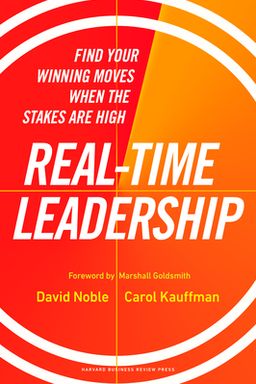
How do you lead effectively when pressure peaks and time vanishes? In MOVE: The Real-Time Leadership Playbook, Carol Kauffman and David Noble argue that great leadership is not about charisma or perfect plans—it’s about your capacity to act wisely and decisively in the moment. Their core claim: between stimulus and response lies a space, and real-time leaders know how to use that space to choose the best next move.
The MOVE framework—Be Mindfully Alert (M), Generate Options (O), Validate Your Vantage Point (V), and Engage and Effect Change (E)—is a practical system for making those choices. It’s a tool for navigating complex, high-stakes moments with clarity and composure. Rather than prescribing personality traits, Kauffman and Noble teach flexible habits you can deploy under pressure.
The Core Promise: Create Space Under Pressure
When crises strike, reflex, ego, or panic can hijack you. MOVE helps you regain control by creating mental space before acting. You stop reacting and start responding—like the executive Matt, who bombed an interview before realizing he was answering technical questions when the board sought strategic composure and compassion. The next day, he paused, realigned with the framework, and won the job.
This capacity to slow down under speed conditions is the book’s foundation. It echoes Viktor Frankl’s insight and applies neuroscience and leadership science to turn mindfulness into action. You don’t escape uncertainty—you learn to move with awareness, range, and purpose.
The Anatomy of MOVE
Each element of MOVE is interdependent. Mindful Alertness sharpens attention; Options prevent tunnel vision; Vantage Point ensures accurate perception; and Engage converts insight to execution. Real-time leaders don’t freeze in stepwise order—they loop and improvise. In some crises, you start by Engaging first (as when a startup team needed rapid alignment before deeper analysis). In others, you begin with Mindful Alertness to restore emotional steadiness. The art lies in diagnosing which part of MOVE you most need in the moment.
Integration of Inner, Outer, and Interpersonal Dimensions
Real-time leadership balances three dimensions: external goals (the organization's outcomes), internal mastery (your mindset and inner regulation), and interpersonal influence (your impact on others). Leadership breakdowns usually happen when one of the three lags. The MOVE model teaches you to look across these simultaneously—like running three dashboards in parallel. This tri-dimensional awareness ensures sustainable, adaptive leadership.
Real-Time Practice and the Leadership Mindset
MOVE is not conceptual—it’s behavioral. Before a meeting, you spend thirty seconds to rate your inner “Five Cs” (Calm, Clear, Curious, Compassionate, Courageous). You ask quick questions: What is the win? Who must I be? How do others need me to show up? Then you generate four options, check your assumptions, select the most effective signal, and act decisively. The repetition of these micro-practices rewires your reflexes over time. The payoff: you lead with agility in volatility.
How MOVE Expands Leadership Range
The book makes a compelling psychological point: many leaders fail not from lack of intelligence but from rigidity. They “lean in” (directive) when they should “lean back” (reflective), or they “lean with” (collaborative) when they should not lean at all (allowing space for emergence). By deliberately training across these four stances, you gain stance agility—the ability to choose your best posture for each moment. Interpersonal mastery comes from matching the stance to others’ needs, what the authors call the Platinum Rule: treat others as they want to be treated.
Across hundreds of cases—from C-suite transitions to crises, acquisitions, and restructures—the MOVE framework proved repeatable. It enabled Cheryl to pivot during a pandemic, Aria to reset board trust, and Akash to break governance bottlenecks. In each case, applying MOVE transformed reactivity into clarity.
A Playbook for Real-World Adaptability
The overarching insight is that leadership is a dynamic skill. Contexts shift constantly; so must your methods. MOVE teaches “micro-rehearsals” of situational awareness, bias checks, emotional scanning, and intentional engagement. You become both centered and fluid. This dual mastery—inner stillness with external adaptability—is what makes real-time leadership possible.
(In essence, MOVE is to leadership what agile methodology is to strategy: structured improvisation. It helps you stay grounded amid complexity, act decisively without rigidity, and evolve faster than the turbulence around you.)