
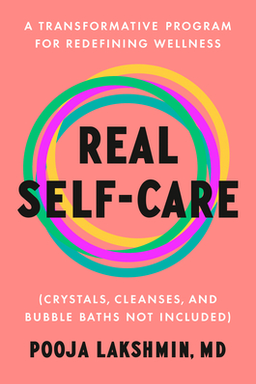
Real Self-Care cover

Real Self-Care

by Pooja Lakshmin

Real Self-Care exposes the misleading trends in the wellness industry, offering a science-based program that emphasizes personal empowerment and systemic awareness. By setting boundaries, embracing self-compassion, and aligning with core values, readers can achieve sustainable well-being.

Redefining Wellness: Real Self-Care as Power and Liberation

How many times have you been told that a bubble bath, a scented candle, or a yoga class will fix your exhaustion? In Real Self-Care, psychiatrist and women’s mental health expert Dr. Pooja Lakshmin argues that modern wellness culture has sold women an illusion—a commodified, consumerist trap that pretends to heal but actually deepens burnout. Real self-care, she insists, isn’t about external fixes at all. It’s not about buying more—it’s about becoming more through an internal process of reclaiming agency, setting boundaries, and aligning your life with your values.

Lakshmin’s argument lands with authority because she’s experienced both sides. A trained psychiatrist specializing in women’s mental health, she once found herself disillusioned by medicine’s failure to address systemic inequality. Her search for meaning led her into an extreme wellness commune that promised empowerment—but ended in emotional collapse. That harrowing experience taught her the difference between faux self-care—external, purchasable, and temporary—and real self-care: a radical, introspective practice that fundamentally reshapes one’s relationship to self and society.

Why “Faux” Self-Care Fails Us

The book begins by exposing the “tyranny of faux self-care.” These are the fixes—massage appointments, meditation apps, wellness retreats—that promise emotional replenishment but deliver guilt and exhaustion. When they don’t work, women end up blaming themselves: they’re not disciplined enough, not mindful enough, not doing “self-care” right. Lakshmin calls this trap another extension of patriarchal capitalism, which teaches women to internalize systemic failures as personal shortcomings.

She illustrates this with poignant clinical examples: Erin, the mother of three who barely sleeps, shamed for “not journaling enough”; Hina, the overachiever drowning in productivity hacks that never seem to buy her any real rest. These women, despite privilege and competence, feel defective. The problem isn’t their lack of resilience—it’s that they’re outsourcing self-worth to products designed to exploit insecurity. As Lakshmin observes, “Our culture has taken wellness and foisted it on the individual, instead of investing in making our social systems healthy.”

Real Self-Care: An Inside Job

In the second half of the book, Lakshmin presents a framework for authentic change—her Four Principles of Real Self-Care:

  • Set boundaries with others—learn to say no and let go of guilt.
  • Change how you talk to yourself—treat yourself with compassion instead of critique.
  • Bring in what matters most—identify your values and decisions that align with them.
  • Use your power for good—extend your growth outward to transform workplaces and communities.

Each principle guides readers from inner work to outward change, blending psychological insight with social critique. She draws from therapeutic models like Acceptance and Commitment Therapy (ACT) and Dialectical Behavior Therapy (DBT) to teach practical tools—psychological flexibility, cognitive defusion, and self-compassion—that make sustainable self-care possible. The emphasis, she reminds readers, isn’t on eliminating suffering but on acting in alignment with one’s values despite it.

Personal Healing Meets Collective Change

What makes Real Self-Care deeply subversive is its insistence that authentic self-care is political. When women reclaim agency over their time, attention, and choices, they disrupt the systems built on their unpaid labor and perfectionism. Real self-care becomes a form of resistance—rooted in the lineage of activists like Audre Lorde, who called self-care “an act of political warfare.” Lakshmin shows that personal boundaries can evolve into cultural revolutions: a teacher leaving an oppressive school district, a mother demanding paid leave, a physician rejecting toxic work hours all ripple outward into social transformation.

For Lakshmin, the goal isn’t perfection or permanent balance—it’s authenticity. This means understanding when to rest, when to act, and when to forgive yourself for doing neither perfectly. Drawing from philosophers of meaning like Aristotle (whose concept of eudaimonia—flourishing through values-aligned living—informs her model), she connects psychological well-being to fulfillment. Real self-care, she argues, cultivates eudaimonic well-being: the deep satisfaction that comes when your outer life reflects your inner truth.

Why These Ideas Matter Now

Lakshmin’s message resonates at a cultural breaking point. In the wake of mass burnout, pandemic caretaking, and renewed awareness of systemic inequities, millions are realizing that “wellness” as marketed by billion-dollar industries hasn’t healed them. From influencers selling detoxes to workplaces offering “resilience workshops” instead of childcare benefits, women are being gaslit into believing stress is a personal flaw.

This book gives language to that betrayal—and a path out. It tells you that your exhaustion is not a sign of failure but proof of empathy and effort in a system designed to exploit both. Lakshmin invites readers to slow down, get curious about their discomfort, and build sustainable change from the inside out. By the end, “real self-care” emerges not as indulgence, but as an act of liberation—starting within you and rippling outward to everyone your life touches.


The Tyranny of Faux Self-Care

Faux self-care is Lakshmin’s phrase for the wellness culture that tells women to fix systemic burnout with bubble baths. Behind its soothing marketing lies an insidious truth: it’s another form of perfectionism disguised as empowerment. This section of the book explores how our culture took a radical idea born in activism and turned it into a trillion-dollar industry that keeps women exhausted and ashamed.

From Radical Care to Retail Therapy

In the 1970s, the term “self-care” emerged within Black feminist and activist circles—Dr. Audre Lorde famously described it as self-preservation in a hostile world. For nurses, doctors, and social justice workers, self-care once meant physical and emotional survival. But as Lakshmin explains, by the 2010s the meaning had been diluted into bubble baths and scented candles.

Corporations turned self-care into a product line. The $4.4 trillion global wellness market (Global Wellness Institute, 2020) sells yoga mats, detoxes, and resilience seminars as “solutions.” Yet these methods often reinforce the very hierarchies that exhaust women—capitalism’s constant drive for productivity and patriarchy’s expectation that women manage everyone’s emotions and needs. The result: guilt-induced consumption without emotional relief.

Three Faces of Faux Self-Care

Lakshmin identifies three major ways women use wellness as a coping mechanism:

  • Escape: turning to retreats, spa trips, or digital detoxes to flee real life (like Monique, the nurse who booked exotic yoga retreats instead of changing her daily stressors).
  • Achievement: using wellness as another competition—from steps tracked to green smoothies (like Sharon, who made yoga and clean eating part of her success résumé).
  • Optimization: using apps, delivery services, or life hacks to maximize productivity, never rest (like Anita, who bought time-saving tools but never used the time she “saved” to restore herself).

All three soothe momentary discomfort but avoid deeper choices. As Anand Giridharadas notes in Winners Take All, “The elite charade of changing the world” often reframes structural oppression as a self-improvement project. Lakshmin argues the same about wellness: women are told to clean up chaos individually rather than reform workplaces and families collectively.

Why We Keep Falling for It

The trap is emotional. Faux self-care gives fleeting relief—an illusion of control in systems that rarely offer any. And it’s reinforced by social media, where “perfect” influencers sell serenity while hiding sweat and conflict behind filters. Lakshmin calls Instagram “the wild west of wellness,” where self-worth becomes a brand.

Yet her tone is never judgmental. She acknowledges why we reach for these fixes: we are tired, lonely, and lacking support. “It’s not our fault,” she writes repeatedly. Instead, her aim is compassion and awareness—to shift from asking “Why can’t I make self-care work?” to “Why is the system stacked against me?”

The Cost of Empty Calories

Lakshmin likens faux self-care to eating empty calories—sweet but unsustaining. The true nourishment we need involves rethinking guilt, saying no, and redistributing emotional labor. Her case studies—like Shelby, who realized that giving up breastfeeding brought her closer to her baby and husband—offer a vivid reminder that real self-care can look like letting go of ideals, not adding new tasks. Each time we reject faux fixes, we reclaim a fragment of agency that cannot be sold back to us.


The Game Is Rigged: Systems, Not Women, Are Broken

Why do women internalize exhaustion as personal failure? Because society rewards them for self-sacrifice and punishes them for resistance. In this sweeping chapter, Lakshmin diagnoses what she calls the rigged game: patriarchy, capitalism, and racism disguised as individual inadequacy. The problem isn’t your lack of grit—it’s that the system relies on your overwork.

Betrayal, Not Burnout

During the pandemic, Lakshmin observed her patients labeling their breakdowns as “burnout.” She reframed it as betrayal. Unlike burnout, which implies exhaustion from overextension, betrayal acknowledges moral injury—when systems you trust abandon you. Mothers choosing between childcare and paychecks weren’t failing self-care; they were failed by infrastructure. This concept resonates with psychologists studying moral distress in caregivers (echoing Susan David’s work on emotional agility).

The Myth of “Having It All”

Lakshmin dismantles the cultural koan of the “modern woman’s dilemma.” As sociologist Martha Beck calls it, women are told to be both selfless nurturers and high-achieving professionals—a paradox that guarantees guilt. Whether you’re baking cupcakes from scratch or replying to 2 a.m. emails, one role accuses the other of neglect. Faux self-care sells peace but cannot solve this existential contradiction.

She illustrates this through Mikaleh, a Black working mother caring for two teen daughters and her ailing father while managing OCD. When her brothers shirk duties, Mikaleh blames herself. Through therapy, she learns to see her emotions as evidence of systemic inequity, not personal weakness. Taking a mental health leave becomes her revolutionary act—and the catalyst for change in her workplace.

The Mental Load and Reproductive Labor

Drawing from feminist scholars like Silvia Federici and Allison Daminger, Lakshmin explores the invisible “mental load”—tracking appointments, groceries, laundry, emotions—that keeps households running. This unpaid labor, primarily performed by women, underpins capitalism itself. When companies offer yoga classes instead of childcare, they’re offloading structural responsibility onto women’s nerves.

Dialectical Healing: Both True, Both Possible

To survive, you must practice dialectical thinking: accepting contradiction without collapse. You can love your family and resent them. You can be professional and exhausted. Change begins when you stop seeking binary answers. Lakshmin’s empowering reframing—“You’re not the problem, but you are the solution”—turns despair into agency. Real self-care becomes the bridge between self-compassion and social reform, showing that inner resistance, when practiced collectively, ripples outward to remake broken systems.


The Four Principles of Real Self-Care

Lakshmin translates lofty ideals into practice with four powerful principles, drawn from her clinical experience and evidence-based psychology. They’re deceptively simple but profoundly transformative. Real self-care, she teaches, is less about doing and more about deciding—learning to make choices that honor your needs and values despite social conditioning.

1. Boundaries: The Pause That Heals

Setting boundaries isn’t selfish—it’s self-respect. Lakshmin recounts her supervisor’s radical advice: “You don’t have to answer your phone.” That moment transformed her relationship to work. Boundaries create space for reflection instead of reaction. They require tolerating guilt and disappointment, especially when others resist. But, she emphasizes, guilt is a “faulty check-engine light,” not an indicator you’re wrong. Practice pausing, asking what’s workable, and rehearsing scripts like “I’d love to, but I can’t right now.”

2. Compassion: Permission to Be Good Enough

If boundaries defend your time, compassion softens your inner world. Drawing on Dr. Kristin Neff’s research, Lakshmin differentiates self-compassion from self-esteem. Instead of inflating ego, compassion builds clarity and acceptance. She urges readers to name their inner critic, whether it’s “Angelica from Rugrats” or “Miranda Priestly,” then speak to it kindly. Holding both flaws and strengths together, you practice the revolutionary idea that you are “good enough.”

3. Values: Matching Your Insides and Outsides

Once you’ve cleared emotional noise, real self-care invites you to identify your values—the compass guiding meaning. Borrowing from Acceptance and Commitment Therapy, Lakshmin distinguishes values from goals. Goals are destinations; values are how you want to drive. Do you prize creativity over conformity? Community over ambition? Each decision reveals priorities. Through exercises like the “Birthday Dinner,” she helps readers name what truly nourishes them, then align choices accordingly.

4. Power: Claiming and Paying It Forward

Real self-care culminates in reclaiming your power—not to dominate, but to redistribute. When you live in alignment, you naturally model possibility. Lakshmin shows this through patients like Sonia, whose self-compassion led her husband to request paternity leave, inspiring a company-wide policy. Power expands through hope, collaboration, and community care. True healing, she insists, happens “from the inside out, one brave decision at a time.”


Boundaries as Liberation, Not Selfishness

Why is saying no so difficult, especially for women? Lakshmin answers: because we’ve been trained to equate self-worth with self-sacrifice. Boundaries, then, are not rude—they’re revolutionary. They mark the energetic line where your needs end and others’ begin, granting you back your time, energy, and personhood.

The Psychology of Saying No

Lakshmin introduces the Real Self-Care Thermometer, a self-assessment revealing whether you’re “red” (exhausted and reactive), “yellow” (guilty and uncertain), or “green” (reflective and empowered). Red women respond to every ping; green women pause. That pause—deciding before reacting—is the birthplace of autonomy. She reminds us of Nora Roberts’s “glass vs. rubber balls” analogy: know which responsibilities can bounce and which will shatter.

Taming Guilt and the “Killjoys”

Every boundary encounter brings guilt. The trick is to befriend it. Lakshmin uses cognitive defusion (from ACT therapy) to teach you to observe guilt (“Here goes my mind again”) rather than obey it. She also warns against letting “killjoys”—critical relatives or colleagues—dictate your choices. “Don’t go to the hardware store for milk,” she quips. Seek validation within, not from those invested in your compliance.

Negotiation Is Self-Advocacy

Boundaries aren’t just refusals—they’re deliberate negotiations. Angela learned to stop rescuing her boyfriend; Tonya shortened family visits to protect her newborn’s health. Both discovered that boundaries create stronger, not weaker, relationships. As Lakshmin reminds readers: “Your boundary is in your pause.” Practicing this pause daily—before you commit, explain, or apologize—is the most concrete self-care you can do.


Self-Compassion: The Cure for Martyr Mode

After boundaries comes the inner revolution: turning kindness inward. Lakshmin’s second principle dismantles what she calls Martyr Mode—the chronic self-erasure women perform under the guise of love. In Martyr Mode, you rescue others while quietly resenting them, waiting for gratitude that never comes. Real self-care begins when you extend compassion to yourself instead.

Redefining Self-Compassion

Drawing on Dr. Kristin Neff’s research, Lakshmin defines self-compassion as the triad of self-kindness (versus judgment), common humanity (versus isolation), and mindful awareness (versus overidentifying with pain). She distinguishes it from self-esteem: the former accepts imperfection, while the latter demands proof of worth. Her patients learn to say “ouch” to inner cruelty—acknowledging pain without attaching shame.

Breaking the Shame Cycle

Shame, Lakshmin notes, whispers two lies: “You’re not good enough” and “Who do you think you are?” These voices fuel performance out of fear. By naming your inner critic (say, “Miranda Priestly”) and replacing “I’m terrible” with “I’m trying,” you quiet Martyr Mode. Practicing Good Enough Thinking—accepting humanity over perfectionism—reconnects you with joy, creativity, and rest.

Rest as Resistance

Lakshmin integrates the work of activists like Tricia Hersey of The Nap Ministry: rest isn’t laziness; it’s political resistance. When women reclaim rest, they reclaim power from structures that feed on exhaustion. Self-compassion, she concludes, is not indulgence—it’s fuel for action. Only when you treat yourself tenderly can you sustain the courage to confront the world’s demands without losing your soul.


Values as a Compass for Fulfillment

In the third stage of real self-care, Lakshmin invites you inward—to locate the values that give your life meaning. Without this compass, boundaries and compassion can drift into avoidance. Values root your decisions in purpose, ensuring that how you live matches who you are.

Values vs. Goals

Using Acceptance and Commitment Therapy concepts, she draws a vital distinction: goals are destinations; values are directions. Running a marathon is a goal; living with courage and vitality is a value. You can fail at a goal and still embody your value. This reframing relieves chronic striving and anchors you in meaning. It’s the shift from asking “What should I do?” to “How do I want to be?”

Your Real Self-Care Compass

Lakshmin’s Real Self-Care Compass exercise asks three questions: What do I want (my goals)? How will I pursue it (my values)? And Why does it matter (my manifesto)? Through examples—her own career shift from academia to writing, her patient Kleo’s blue kitchen inspired by authenticity—she shows how embracing “impractical” desires can restore vitality. Your insides begin to match your outsides.

Living with Shifting Priorities

Values evolve. Lakshmin herself shifted from freedom in her thirties to stability while expecting a child. Flexibility, she emphasizes, is key: you can hold multiple truths at once. Each season demands recalibration. Practicing gratitude—what she calls “digesting the good stuff”—helps integrate change without losing selfhood. The goal isn’t to freeze your North Star but to keep your compass alive and moving.


Power, Hope, and Collective Change

The final movement in Lakshmin’s framework transforms personal healing into public action. Real self-care is not merely internal growth—it’s how we reclaim systemic power. By aligning inner boundaries, compassion, and values, you begin to act differently within institutions, families, and communities. “When one woman widens her circle of permission,” she writes, “she expands the circle for all.”

From Individual Healing to Systemic Shifts

Lakshmin rejects toxic positivity (“everything happens for a reason”) and replaces it with hope as practice: believing you can make things better without denying reality. Drawing from Arthur C. Brooks’s distinction between hope and optimism, she shows that hope involves agency. Patients like Lena, underpaid at a TV station, enact it by setting limits and requesting fair treatment—small rebellions that accumulate into structural change.

Both/And Thinking

Real self-care thrives in paradox. You can heal personally and fight politically, rest and act, grieve and hope. This dialectical mindset—the “both, and”—transforms shame into strength. Lakshmin herself embodies this paradox: the same experience that broke her (joining a wellness cult) became the source of her authority and empathy. “We are both the wooden knight and the player that can change the game,” she writes.

Community Care: Paying Power Forward

Ultimately, self-care matures into solidarity. Lakshmin champions community care: using privilege to support those with less access and amplifying collective reform. She cites movements like the 2021 Chamber of Mothers advocating for paid leave—a reminder that personal healing fuels activism. Power is not a zero-sum commodity; when shared, it multiplies. Hope, agency, and compassion together form an engine for sustainable cultural transformation.

Dig Deeper

Get personalized prompts to apply these lessons to your life and deepen your understanding.

Go Deeper

Get the Full Experience

Download Insight Books for AI-powered reflections, quizzes, and more.