
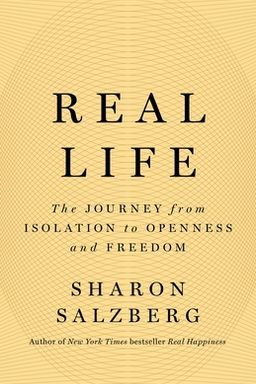
Real Life cover

Real Life

by Sharon Salzberg

Real Life by Sharon Salzberg offers a transformative guide to overcoming life''s challenges with clarity and connection. Drawing on Buddhist philosophy and personal anecdotes, Salzberg provides practical tools to cultivate openness, navigate emotional landscapes, and embrace life’s dualities for a richer, more engaged existence.

Real Happiness at Work: Mindfulness as the Foundation for Meaning and Joy on the Job

How can you remain grounded, kind, and fulfilled in a workplace that often seems hectic, uncertain, or even toxic? In Real Happiness at Work, meditation teacher Sharon Salzberg argues that true happiness at work doesn’t depend on perfect circumstances—it depends on awareness. She contends that mindfulness is not a retreat from everyday life but a way of meeting it fully. By cultivating presence, compassion, and purpose, you can transform even the most stressful workplace into a field for growth and wisdom.

Salzberg’s central message is deceptively simple: happiness at work is not about getting the perfect job but about mastering the inner tools to face challenges skillfully. Work will always involve pressure, deadlines, and friction with others—but with mindfulness, those difficulties can become opportunities to strengthen resilience, empathy, and integrity. Drawing on Buddhist principles, modern psychology, and stories from people in diverse careers—from baristas to executives—Salzberg presents a path composed of eight pillars of workplace happiness.

The Eight Pillars of Workplace Happiness

Throughout the book, Salzberg organizes her guidance into eight interconnected pillars. These include Balance (staying centered despite stress), Concentration (developing focus in a distracted world), Compassion (responding with care to oneself and others), Resilience (bouncing back after setbacks), Communication and Connection (building authentic relationships), Integrity (aligning work with personal values), Meaning (infusing tasks with purpose), and Open Awareness (seeing the larger picture beyond ego or circumstance).

For Salzberg, mindfulness and meditation are not fringe spiritual practices—they are highly practical mental disciplines akin to exercise for the body. Just as physical training builds strength, training the mind builds clarity, patience, and kindness. Each chapter concludes with short meditations and practical exercises—called “stealth meditations”—that can fit conveniently into a workday, from mindful breathing before a meeting to pausing for gratitude during an email exchange.

Why Happiness at Work Matters

Salzberg grounds her ideas in the reality of modern work life: long hours, burnout, and technological overload. She notes that most people spend more waking hours at work than anywhere else, making it a vital arena for cultivating emotional and spiritual well-being. Neuroscience supports this view—studies by researchers like Dr. Richard Davidson show that meditation can reshape brain pathways associated with stress, empathy, and joy. Salzberg likens this to ‘training the mind for happiness,’ emphasizing that emotions are not fixed traits but learned patterns that can be rewired through practice.

Under the surface of these scientific explanations lies a deeper truth: we often conflate who we are with what we do. When work defines our identity, failure at the office feels like failure as a person. Salzberg’s teachings invite a separation between the two—you are not your job. Instead, work can be a context for expressing your deeper qualities: compassion, patience, courage, and integrity. This internal shift allows professional challenges to become spiritual training grounds, transforming obstacles into teachers. (This mirrors Jon Kabat-Zinn’s message in Wherever You Go, There You Are—that mindfulness meets you in any situation, not just on a meditation cushion.)

From Struggle to Opportunity

The book opens with real-world examples: Hannah, the secretary in a cutthroat office; Peter, the social worker on the edge of burnout; and Louise, the police officer whose aggression at work spills into her home life. Their suffering represents universal questions: Can you be happy in a job you dislike? Can kindness survive in competition? Can meaning exist in repetitive, uninspiring work? Salzberg answers with a resounding yes—but only through conscious practice. Work’s challenges, she insists, can become the practice. As teacher Michael Carroll once said, “Maybe problems arise at work not as interruptions, but as invitations to gain wisdom.”

This shift from avoidance to engagement marks a revolutionary view of workplace stress. Instead of resisting discomfort, you learn to breathe with it, examine it, and let it soften your heart. The workplace becomes a lab for self-awareness: the difficult boss teaches patience; the tedious task teaches focus; the moral dilemma deepens one’s integrity. Salzberg’s own decades as a meditation instructor have shown that people across professions—soldiers, doctors, executives, shelter workers—all can use mindfulness to transform their relationship with work, and thus with life itself.

The Bigger Picture

Ultimately, Real Happiness at Work is more than a book about meditation—it’s a guide for infusing awareness and compassion into the heart of daily life. Salzberg argues that our work represents a microcosm of the wider world: how we handle stress, competition, and relationships there mirrors how we address them everywhere. By learning balance, honesty, and kindness at the desk or workshop, we learn them for the rest of life.

This approach has far-reaching implications. At the organizational level, mindfulness fosters cultures of respect, creativity, and openness—traits now being embraced even by corporations like Google and General Mills. At a personal level, it provides a daily antidote to anxiety and alienation, helping you reconnect with what is always available: your innate capacity for awareness. In Salzberg’s words, real happiness at work—and in life—arises when you stop fighting against your experience and begin to meet it with wakefulness, compassion, and an open heart.


Balance: The Foundation of Workplace Well-Being

Salzberg begins her eight-pillar model with Balance, calling it the foundation for all the rest. In today’s overextended world, she writes, we are constantly pulled between screens, deadlines, and expectations, creating a state of chronic imbalance. Without inner equilibrium, creativity, competence, and joy at work all vanish. Balance is not about splitting time evenly—it’s about recovering calm and perspective amid constant motion.

The Stress Factor

Stress is now a defining feature of work life, aggravated by technology that keeps us “plugged in.” Salzberg cites surveys showing most Americans feel overworked and undervalued. She quotes neuroscientist Dr. Richard Davidson, who has demonstrated that happiness, like a motor skill, can be trained. When stress triggers the brain’s amygdala—a fight-or-flight center—we lose access to our prefrontal cortex, which manages judgment, patience, and creativity. Mindfulness retrains the mind to recover faster from stress, restoring what Davidson calls the brain’s “toward state”—a mental mode of openness and curiosity.

A student named Sonia illustrates this transformation. Once a freelance writer, she joined a frenetic office where colleagues raced and spoke in bursts of panic. She found herself “barely breathing.” Mindfulness helped her reclaim her calm by slowing down and noticing her breath. With time, she could meet demanding colleagues with patience rather than irritation. Her story reveals how stress isn’t the problem itself—it’s how we relate to it.

The Beauty of Mental Space

As corporate leaders now recognize, inner spaciousness enhances outer productivity. Salzberg highlights the General Mills campus, where every building includes a meditation room stocked with yoga mats. Programs like Google’s “Search Inside Yourself,” developed by Chade-Meng Tan, demonstrate how mindfulness training improves creativity, focus, and compassion. These initiatives confirm Salzberg’s principle: when you make mental space, performance follows naturally.

Emotional Intelligence in Action

Salzberg ties balance to the cultivation of emotional intelligence—the ability to understand and regulate emotions. Divorce lawyer Merry Nasser, for instance, found that meditation allowed her to respond to clients’ rage with empathy instead of impatience. Instead of absorbing their negativity, she practiced silent compassion during sessions. The result? Clients felt genuinely heard, and mediation became possible.

Similarly, corporate leaders such as Patagonia CEO Casey Sheahan use mindfulness to accept their own frustrations. Sheahan describes starting each morning with yoga and meditation, bringing awareness to his anger until it “dissolves into laughter.” Such practices transform difficult emotions into clarity—a dynamic example of what psychologist Daniel Goleman calls “emotional regulation,” a core competency of high-functioning teams.

Breathing, Boundaries, and Balance

Practical tools for balance begin as simply as one conscious breath. Psychiatrist Patricia Gerbarg teaches how slow breathing—about five breaths per minute—activates the parasympathetic nervous system, reducing stress hormones. Salzberg also encourages setting boundaries: taking full lunch breaks, declining unrealistic requests, and remembering that martyrdom helps no one. Balance, she says, involves wise discernment—knowing when to say yes with enthusiasm and when to say no with integrity.

Ultimately, balance is about learning to stand on solid inner ground. Whether facing toxic coworkers or relentless deadlines, mindfulness lets you relate to life’s chaos rather than be consumed by it. This calm alertness—embracing both ease and energy—is the starting point of real happiness at work.


Concentration: Mastering Attention in a Distracted Age

If balance stabilizes the mind, concentration gives it focus. Salzberg defines concentration as the art of gathering scattered attention into the present moment, freeing energy otherwise wasted on worry or regret. In the digital workplace, where multitasking is mistaken for efficiency, concentration becomes a superpower.

The Science of Attention

Researcher Edward Hallowell coined “Attention Deficit Trait” to describe how constant inputs—emails, texts, notifications—create attention fragmentation even in mentally healthy people. Salzberg cites studies showing multitasking makes us up to 50% slower and twice as error-prone because the brain must repeatedly switch contexts. Each “switch” drains cognitive energy and fuels stress hormones like cortisol. Mindfulness meditation trains you to notice distraction and return attention gently, building mental stamina much as weightlifting builds strength.

Breaking the Myth of Multitasking

Salzberg exposes the illusion of multitasking with relatable stories. Rita, an editor inundated by hundreds of daily emails, learned through mindfulness to “unitask”—to focus on one message or project at a time. She discovered that slowing down, paradoxically, made her more efficient and less anxious. Similarly, a web designer named Brian restored focus through deliberate breaks: every hour, he walked or read for ten minutes before returning to work. Like oxygen to fire, pauses ignite concentration.

From Boredom to Flow

Boredom, Salzberg notes, often signals disconnection rather than lack of stimulation. When we’re fully attentive, even repetitive tasks become interesting. Quoting Gestalt therapist Fritz Perls—“If you are bored, you are not paying attention”—she encourages viewing monotony as an invitation to deeper observation. For instance, turning a coffee break into a walking meditation—feeling each step, breath, and sound—can turn tedium into presence. (This reframes flow in the same way psychologist Mihaly Csikszentmihalyi described it—as total absorption rather than external excitement.)

Procrastination and Perfectionism

Concentration also combats procrastination, which Salzberg links to self-judgment and fear of failure. She shares the story of Doreen, a visual artist paralyzed by unfinished projects. By focusing on completing just one task a day and treating each as a meditation—“just this desk, just this mailing”—Doreen rediscovered momentum and confidence. Concentration, Salzberg says, turns chaos into clarity by anchoring you to the next right action rather than the overwhelming big picture.

As you practice concentration, you realize attention itself is joy. When your mind stops splintering into past and future, even mundane work feels vibrant. Salzberg closes this chapter with a powerful idea: “When you’re walking, walk. When you’re sitting, sit.” Simple, but transformative—a practice of doing one thing completely, and thereby reclaiming your life from distraction.


Compassion: The Heart of Human Work

Salzberg devotes an entire pillar to Compassion because happiness at work is not a solo pursuit—it’s relational. Compassion, she writes, means recognizing the common struggle underlying everyone’s behavior, including your own. Loving-kindness is not weakness; it’s courage that dissolves fear and resentment.

Moving from Judgment to Understanding

She illustrates this through Marion, who dreaded lunch with a bitter coworker named Kate. Only when she acknowledged Kate’s pain—a hard marriage and chronic illness—did judgment melt into empathy. This mirrors the teaching of psychologist Kristin Neff, whose work on self-compassion shows that kindness toward oneself expands outward naturally. Salzberg emphasizes that gentleness toward your own flaws prevents burnout and helps you see others’ actions as symptoms of suffering rather than malice.

The Practice of Loving-Kindness

Central to this pillar is metta, or loving-kindness meditation—a structured way to cultivate goodwill. The practice begins with repeating phrases like “May I be happy. May I be safe,” and then extending them to loved ones, neutral people, and finally those you find difficult. Salzberg explains that even if the words feel mechanical at first, the repetition plants seeds that soften the heart. One executive who practiced sending silent goodwill before meetings found former adversaries becoming more cooperative—proof that compassion changes both your energy and the atmosphere around you.

Compassion as Strength

Salzberg is clear that compassion is not compliance. Strength and softness coexist. She recounts police officer Cheri Maples, who, trained in mindfulness by Thich Nhat Hanh, responded to a domestic threat not with force but honest presence—resulting in calm, not conflict. Later, the aggressor thanked her for saving his life. Such moments show compassion’s transformative power: it disarms hostility without surrendering boundaries.

From Resentment to Equanimity

At work, compassion also means managing praise and blame. Salzberg recalls how her joy over compliments quickly turned to despair at criticism, until meditation taught her steadiness. Others, like publicist Betty reading her performance review, learned to detach self-worth from external approval. True compassion, Salzberg concludes, rests on equanimity—the ability to care deeply without being controlled by outcomes. When you hold both failure and success lightly, your heart stays free.

Compassion makes workplaces human again. It breaks cycles of gossip, burnout, and alienation by replacing judgment with curiosity and fear with connection. As Salzberg writes, “The more anyone of us can tap into well-being within, the more room we have for others.” With compassion, your career becomes not a battlefield but a field of relationship where both you and others can thrive.


Resilience: The Art of Beginning Again

Resilience, Salzberg explains, is not toughness but the willingness to begin again—over and over. Every setback is an invitation to start fresh, just as in meditation you return to the breath whenever the mind wanders. No job is conflict-free, and no career unfolds neatly; resilience is the muscle that turns adversity into wisdom.

Burnout and the Need for Renewal

Burnout, Salzberg writes, is not just exhaustion but “the loss of purpose that makes the work unbearable.” Teachers, doctors, social workers, and executives all confront this depletion. She introduces Ellen, a teacher working with emotionally troubled teens, who avoided collapse by sharing her vulnerability with students. By telling them truthfully that she too sometimes felt hopeless, she helped both them and herself find courage. This act of shared humanity became her self-care.

Letting Go of Control

A taxi driver once told Salzberg, “Traffic is not your fault—nor is it mine.” That simple wisdom captures the essence of resilience: realizing how little we control. Whether you face layoffs, criticism, or failed projects, resilience arises from recognizing conditions beyond blame. As mindfulness teacher Mirabai Bush puts it, “Letting go of the illusion of control introduces radical self-confidence.”

Patience, Perspective, and the Bigger Picture

Resilience depends on patience—the underrated virtue that lets you stay present while life unfolds. Salzberg reminds us that the brain’s capacity for neuroplasticity means we can train this patience at any age. Her analogy: your mind can be “like the sky rather than a sponge.” A sponge absorbs every stressor and thought, becoming heavy and soaked; the sky, by contrast, holds clouds without being harmed. Meditation teaches you to be the sky—to contain what happens without becoming it.

Compassion Fatigue and Caregivers

For caregivers, resilience requires balancing compassion with equanimity. Salzberg discusses the difference between empathy—feeling another’s pain—and compassion—caring without drowning in it. Studies by Tania Singer show that compassion activates regions of joy and love in the brain, whereas empathy alone can lead to distress. Nurses at Walter Reed Hospital and humanitarian workers in Afghanistan learned that acknowledging suffering while maintaining openness allowed them to serve sustainably.

Ultimately, resilience is less about bouncing back to the old self than about growing into a wiser one. As Salzberg notes, “Each moment we forget, we can begin again.” The real skill is remembering that beginning again is always possible.


Communication and Connection: Speaking and Listening with Awareness

Effective communication, Salzberg argues, is not about polished words but about mindful intention. Every email, meeting, or conversation either builds connection or erodes it. By cultivating awareness before speaking or typing, you transform daily interactions into opportunities for empathy and clarity.

The Ethics of Speech

Borrowing from Buddhist precepts, Salzberg urges that speech meet three tests: Is it true? Is it useful? Is it kind? Many workplace conflicts fail this simple filter. PR officer Allison, for instance, discovered that “truth without kindness” damages trust just as much as silence does. Her integrity came from speaking honestly but without aggression, embodying what Salzberg calls skillful expression.

Listening as a Superpower

Listening, she insists, is the heart of communication. In group exercises developed by mindfulness trainer Leslie Booker, one partner speaks for five minutes while the other listens without interrupting or planning a reply. The result? A palpable dissipation of tension and an unexpected intimacy. This “deep listening” dissolves defensiveness—the listener learns patience, and the speaker feels truly seen.

Curbing the Culture of Disparagement

Salzberg critiques the modern workplace’s “culture of disparagement,” comparing it to reality TV’s gladiatorial tone. When cynicism replaces curiosity, collaboration dies. She contrasts this with a manager named Caroline, who responded to an employee’s rudeness not with punishment but kindness—first praising her strengths, then gently correcting behavior. That disarmed confrontation and inspired real change.

The Ripple Effect

Communication ripples far beyond the office. Studies at Baylor University show that rudeness at work can affect partners and families at home. Salzberg reminds us that every message we send transmits emotion as well as information. Pausing to breathe before “pressing send,” she writes, is mindfulness in action. In short, communication begins not with others but with how calmly and consciously you meet yourself.

When you speak mindfully and listen deeply, you replace reactivity with understanding. Work becomes less a contest of egos and more a web of interdependence where everyone’s humanity has space to breathe.


Integrity: Aligning Values and Work

Integrity, the sixth pillar, means wholeness—living without the split between who you are and what you do. For Salzberg, moral distress—acting against your values at work—is a chief cause of unhappiness. Without integrity, you may earn money or praise, but you lose peace.

Intention and Honesty

Integrity starts not with rules but with intention. Salzberg recalls Cheri Maples, a police officer who carried a gun with mindfulness, asking herself, “Who else would we want carrying one but someone aware?” Her reflection reveals a universal principle: difficult jobs done with awareness can still honor compassion. Similarly, companies like L.L.Bean operationalize ethics through customer-first service—a “golden rule” approach that treats every caller like a human being, not a transaction.

Dealing with Moral Distress

When personal ethics clash with job demands, Salzberg advises examining the suffering clearly. Are you required to deceive customers, ignore injustice, or harm others indirectly? One sushi waitress refused to lie about fish freshness, leaving her job rather than compromise. Acts like these, though costly, preserve inner dignity. Integrity sometimes requires uncomfortable honesty with both employers and oneself.

Authenticity and Belonging

Salzberg links authenticity to a deeper sense of belonging—feeling “at home” in your own being. She shares Mae Jemison’s insight that she felt equally at home in space as on Earth because she belonged to the universe itself. Similarly, employees who feel authentic at work express less anxiety and greater creativity. The poet Maya Angelou’s words—“making a living is not the same as making a life”—echo Salzberg’s point: to be whole, you must align action with purpose.

Integrity doesn’t require perfection. It’s the courage to notice when you’ve strayed, to apologize, and begin again. In Salzberg’s world, doing the right thing is less about moral heroism than daily mindfulness—catching dishonesty, fear, or greed the moment it forms, and choosing clarity instead.


Meaning and Open Awareness: Expanding the View of Work and Life

The final two pillars—Meaning and Open Awareness—bring all others into synthesis. Meaning answers why you work; open awareness answers how you meet whatever arises. Together, they make any job, however modest, an avenue for self-realization.

Finding Meaning Beyond the Paycheck

Drawing on research by Amy Wrzesniewski, Salzberg distinguishes among seeing work as a job (a means to survive), a career (a means to advance), or a calling (a means to serve). But even a job can be infused with calling if approached with presence. She recounts how a hotel waitress and manager transformed her stay by helping her find a non-smoking room—not because it was required, but because they cared. Through simple kindness, their mundane roles became meaningful. Meaning arises, she reminds us, wherever compassion and intention meet.

Beyond Ego: I Am Not My Job

When work defines identity, failure becomes personal catastrophe. Salzberg’s antidote is humility. Tracy, a secretary who felt invisible, reclaimed her dignity by focusing on service rather than status. For aspiring actress Jessica, waiting tables without resentment meant honoring freedom over prestige. As Salzberg puts it, “Work is not who we are—it’s what we do with who we are.”

Open Awareness and Possibility

Open awareness, the book’s culmination, means seeing everything—the pleasant and the painful—as part of a vast, changing whole. John, once embittered by his boss, experienced a shift when the same boss showed kindness during his wife’s illness; suddenly, his world looked different. Awareness had widened, revealing complexity where judgment once stood. Salzberg defines this as “seeing with the big mind rather than the small self.”

In open awareness, you stop clinging to control and let creativity flow naturally. Susan, a once-ruthless CEO fired from her job, rebuilt her career after discovering mindfulness. By releasing her need to dominate, she became a better listener and leader. Similarly, composer Rob learned to conduct with humility after mindfulness retreats, realizing he was “a chimney through which the orchestra’s energy flows.”

For Salzberg, open awareness completes the journey: it transforms work from self-protection into service. When you rest in awareness instead of anxiety, you see your role in the grand web of interdependence. Work ceases to be a grind—it becomes a living meditation, a field for compassion, creativity, and renewal. Every time you lose balance, forget compassion, or close your heart, you can begin again—with a single mindful breath.

Dig Deeper

Get personalized prompts to apply these lessons to your life and deepen your understanding.

Go Deeper

Get the Full Experience

Download Insight Books for AI-powered reflections, quizzes, and more.