
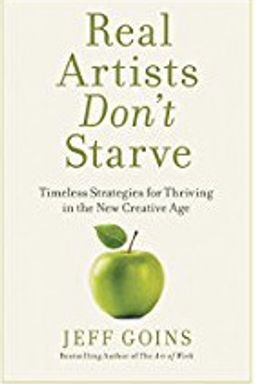
Real Artists Don’t Starve cover

Real Artists Don’t Starve

by Jeff Goins

Jeff Goins'' ''Real Artists Don’t Starve'' challenges the myth of the starving artist. With timeless strategies, it empowers creatives to thrive in today’s world by embracing collaboration, persistence, and entrepreneurial spirit. Break free from outdated beliefs and discover a path to artistic and financial success.

Real Artists Don’t Starve: The New Renaissance of Creativity and Prosperity

What if the story you’ve been told about creative work— that artists must suffer, starve, and live on the fringes— is completely false? In Real Artists Don’t Starve, Jeff Goins takes aim at one of our culture’s most damaging myths: the romanticized notion that creativity and prosperity cannot coexist. Through engaging stories, research, and practical rules, Goins shows that not only is thriving as an artist possible—it’s the natural state when you embrace the right mindset, community, and business discipline.

According to Goins, the idea of the Starving Artist was born from a misunderstanding. While many imagine Michelangelo as a destitute genius laboring for art, researcher Rab Hatfield discovered five-hundred-year-old bank ledgers proving that Michelangelo died wealthy—worth the modern equivalent of $47 million. He wasn’t starving; he was thriving, mastering both art and the art of business. Yet the myth of the broke, misunderstood genius persisted, reinforced by later figures like Henri Murger, whose romantic Scènes de la vie de bohème cemented the idea that real creativity meant suffering.

Artistry in a New Light

Goins declares that we are living through a New Renaissance—a time where technology, connection, and opportunity create unparalleled potential for creative people. The starving artist, Goins suggests, is a choice, not an inevitability. To thrive, you must replace outdated myths with twelve practical rules that blend creativity and commerce. These rules fall into three domains: Mind-Set, Market, and Money.

In the Mind-Set section, Goins dismantles limiting beliefs that keep creatives poor and obscure. You’ll learn that talent is not innate but developed through disciplined apprenticeship, and that “stealing” from your influences—like Picasso or Jim Henson did—is fundamental to innovation. You’ll discover how to channel stubbornness productively, learning from figures like Jeff Bezos, F. Scott Fitzgerald, and Michelangelo, who turned grit into greatness.

Thriving in the Market

The second part, Market, explores how to connect your art with others. Goins insists that creative success is not just about skill, but community. You must cultivate patrons (like Elvis did with Sam Phillips), embed yourself in creative “scenes” (as Hemingway did in 1920s Paris), collaborate with peers (like C.S. Lewis and J.R.R. Tolkien among the Inklings), and share your process publicly to attract genuine audiences. Gone is the image of the lonely genius toiling in obscurity—thriving artists build networks, scenes, and visibility.

Mastering Money Without Selling Out

In Money, Goins tackles the most taboo topic for artists: earning. He argues that being paid is not corrupting—it’s dignifying. Through stories of creatives like Melissa Dinwiddie, Jay-Z, and astronaut-artist Alan Bean, he illustrates that making money sustains creativity. The key is to work for something (never for free), own your work (retain rights like Shakespeare and Henson), and diversify your portfolio (like Dr. Dre’s move from music to Beats headphones). The Thriving Artist doesn’t chase fame or fortune for their own sake—they use money to make more art.

Why These Ideas Matter

Michelangelo’s story wasn’t just an historical curiosity—it’s an invitation. Goins’s central thesis is one of empowerment: creativity has always thrived when artists master both their crafts and the systems that sustain them. The book’s twelve rules form a blueprint for modern creators to flourish without compromising their values. Whether you’re a painter, writer, entrepreneur, or designer, Goins challenges you to stop waiting to be discovered and start acting as a professional in the New Renaissance—bold, connected, and unapologetically prosperous.


Creativity Is Learned, Not Inborn

Goins opens the book’s first chapter with a provocative idea: artists are not born—they are created. This belief counters romantic myths of divine inspiration and fixed talent. You don’t emerge from the womb a creative genius; you become one by re-creating yourself over and over through practice, curiosity, and courageous reinvention.

Re-Creating Yourself

Adrian Cardenas’s story embodies this rule. Once a professional baseball player for the Chicago Cubs, Cardenas walked away at 25 to become a writer. Despite living the dream of athletic success, he realized that baseball didn’t align with his identity. By changing his story, he proved that reinvention is possible at any point. Cardenas’s choice reflects what Goins calls the Rule of Re-Creation: you are not born an artist—you become one by choosing courage over compliance.

Breaking Rules to Find Creativity

The psychology researcher Paul Torrance found that creativity requires defying the impossible. His studies showed that creative individuals routinely break unnecessary or outdated rules— what Goins calls “beneficial deviance.” From Hemingway leaving journalism to write novels in Paris, to Michelangelo rejecting the identity of a craftsman to become a master, all thriving artists defy the limits imposed on them. Creativity flourishes when you step outside what others expect.

Small Risks, Big Reward

Goins also reminds us that bold reinvention doesn’t always begin with massive leaps. John Grisham, for instance, wrote just one page a day as a lawyer before becoming a best-selling author. Likewise, creative progress often grows from incremental risks, not reckless ones. A study from the University of Wisconsin found that entrepreneurs who kept their day jobs while pursuing side ventures were 33% more likely to succeed than those who quit early. Becoming an artist, therefore, is an evolution of persistence, not a single heroic leap.

You’re Never Finished Becoming You

The chapter closes with a profound insight: creative identity is fluid. You are always “becoming,” never finished. Michelangelo reinvented himself multiple times — from sculptor to painter to architect to poet. Likewise, Goins encourages readers to shed stale identities and keep evolving toward their truest creative selves. As Hemingway said, “We are all apprentices in a craft where no one ever becomes a master.”


Steal Smart: The Rule of Creative Theft

Forget originality. Goins’s second rule, drawn from the lives of Jim Henson, Michelangelo, and Twyla Tharp, declares that great artists don’t create from nothing—they build on what came before. This principle echoes Austin Kleon’s (Steal Like an Artist) philosophy: all creativity is recombination. In Goins’s telling, invention is really elegant appropriation.

Jim Henson’s Inspired “Theft”

When 19-year-old Jim Henson launched the television show Sam and Friends, audiences thought his puppetry was revolutionary. But Henson had borrowed freely from Burr Tillstrom’s Kukla, Fran and Ollie, his grandmother’s sewing, and the visual humor of Ernie Kovacs’s camera work. Henson succeeded because he curated these influences into something fresh—a living collage of what he admired. As Goins writes, “Greatness doesn’t come from lightning-bolt originality, but from disciplined rearrangement.”

Copying to Learn

Michelangelo, even as a teenager, learned mastery by copying ancient sculptures so precisely that experts mistook his replicas for originals. His forged “antique” statues not only fooled buyers but earned him valuable patrons. Tharp, likewise, copied senior dancers move for move, calling it “muscle memory apprenticeship.” These stories prove that imitation is not plagiarism—it’s preparation.

Honor Among Thieves

Goins insists that there are ethical ways to steal: study your influences deeply, give credit generously, and remix rather than rip off. Creativity thrives on humility—the willingness to learn and then innovate. Ultimately, copying evolves into mastery, and mastery invites new generations to steal from you. The creative cycle is endless, and the only rule is to keep it going.


Apprentice Under a Master

Talent may get you started, but mentorship gets you there. Goins’s third rule, embodied by Michelangelo’s apprenticeship under Domenico Ghirlandaio and modern stories like Tia Link’s journey from lawyer to actress, underscores an ancient truth: mastery is not spontaneous—it’s transmitted.

The Discipline of Apprenticeship

Apprenticeship, Goins argues, is more than formal training—it’s humility in motion. Tia Link had a lucrative law career, but her creative hunger led her to acting classes. She balanced auditions and legal briefs for years before pursuing acting full-time. Her legal discipline—attention, persistence, confidence—became her artistic foundation. Like Michelangelo studying Ghirlandaio’s frescoes, Link absorbed technique by serving first.

Boldness Meets Humility

The secret, Goins notes, is paradoxical: apprentices must be both bold and humble. Michelangelo dared to ask Ghirlandaio to pay him—a shocking demand for an apprentice—but he repaid it with obsessive dedication, soon impressing Lorenzo de Medici. The lesson: confidence earns opportunity, but teachability keeps it.

From Apprentice to Master

Apprenticeship ends when imitation matures into independence. As Goins observes, “You can’t become a master without first being an apprentice—but you can’t stay one forever.” Whether you learn under a mentor, a system, or through imitation, your job is to internalize the craft until it’s your own voice. Then it’s your turn to teach.


Harness Your Stubbornness

Passion without perseverance burns out. The fourth rule of thriving artists is to transform raw stubbornness into strategic grit. Goins contrasts the self-destructive pride of F. Scott Fitzgerald with the flexible persistence of Jeff Bezos and Michelangelo, reminding you that resilience is your true creative edge.

Grit versus Ego

Fitzgerald’s tragic arc illustrates what Goins calls misplaced stubbornness. After The Great Gatsby failed commercially, his confidence shattered. He mistook temporary rejection for permanent judgment. Michelangelo, in contrast, transformed frustration into production, returning to abandoned projects for decades until he mastered them. Their difference? One quit; the other persisted.

Strategic Stubbornness

Goins draws insight from Jeff Bezos’s maxim: “We are stubborn on vision, flexible on details.” Thriving artists hold tight to their mission but stay open to process changes. For example, filmmaker Zach Prichard’s persistence in reviving Donald Miller’s film Blue Like Jazz through a crowdfunded campaign redefined his career. His all-night effort—followed by success—proves that grit can open unexpected doors.

Channel Passion into Process

Stubbornness becomes toxic when tied to ego; productive when tied to purpose. Goins’s advice? Be unyielding about your calling but adaptable about execution. Michelangelo’s decades-long completion of Julius II’s tomb, despite failures and papal conflicts, embodies this. He didn’t chase perfection—he stayed in motion. Ultimately, to endure creatively, you must be “step by step, ferocious.”


Cultivate Patrons, Don’t Wait to Be Discovered

The fifth rule dismantles the myth of divine discovery. No artist makes it alone. Goins revives the ancient tradition of mentorship and patronage, illustrating how relationships—not luck—launch creative careers. Patrons are not just wealthy benefactors; they’re anyone who believes in your work and opens doors.

From Elvis to Michelangelo

Elvis Presley’s rise from truck driver to icon began when studio owner Sam Phillips gave him a chance. Likewise, Michelangelo’s destiny shifted when Lorenzo de Medici invited him into his palace. The thread is clear: opportunity follows initiative. “Before you reach an audience of many,” Goins writes, “you must first reach an audience of one.”

Find and Cultivate Your Patrons

Modern patronage may look like a boss who funds your creative growth, a client who champions you, or a mentor who shares your work. Goins shares Kabir Sehgal’s story—an investment banker who used his corporate job to fund Grammy-winning music projects. Sehgal turned his employer into his accidental patron by “using his day job to pay for his art.”

Be Teachable and Bold

Patrons invest not only in skill but in character. Michelangelo’s willingness to take feedback impressed powerful sponsors. Tia Link’s openness to learning invited acting teachers to champion her. To cultivate patrons, show that you’re serious, humble, and ready. As Goins concludes, “Influencers want to help. They just need to know you’re worth their time.”


Go Where the Creative Magic Is

According to Goins’s sixth rule, creativity is geographic. Ideas thrive in ecosystems of energy, not in isolation. From Hemingway’s Paris to the Brontës’ Haworth, he proves that genius clusters are not accidents—they’re environments carefully formed by proximity, collaboration, and exchange.

The Power of the Scene

Inspired by sociologist Richard Florida’s work on the “Creative Class,” Goins articulates the Rule of the Scene: “Places and people shape your success more than you realize.” Hemingway’s move to Paris—where Gertrude Stein, Ezra Pound, and F. Scott Fitzgerald formed a literary crucible—turned him from a journalist into a legend. Thriving artists intentionally place themselves where creative work is already happening.

Find or Build Your Network

Hank Willis Thomas discovered that graduate school was valuable not just for training but for networking. His art career launched because of relationships, not galleries. Goins contrasts him with Van Gogh, whose network of supportive peers (and his brother Theo) kept him alive and painting. Creative success, Goins writes, “is not a solo act—it’s choir work.”

Create Genius in Unlikely Places

You don’t need to move to Paris. Potter Tracy Weisel turned the ghost town of Jerome, Arizona, into a thriving artist community. Goins’s point: art scenes can be built anywhere creative people gather and support one another. Whether online or in person, seek your tribe—or create it yourself.


Share Your Work, Don’t Hide It

Secret geniuses starve. Visible ones thrive. Goins’s seventh rule reminds you that creating isn’t enough—you must practice in public. Through stories of Stephanie Halligan’s cartoons and Picasso’s bold outreach, he teaches that sharing generously is both practice and promotion.

Visibility Is Not Vanity

Halligan rekindled her childhood dream of cartooning by illustrating her finance blog. When a friend dared her to sell three drawings, she made her first $45 sale in one day, proving that audience and income follow exposure. Sharing your process turns your work into a conversation, not a secret.

The Rule of the Audience

Picasso succeeded not by retreating but by embedding himself in Montmartre’s creative scene and offering his art freely to early collectors like Gertrude Stein. His generosity created advocates. Goins contrasts this with the reclusive “starving” Bohemians who worked in isolation. Visibility is courage in action.

Performance as Practice

Like stand-up comic Chris Rock testing jokes in small clubs, you improve only in front of an audience. Imperfect exposure builds mastery. In Goins’s words, “Promotion isn’t something an artist avoids; it’s part of the job.” Practice in public, serve your audience, and trust that courage compounds into opportunity.


Charge What You’re Worth

To thrive, you must stop working for free. Goins’s ninth rule reframes money as dignity. If art is valuable, it must have value—financially too. Creatives who charge fairly not only sustain their work but elevate the perception of art in society.

The Rule of Value

Melissa Dinwiddie’s first $25 sale marked the moment she began taking herself seriously. Charging transformed her identity from hobbyist to professional. Goins cites research proving that unpaid internships and “exposure gigs” rarely lead to success—they teach others to undervalue you. “Opportunity doesn’t pay the bills,” Goins warns; “exposure won’t buy groceries.”

Work for Something—Always

Sci-fi writer Harlan Ellison famously refused to work for free, even when Hollywood expected it. Michelangelo also demanded payment as recognition of dignity. This isn’t greed; it’s self-respect. “You teach others how to value you by how you value your work,” Goins reminds us. Every unpaid project reinforces poverty, not progress.

Be Your Own Patron

Paul Jarvis, a web designer turned independent entrepreneur, discovered freedom in becoming his own patron. Rather than relying on corporate clients, he parlayed his skills into courses and books. The lesson: making money and making art aren’t opposites. They’re partners in a creative dance that sustains your craft and your confidence.


Own Your Work and Protect It

Ownership, Goins argues, is the creative’s ultimate act of freedom. The tenth rule insists that artists retain rights to their work, even at short-term cost. Selling out too soon—whether to a patron, publisher, or platform—means losing control of your art’s destiny.

Lessons from Shakespeare to Jay-Z

When William Shakespeare helped establish the Globe Theatre, he broke from the patronage model and became part-owner. This equity turned him from playwright to mogul. Likewise, Jay-Z insisted on owning his master recordings, sacrificing upfront money for long-term freedom and generational wealth. Goins calls this “the Rule of Ownership.”

Short-Term Loss, Long-Term Power

Animator John Lasseter was fired from Disney for experimenting with computer graphics; years later he built Pixar and sold it back to Disney for billions. His risk restored control and revolutionized animation. Ownership requires sacrifice but builds legacy.

Freedom Over Fame

Owning your work means betting on yourself. “If you don’t own your masters,” musician Prince warned, “your master owns you.” Goins urges creators to treat their work as assets—protect them, leverage them, and never mistake exposure for equity. The goal isn’t control for its own sake; it’s the freedom to keep creating on your terms.


Make Money to Make Art

The book’s twelfth and final rule resolves a creative paradox: money and meaning don’t compete—they cooperate. The Thriving Artist treats money as fuel for creativity, not its enemy. Goins unites artistry and entrepreneurship under one principle: you make money to make art.

Art as Duty and Gift

Alan Bean, a former astronaut, left NASA to paint the moon from firsthand memory. His peers scoffed, but Bean saw his art as duty: “They won’t miss me here. But if I don’t paint, these stories will be lost.” His commitment—and his profitable moon-textured paintings—redefine art as responsibility. Money allowed him to keep telling those cosmic stories.

The Gift Economy

Drawing on Lewis Hyde’s The Gift, Goins explains that artists live in two economies: the market, where we sell, and the gift, where we share. Balancing both sustains true art. You can remain generous without becoming destitute. Often this means having a side income, as Hyde did by teaching, to “buy time” for the work that matters.

Money as Creative Means

From Japanese street storytellers funding manga sales through candy to Walt Disney’s practice of profiting to reinvest in animation, Goins concludes that earning sustains art’s flame. “We don’t make art for money,” he writes. “We make money to make more art.” A full bank and a full heart are not contradictions—they’re co-creators.

Dig Deeper

Get personalized prompts to apply these lessons to your life and deepen your understanding.

Go Deeper

Get the Full Experience

Download Insight Books for AI-powered reflections, quizzes, and more.