
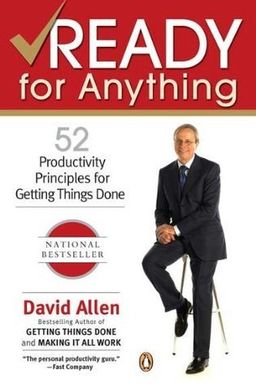
Ready for Anything cover

Ready for Anything

by David Allen

Ready for Anything by David Allen offers 52 productivity principles that help clear your mind, manage tasks effectively, and prepare for creative challenges. Learn to balance structure with flexibility to unleash your full potential.

Ready For Anything: The Art of Fluid Productivity

How do you stay calm, adaptable, and productive when life throws a curveball at you? In Ready for Anything, David Allen—renowned productivity expert and author of Getting Things Done—argues that the ultimate form of productivity isn’t about rigid control or busyness, but about achieving a state of relaxed readiness. Allen contends that true mastery of work and life requires being “ready for anything”—developing systems and habits that let you flow effortlessly between chaos and clarity. This book digs into the deeper philosophy behind productivity, asking not just how to get things done, but why we work the way we do.

Allen draws on his decades of coaching experience and his earlier seminal system, GTD, to present fifty-two essays that blend practical advice with spiritual depth. They explore the mental, emotional, and structural foundations that enable “stress-free productivity”—a way of living that allows creativity, intuition, and efficiency to co-exist. You’ll discover principles for clearing your head, sharpening your focus, structuring your workflow, and then taking graceful, effective action. More than a toolkit, it's a mindset shift: productivity as the art of presence.

Clearing the Mind: From Chaos to Clarity

The first step toward fluid productivity, Allen explains, is to free your mind from clutter. Mental noise drains creative energy. As he puts it, “you can only feel good about what you’re not doing when you know what you’re not doing.” Most people carry hundreds of half-remembered obligations in their psychic RAM—unfinished tasks, incomplete loops, vague intentions—and this creates background stress. To clear it, you must capture everything externally, in trusted systems, that hold these commitments so your mind can relax. This act of completeness and externalization turns mental friction into focus.

Focus and Perspective: Seeing What Matters

Once your mind is clear, you can use focus—the second pillar of Allen’s model—to align your actions with purpose. In the book’s middle section, Allen emphasizes perspective as “the most valuable commodity on the planet.” Clarity comes from shifting altitude, moving between the details of daily actions and the higher-level picture of goals and purposes. Whether thinking eighteen months ahead or eighteen minutes ahead, your point of view determines your effectiveness. Alternating between “visionary” and “doer” modes allows you to move fluidly between ideas and execution—without confusion.

Systems That Support Spontaneity

The third layer is structure. Ironically, the right systems create freedom, not confinement. Allen dismantles the myth that organization kills creativity. On the contrary, he writes, “Stability on one level opens creativity on another.” By crafting systems better than your mind, you allow your mind to let go. These systems—like lists, calendars, and weekly reviews—anchor your commitments, freeing attention for meaningful work and creative play. Good systems are invisible; their success is “inversely proportional to your awareness of them.”

Relaxed Action: Flow as Productivity

Finally, Allen turns to action—the practice of moving in harmony with your environment. “Your power,” he writes, “is proportional to your ability to relax.” Paradoxically, the fastest way to speed up is to slow down, regain presence, and trust process. True productivity emerges when action and reflection balance, when you’re both alert and effortless. In this way, productivity becomes a spiritual discipline—a way to live lucidly amid life’s chaos.

Throughout these essays, Allen weaves anecdotes—from cleaning a garage to practicing karate—that reveal how ordinary actions can spark extraordinary awareness. His recurring idea, borrowed from martial arts, is the “mind like water” state: a dynamic calm that responds with total appropriateness to whatever appears. This mindset is not passive but profoundly engaged—it’s readiness incarnate.

When you finish Ready for Anything, you realize it’s not just about work—it’s about mastering the business of life itself. Allen’s vision calls you to be simultaneously structured and spontaneous, disciplined and free, grounded and inspired. In essence, to become someone who’s not merely getting things done, but ready for whatever comes next.


Clear Your Head for Creativity

Allen insists that clearing your head isn’t optional—it’s the foundation of creativity. Part I of the book, “Clear Your Head for Creativity,” describes how incomplete commitments act like clogged pipes, blocking flow. Each unclosed loop—a forgotten email, a delayed project, even a messy garage—consumes psychic energy. When you face your incompletions and process them to closure, that energy is reclaimed for use in more creative, higher-level thinking.

Closing Loops to Release Energy

Allen reminds us that even small unresolved tasks drain power. The act of cleaning something physical—a desk drawer or your inbox—can spark imaginative insights. He uses the image of “cleaning the garage” as a metaphor for personal productivity: the mundane is a secret path to the sublime. As you physically engage with your environment, new visions emerge organically. This echoes Ernest Becker’s idea (in The Denial of Death) that fully engaging the tangible world reconnects you to existential meaning.

The Fear of Emptiness

Allen acknowledges that many resist capturing everything out of fear—it’s uncomfortable to see everything you’ve created and realize your limitations. We fear “emptiness,” imagining that if all is captured, maybe that’s all there is. But Allen flips the script: writing everything down doesn’t constrict you; it liberates you. By embracing the void, you make space for new creative energy to fill the channel. As he notes, “The universe abhors a vacuum.”

Completeness as Liberation

The most powerful method, according to Allen, is the “total core dump.” Empty your mind into trusted external systems—notes, files, or digital lists—to declutter awareness. Once captured, the mind settles into clarity, just as muddy water clears when left still. This shift from chaos to order mirrors psychologist Mihaly Csikszentmihalyi’s concept of “flow”: mental mastery begins when consciousness is freed from encumbrances.

Ultimately, clearing your head is a spiritual act as much as a practical one. It’s forgiveness in motion—the release of attachment to old clutter, both physical and psychological. In Allen’s view, when you finish each day—completed or not—you should begin the next “well and serenely and with too high a spirit to be encumbered with your old nonsense.” That serenity opens the door to creativity, the real work of living.


Focus Productively: Seeing from Higher Altitudes

Part II, “Focus Productively,” explores the link between perspective and results. Allen’s central claim: your outcomes change when your focus changes. In messy or stressful situations, clarity doesn’t come from more effort—it comes from shifting perspective. He emphasizes the use of “vertical focus,” moving between horizons of experience from ground level (daily actions) up to 50,000 feet (life purpose). This multi-level awareness lets you plan and act intelligently at any altitude.

Changing Focus Changes Reality

When your eyes move from tasks to purpose, detail aligns with vision. Allen argues that you can’t see how to do something until you first see yourself doing it. In other words, internal visualization guides external action (similar to Maxwell Maltz’s insight in Psycho-Cybernetics). By picturing success, you trigger the unconscious mechanisms to make it real. He illustrates this with his own example of mind-mapping his ideal life years before it materialized—proof that imagination builds reality through attention.

The Power of Perspective

Perspective determines how we experience challenges. The same circumstance viewed from different mental altitudes can feel oppressive or empowering. Allen writes, “An infinite number of things in the universe are held back from you only by your altitude and attitude.” Adjusting your mental altitude—from the frustration of the moment to the larger trajectory of growth—transforms blockage into opportunity.

Thinking Enough, but Not Too Much

Allen warns that modern professionals either overthink or underthink their commitments. You have to think about your stuff more than you think—but less than you fear. The trick is minimally requisite thinking: decide your desired outcome and your next physical action. This focused reflection, done regularly, prevents reactive busyness and nurtures presence.

When you review your commitments from multiple horizons weekly, you create a panoramic understanding of your life. You know when to zoom out and when to act. This vertical flexibility makes you not just efficient, but wise—and wisdom, Allen suggests, is the real currency of productivity.


Structure Sets You Free

Part III, “Create Structures That Work,” reveals Allen’s paradoxical insight: systems are the scaffolding of freedom. He shows how organization, planning, and proper workflow structures liberate rather than constrain. “Want freedom?” he writes. “Get organized.” The best artists, entrepreneurs, and professionals thrive within frameworks that support creativity by removing friction.

Your System Must Be Better Than Your Mind

The mind rebels against chaos but cannot handle complexity indefinitely. Its job is not to remember but to think. If your system can’t be trusted to track your commitments, your brain will keep reminding you anxiously. You can’t fool your mind; it knows whether your lists and calendars are reliable. Keeping a clear system—organized, current, and reviewed weekly—frees the mind to operate creatively rather than defensively.

Form and Function

Structure should match purpose. Allen compares this to architecture: forms that align with function create flow; those that don’t create bottlenecks. Scheduling too many meetings for minor goals or designing organizations unfit for growth creates constraint, not support. Similarly, within yourself, your “Visionary” and “Doer” parts must have distinct roles—the visionary generates possibilities; the doer executes details. His “Weekly Review” is the internal meeting that brings both together to cooperate harmoniously.

Silent Systems

The hallmark of a great system is invisibility: “The effectiveness of your system is inversely proportional to your awareness of it.” Think of a car’s transmission—you don’t want to be noticing how to shift gears while driving. Allen’s goal is “silent running,” where your workflow hums effortlessly, leaving full attention for creative work.

Allen’s structural philosophy echoes Dee Hock, founder of Visa, who said, “Simple, clear purpose and principles give rise to complex and intelligent behavior.” The right limits liberate the mind. When form fits function, the result is flow—work that feels as natural as breathing.


Relax and Get in Motion

Part IV, “Relax and Get in Motion,” explores the dynamic balance between calm and action—the “mind like water” state. Allen argues that you speed up by slowing down. Rest and stillness are not luxuries but mechanisms for improvement. By relaxing, you regain clarity, energy, and timing. Productivity is rhythmic; pushing constantly breaks the rhythm, while patience recalibrates it.

The Paradox of Motion

Allen’s karate experience provides an analogy. Students often plateau, improving through effort until progress stalls. His coach’s solution: stop training entirely for a while. After the rest, performance jumps unexpectedly. Growth happens in silence as much as in exertion. “You have to put in the clutch to shift gears,” he says. Timing is everything; impatience ruins it.

Flow and Relaxation

Relaxation opens access to higher power—psychologically and physically. Allen’s martial metaphor is striking: precision and speed increase when tension decreases. This applies to work, negotiation, and even relationships. A relaxed mind sees options where a stressed mind sees threat. He affirms that “your power is proportional to your ability to relax.” This mirrors Csikszentmihalyi’s “flow” and Buddhist mindfulness—focus without force.

Embracing Uncertainty

Being “ready for anything” also means being ready for change. Allen encourages contingency thinking: confront the worst-case scenario mentally, and you free yourself from fear. “Surprises, expected, are no surprise.” This principle promotes equanimity; the realist adjusts sails instead of cursing the wind. Acceptance transforms unpredictability into creative fuel.

In the end, Allen’s vision of action is not frenzied doing but graceful responsiveness. Like a martial artist or a jazz musician, you move intuitively, improvising within structure. The essence of readiness is motion without strain—effortless competence amid constant change.


The Philosophy of Productive Freedom

Across all sections, Allen’s deeper philosophy emerges: productivity is personal freedom. He sees the history of productivity as “the history of liberty,” because freedom of attention enables freedom of creation. When your systems, perspective, and focus align, you experience sovereignty over your time and energy. You stop being enslaved by unfulfilled commitments or reactive stress.

Freedom Through Attention

Allen distinguishes between two voices within us—the busy chattering mind that reminds and worries, and the executive self that reflects and chooses. The latter brings freedom. A trusted system allows the executive mind to operate easily, turning chaos into choice. “You can only feel good about what you’re not doing when you know what you’re not doing,” he quips. In that awareness lies liberation.

Readiness as a Way of Life

Being ready means aligning inner calm with external motion. Allen borrows from martial arts: the “ready stance” is not passive but poised, able to act instantly or rest completely. Productivity here becomes spiritual training—developing non-attachment, presence, and flow while managing daily work. The “mind like water” metaphor sums it up perfectly: complete responsiveness, then return to stillness.

Small Acts, Big Impact

For Allen, consistent small actions—like weekly reviews or maintaining inbox zero—create profound changes. He invokes the “critical 20 percent” perspective: a modest change in responsiveness makes an exponential improvement in peace and control. Small disciplines, done regularly, yield liberation far greater than grand resolutions. In that sense, productivity evolves into a spiritual practice: order as the path to enlightenment.

Ultimately, Ready for Anything is not just about time management—it’s a philosophy of conscious living. It teaches you to manage attention rather than time, alignment rather than effort, presence rather than perfection. When you cultivate readiness, life ceases to be a struggle—it becomes art in motion.

Dig Deeper

Get personalized prompts to apply these lessons to your life and deepen your understanding.

Go Deeper

Get the Full Experience

Download Insight Books for AI-powered reflections, quizzes, and more.