
Idea 1
Law That Works
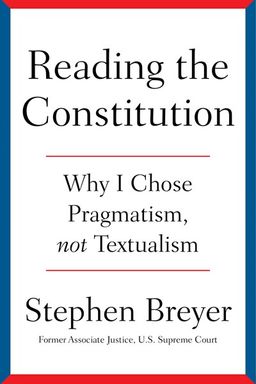
How can you read law so it governs real people in a real world? In Reading the Constitution: Why I Chose Pragmatism, Not Textualism, Stephen Breyer argues that judges should read statutes and the Constitution as tools designed to accomplish purposes, not as static linguistic riddles. He calls this a pragmatic, purpose-oriented approach that puts workability first: when text runs out or runs into conflict, you weigh purpose, consequences, history, and precedent to keep the legal system effective and democratically accountable.
What Breyer asks you to do
You start with text and its ordinary meaning. But when the words leave room for judgment—as they often do—you ask why Congress or the Framers wrote them and what problem they sought to solve. You then consider how your reading will work for agencies, courts, regulated parties, and communities. This is not policy freelancing; it is fidelity to legislative and constitutional aims in their practical setting (think Chief Justice Marshall’s instruction that the Constitution must “endure for ages”).
Purposes, not puzzles
Breyer’s purposivism draws on the common-law method: decide cases incrementally, building standards that adapt to new facts. In County of Maui v. Hawaii Wildlife Fund, for instance, the Court adopted a “functional equivalent” test to decide when discharges traveling through groundwater need a Clean Water Act permit. That standard honors the statute’s goal—protecting the Nation’s waters—while leaving room for agency expertise and future fact patterns. Similarly, in his Brown & Williamson dissent, Breyer read the Food, Drug, and Cosmetic Act through its health-protective purpose to argue the FDA could regulate tobacco without forcing market withdrawal.
Limits of textual fixations
Textualism promises neutrality and clarity, but Breyer shows where it falters. Words often raise scope, not dictionary-meaning, disputes. In Wisconsin Central, the majority read “money remuneration” by 1937 dictionaries to exclude stock options; Breyer argued the purpose of taxing cash-like pay fits stock options too. Empirical work (Bressman & Gluck) shows Congress does not actually draft against many canons textualists invoke. And in practice, judges choosing among plausible “plain meanings” still exercise value-laden discretion.
History and consequences as guides
Breyer rehabilitates legislative history as a map of purpose and compromise. In Ali v. Federal Bureau of Prisons, focusing on the statute’s customs-and-excise context prevented unintended immunity for every federal officer. In Bruesewitz v. Wyeth, committee reports clarified which vaccine claims Congress meant to leave in court. He also insists on consequence-awareness. Azar v. Allina would have required time-consuming rulemaking for Medicare’s interpretive guidance, risking paralysis of a vital program. Courts should avoid readings that cripple administration unless Congress is unmistakably clear.
A throughline
Workability is the constitutional cousin of purposivism. Both ask: which interpretation best allows our democratic institutions to function effectively over time?
Constitutional applications
Breyer extends the same lens to the Constitution. In McCulloch v. Maryland, Marshall upheld broad national power under the Necessary and Proper Clause because a rigid reading would hobble governance. Breyer’s majority in NLRB v. Noel Canning likewise read the Recess Appointments Clause in light of two centuries of practice to keep the executive and Senate functioning. He critiques originalism (e.g., Bruen) for demanding historical analogues judges are ill-equipped to parse and for ignoring modern consequences. He defends balancing over rigid rules in rights cases (his Heller dissent) and uses contextual analysis in Religion Clause disputes (McCreary vs. Van Orden).
Separation of powers today
Modern governance depends on delegation and agency expertise. Breyer supports Chevron deference as a rule of thumb that respects that expertise, while warning that the “major questions” doctrine (NFIB v. OSHA, West Virginia v. EPA) risks undercutting Congress’s choice to empower agencies in complex domains. He favors principled limits, not blunt tools that breed instability or thwart problem-solving.
Across statutes, rights, and structure, Breyer’s message is steady: law should work. Use text, yes—but also purpose, history, precedent, and consequences. Resist seductive theories that promise certainty while leaving government unable to do its job. And when precedent has organized social life for decades, treat stare decisis with the gravity it deserves (Dobbs is his cautionary tale). Read law to make democracy function—today and tomorrow. (Note: This approach echoes Breyer’s earlier themes in Active Liberty and Making Our Democracy Work while engaging directly with the Court’s recent turn toward textualism/originalism.)