
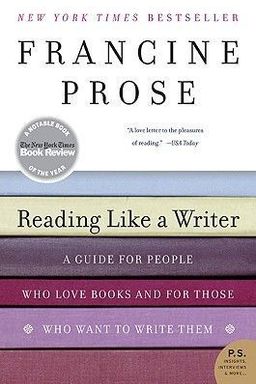
Reading Like a Writer cover

Reading Like a Writer

by Francine Prose

Reading Like a Writer invites you to slow down and savor every word. Francine Prose reveals the secrets of literary masters, helping readers uncover the layers of meaning that make fiction memorable and compelling. Learn to appreciate the artistry in word choice, sentence structure, and character development, elevating both your reading pleasure and writing skills.

Reading Like a Writer: Seeing Literature Through a Writer’s Eyes

What if you could turn every novel or short story you read into a private writing lesson? In Reading Like a Writer, Francine Prose invites you to do exactly that. She argues that the surest way to learn to write—and to deepen your appreciation of literature—is by paying exceptionally close attention to how great authors use language. Instead of treating fiction as a collection of metaphors or political statements, Prose contends that readers should restore focus to the sentences, paragraphs, gestures, and details that create a writer’s distinctive voice. If you read as a writer reads, she says, every book becomes both a source of pleasure and a guide to craft.

Why Reading Closely Matters

Prose begins with the question she’s asked most often as a teacher: “Can creative writing be taught?” Her answer is both yes and no. You can’t teach imagination or genius, she admits, but you can teach students to read deeply—word by word, sentence by sentence—to discover how the finest writers achieve their effects. Through close reading, a writer learns to recognize precision, rhythm, and economy in prose the way a musician learns phrasing from Bach. Reading this way turns authors like Chekhov, Austen, or Nabokov into lifelong mentors whose works become laboratories for studying narration, dialogue, and character development.

Each time you copy or reread their sentences, Prose explains, you internalize how they balance clarity with complexity, how they reveal personality in a gesture, or how they use punctuation to control rhythm. In this method, every book is a master class, and the best teachers are the dead—generous, uncritical, and infinitely patient.

From Childhood Wonder to Literary Awareness

Prose recalls her own evolution from a child entranced by stories to a reader attuned to language. Like many of us, she discovered early pleasure in escapism—from Mary Poppins to Alice in Wonderland and Little Women. But the mechanical exercise of circling every mention of “eyes” or “darkness” in Oedipus Rex and King Lear gave her an unexpected thrill—the awareness that writers plant patterns and clues within their work. She realized that close reading is less a duty than a kind of decoding, a private conversation between reader and writer across centuries.

Her later training as a student of New Criticism—an approach that emphasized studying “what is on the page” rather than an author’s biography—reinforced this discipline. For Prose, the independence of mind that comes from reading this way is crucial, especially in an age of ideological criticism. She warns against classrooms where students are trained to prosecute authors rather than understand them. The goal is not to judge literature for its politics but to learn from its craft, its subtle phrasing, and its moral complexity.

Learning to Read—and Write—Word by Word

To Prose, writing requires the same precision as reading. Every word must “stand trial for its life.” She insists that revision—adding, cutting, replacing, even moving commas—is how a writer forces language to reveal meaning. Over time, this disciplined attention becomes instinctive. When she copied long passages from authors she admired, she found her own prose becoming more fluent. Through practice, osmosis, and the humility of imitation, writers develop their own voices.

Her method joins intuition with analysis. Reading Chekhov’s “The Lady with the Dog,” for instance, teaches empathy; reading Flaubert’s Madame Bovary teaches irony and restraint. The more you study such masters, the more you realize that technical choices—sentence length, diction, the placement of a gesture—carry moral weight. For Prose, style reveals the writer’s worldview.

The Writer’s Apprenticeship

Every writer, Prose argues, begins as an apprentice. She herself learned more from reading than from any creative writing class. And even after years of teaching, she saw that her students’ greatest challenge wasn’t lack of talent but lack of attention. They loved stories but skimmed past the words themselves. Only by slowing down—reading a few pages in two hours, savoring every word—could they begin to perceive what makes fiction alive. She restructured her courses to move line by line through short stories by Joyce, Babel, and Mansfield, rediscovering with her students that the smallest decisions—a missing preposition in a Mansfield opening or a dialect word in an O’Connor story—can hold the key to tone and theme.

Why These Lessons Matter Now

At a time when speed-reading, summarization, and superficial interpretation dominate, Prose’s case for patience and depth feels radical. She sees close reading as an act of resistance: against distraction, against moral oversimplification, and against cynicism. It requires empathy—the ability to enter another’s consciousness—and rewards you with wonder at how language works. Reading like a writer means becoming more alive to the possibilities of thought and expression, not just as an artist but as a human being.

In the pages that follow, Prose explores every element of craft—words, sentences, narration, dialogue, character, and detail—showing how the greatest writers use them with intentional brilliance. Her message is both practical and inspiring: if you want to write well and live more attentively, you must first learn to read—not for plot, not for ideas, but for the miracle of how meaning is built from words.


Close Reading as Writer’s Training Ground

To Prose, close reading is both discipline and delight. It’s how you train your eyes to notice the life inside sentences, the way a musician practices scales. Rather than sprinting through stories for plot, she asks you to slow down until each word, comma, and rhythm announces its purpose. "Most—maybe all—writers," she says, "learn to write by reading books." Long before MFA programs, writers learned from their predecessors by imitation, observation, and reverent theft.

Learning by Osmosis

Through constant exposure, you absorb technique as naturally as a child acquires language. Writers before us studied meter with Ovid and plot with Homer. Harry Crews dissected Graham Greene to analyze his pacing and voice. When you copy out passages from Montaigne or Johnson, as Prose once did, your prose becomes more supple—not by magic, but by muscular memory. Reading is not passive consumption but apprenticeship. You begin to sense how Dickens modulates tone, how Austen’s irony hinges on diction, or how Joyce orchestrates dialogue like music.

Relearning Childhood Wonder

Prose reminds you that you were once a master of close reading—before school trained you otherwise. As a child, being read to taught you to listen word by word. You cared about the pulse of language. Close reading is really a return to that intensity, that curiosity about how stories work. When she circled every mention of blindness in King Lear and Oedipus Rex, she discovered the thrill of pattern—not academic symbolism, but the realization that language foreshadows meaning long before plot reveals it.

Against Lazy Interpretation

For Prose, literary academia’s descent into ideological warfare—deconstructionists vs. Marxists vs. feminists—has often alienated students from literature’s pleasure. She recalls teaching students who were more comfortable diagnosing authors’ politics than responding to their artistry. They read to condemn or redeem, not to understand. To restore joy, she stripped her classes down to bare essentials: line-by-line readings of Borges, Chekhov, and Babel. Students relearned attention; so did she. This method, she realized, wasn’t just pedagogy—it was therapy for the distracted mind.

Practice Breeds Insight

Each rereading teaches something new. Studying Isaac Babel’s transitions between lyricism and brutality helped her solve a problem in her own writing. Like a pianist dissecting each note, you learn to see how great fiction balances compression and expansiveness. In time, reading closely transforms your perception—the way Borges’s student once said, “Each time I read, I see a different book.” That’s the promise of Prose’s lesson: read deeply enough, and the world itself opens word by word.


The Power of Words

After attention, comes reverence—for words themselves. In her chapter on “Words,” Prose argues that every decision in writing begins here. Words are to a writer what notes are to a composer or pigment to a painter. They are not transparent vehicles for ideas but the very medium that shapes thought. Too often, modern readers rush past them for plot. Prose calls for a slower, conscious reading that asks not “What happens?” but “Why this word, and not another?”

Language as Material

Every page, she reminds us, was once blank. Each word reflects an artist’s deliberation. In Flannery O’Connor’s “A Good Man Is Hard to Find,” the first eight words—“The grandmother didn’t want to go to Florida”—quietly carry moral weight. Even the choice to call her “the grandmother” instead of Ethel gives her mythic resonance and distance. The verb “seizing” rather than “taking” transforms obstinacy into tragic determination. Words reveal not only character but theology: her “conscience” and “aloose” dialect hint at divine inevitability and local realism at once.

How Meaning Hides in Language

Prose shows that careful diction can whisper psychological truth. In Katherine Mansfield’s “The Daughters of the Late Colonel,” the phrase “The week after . . .” omits an object, signaling the sisters’ denial of their father’s death. Even adjectives like “simply fearful” originate from character consciousness—these words are the sisters’ self-deluding voices. Writers like Alice Munro and Richard Yates achieve the opposite effect: telling rather than showing, they strip prose to its bare essentials so each plain word glows with restraint. Munro’s Lydia says she “noticed something about herself”—a neutral phrase masking existential despair.

Reading Carnivorously

One of Prose’s most memorable metaphors is that of “reading carnivorously.” She doesn’t mean pillaging other writers, but digesting their virtues. When you face a craft problem—how to choreograph crowd scenes, compose lies, or depict violence—you can look to Tolstoy, Tolstaya, or Babel for instruction. Assimilate their techniques, not their syntax. This active reading turns admiration into adaptation, modelling creative learning without mimicry.

Language as Moral Choice

Ultimately, word choice exposes a writer’s moral imagination. Fitzgerald’s “deferential palms” in Tender Is the Night or Joyce’s use of “literally” for Lily’s exhaustion in “The Dead” isn’t error but art—a purposeful bending of language to fit life’s complexity. Reading every word, Prose insists, restores this moral attention. It’s how writers teach us not only what words mean, but what meaning costs.


Mastering Sentences

If words are building blocks, sentences are architecture. Prose’s chapter “Sentences” reveres the sentence as fiction’s basic heartbeat—unit of rhythm, clarity, and thought. She opens with an anecdote of a young writer telling an agent he only wants to write “really great sentences.” The agent sighs, but Prose sides with the writer. Beautiful sentences, she argues, transcend genre and era; they are the common craft of all great literature.

Clarity and Cadence

She guides us through examples from Samuel Johnson’s The Life of Savage—134 words long yet perfectly clear—and Virginia Woolf’s 181-word opening of “On Being Ill,” whose syntax ripples like music. Long sentences, she teaches, succeed when they evolve logically from clause to clause, when grammar supports movement rather than obstructs it. Like music, sentences rely on rhythm: pauses, repetitions, syllabic melodies that carry emotion beneath meaning. Hemingway’s staccato and Woolf’s sonorous periodicity serve the same master—musical necessity.

Grammar as Courtesy

To Prose, grammar isn’t drudgery but etiquette. It’s how writers make readers comfortable in unfamiliar surroundings. Citing Strunk and White’s The Elements of Style, she compares grammar to hospitality: you set a table for guests before serving surprises. But clarity outweighs correctness—Philip Roth’s fragmentary sentences in American Pastoral prove that deviation, when deliberate, enhances expression. What matters is energy, variety, and precision: a balance of short and long, declarative and lyrical, thought and breath.

Rhythm and Revision

She urges writers to read their work aloud. If you trip, revise. Rhythm reveals awkwardness faster than grammar. Hence her admiration for passages like Tim O’Brien’s inventory in The Things They Carried or Joyce’s snow in “The Dead,” both of which pulse with hypnotic repetition. Rhythm gives prose emotional momentum—what T. S. Eliot might call “the auditory imagination.”

One True Sentence

Prose returns finally to Hemingway’s creed: “All you have to do is write one true sentence.” She interprets “truth” as beauty and precision—the sentence that feels inevitable. To chase that truth, a writer must labor line by line, like a mathematician chasing elegance. Reading other writers’ sentences offers a compass: they remind you that perfection, though rare, exists within reach of rewriting.


The Paragraph as Rhythm and Revelation

Where sentences breathe, paragraphs dance. Prose’s meditation on paragraphs asks you to see them not as arbitrary breaks but as shifts in rhythm, thought, or mood—a “flash of lightning,” in Isaac Babel’s words. A paragraph controls tempo the way stanza controls poetry; it determines when you inhale and when meaning changes direction. She treats paragraphing as an invisible art that reveals a writer’s instinct as surely as fingerprints.

Forms and Functions

Analyzing Babel’s “Crossing into Poland,” she shows how the first paragraph ends with the shock of “upon the bones of peasants,” transforming report into revelation. Paragraph endings—where readers’ hearts quicken—carry disproportionate weight. The break’s silence is as expressive as words. From Kleist’s long breathless openings to Raymond Carver’s two-sentence finale in “Fat” (“It is August. My life is going to change.”), paragraph rhythm mirrors consciousness itself—now rushing, now stilled.

Instinct and Emphasis

Prose quotes Rex Stout’s Nero Wolfe, who claims paragraphing comes from instinct “from the depths of personality.” You can disguise diction, but not how you breathe. Look at Jane Austen’s paragraphs introducing Mr. and Mrs. Dashwood: poised, ironic, perfectly balanced; compare them to Chekhov’s fluid stream or Balzac’s layered “camera shots.” The choices reveal temperament—a writer’s pulse made visible on the page.

Breaking and Holding Breath

Prose celebrates both long and short paragraphs, depending on their internal necessity. García Márquez’s lush unbroken pages in One Hundred Years of Solitude immerse us in mythic continuity, while Brest’s naturalists used short bursts to mimic speech. The rule: paragraph when your story needs air, not when your teacher says so. Even a one-sentence paragraph can hit like a punch—if the thought demands isolation.

Seeing Shape as Meaning

Each paragraph carries emotional geometry, the contour of perception. Jonathan Franzen’s description of his parents in The Corrections or James Baldwin’s paragraph of ice melting in fear (“Sonny’s Blues”) exemplify how structure itself conveys tension, shifts perspective, and prefigures theme. To master rhythm, Prose advises, study how paragraphs move—not only what they say but when they stop and why.


Narration and the Art of Perspective

Who tells the story is as important as what happens. In her chapter on narration, Prose explores the heart of fiction’s illusion—the act of listening to a voice. Every story implicitly answers two questions: Who is speaking, and who is being spoken to? Understanding this relationship liberates writers from formulaic point-of-view rules and reveals narration’s emotional and moral dimension.

Framing the Story

Prose describes how she once overcame writer’s block by using framed narratives—stories nested within stories, echoing Wuthering Heights or James’s Turn of the Screw. The outer narrator creates plausibility; the inner narrator multiplies mystery. A voice like Nelly Dean’s arcs between gossip and divine witness, letting Brontë’s passion appear both credible and gothic. Framing reinvents distance, reminding you that narration always implies an audience—a crucial cue for tone and authenticity.

Point of View as Character

Prose delights in how flexible voice can be. From Nabokov’s seductive Humbert in Lolita to Twain’s Huck Finn, she highlights how diction and rhythm construct consciousness. Humbert’s ornate syntax betrays mania; Huck’s plain idiom broadcasts honesty and humor. Even omniscient narrators—from Eliot’s serene God-like eye to Jane Bowles’s eccentric childlike one—carry personality. The narrator is the reader’s host, and hospitality begins with trust, not neutrality.

Breaking the Rules

Chekhov, Austen, Brontë, Díaz—each violates workshop orthodoxy. Shifting points of view, unreliable voices, even second-person “you” narrations (as in William Trevor’s or Jay McInerney’s experiments) expand empathy rather than confuse it. Prose encourages writers to exploit these transitions consciously; after all, life itself switches perspectives moment by moment. Fiction’s magic lies in its ability to inhabit more than one consciousness without losing coherence.

Honesty Over Formula

Ultimately, narration succeeds when it feels true—emotionally, not autobiographically. What matters is not technical consistency but moral authenticity: does the voice know what it knows? Does it hide what it must? The narrator’s ignorance can be more revealing than omniscience. By reading masters of voice—Chekhov, Nabokov, Baldwin—you internalize how to balance distance and intimacy, authority and doubt, until your own voice sounds inevitable.


The Courage to Read and Write Fearlessly

In her closing chapter “Reading for Courage,” Prose admits that writing may seem harmless compared with fighting fires or performing surgery, yet few acts demand more inner bravery. To face the blank page is to risk exposure—of failure, ignorance, or self-knowledge you’d rather avoid. For her, reading great works offers not only technical lessons but courage: proof that the rules can be broken and still produce beauty.

Defying Convention

She reminds you how every masterpiece once looked strange. Madame Bovary was condemned for immorality; Crime and Punishment centers on a murderer; Beckett’s narrators ramble through decay and doubt. Reading these works frees you from anxiety about approval. They show that fiction thrives on risk—unlikeable characters, unresolved endings, nonlinear plots. When Chekhov ends “The Lady with the Dog” by saying the difficult part has only begun, he honors life’s mystery over neatness. That generosity of ambiguity is courage itself.

Learning from Struggle

Prose closes with meditations on the lives of writers—Chekhov’s objectivity, Babel’s discipline, Tolstoy’s perfectionism, Flaubert’s torment. Babel revised each line until it became “as accurate as a slide rule,” yet feared killing the story through overwork. Such devotion reminds you that art’s difficulty dignifies it. Even in oppression—Babel executed by Stalin, O’Connor writing through illness—writers persisted because language itself demanded allegiance.

Why We Still Read

Reading, for Prose, equips you to face both beauty and terror. In Czeslaw Milosz’s translation of Zbigniew Herbert’s “Five Men,” poetry testifies to dignity amid atrocity. When you doubt art’s worth, she says, look at those who offered “a rose to the betrayed world.” Literature’s job isn’t to solve suffering but to witness it truthfully. To read and write well is to refuse despair.

So courage, for Prose, means paying attention—writing one true sentence though the world wobbles, reading one honest line though your heart aches. In learning to see as writers see, you arm yourself with the same compassion and curiosity that made Chekhov, Flaubert, and Babel immortal. That is the bravest act of all.

Dig Deeper

Get personalized prompts to apply these lessons to your life and deepen your understanding.

Go Deeper

Get the Full Experience

Download Insight Books for AI-powered reflections, quizzes, and more.