
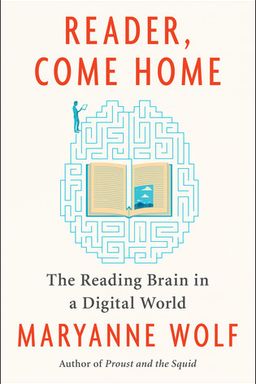
Reader, Come Home cover

Reader, Come Home

by Maryanne Wolf

In ''Reader, Come Home,'' Maryanne Wolf delves into the impact of digital media on our reading abilities, emphasizing the importance of deep reading. Drawing on neuroscience, she offers insights into nurturing a balanced relationship with technology to preserve empathy, critical thinking, and wisdom in an evolving world.

The Reading Brain in a Digital World

How can you truly think, imagine, and empathize in a world where your attention is constantly hijacked? In Reader, Come Home, cognitive neuroscientist Maryanne Wolf argues that our brains—biologically wired for spoken language but not for reading—are now being reshaped by digital culture. Because literacy is a learned invention, the medium we use to read determines how our neural circuits develop. Wolf contends that the very capacity for deep thought, empathy, and reflection may be at risk in the twenty-first century.

Wolf’s core claim is simple but profound: human beings were never born to read. Reading is not a natural act; it’s a neurological achievement that rewires the brain to link vision, language, emotion, and cognition. Over millennia, this reading brain gave rise to abstraction, insight, democracy, and shared moral reasoning. Now, under the pressure of rapid media consumption, this circuitry may be evolving in ways that favor skimming and multitasking over comprehension and contemplation. The very “fertile miracle of communication effected in solitude,” as Marcel Proust once described reading, risks being lost.

The Evolution of Reading and the Brain

Drawing on research from neuroscience and education, Wolf shows that learning to read transforms neural networks originally designed for other functions—vision, speech, attention—and repurposes them for new symbolic tasks. This recycling process, as described by neuroscientist Stanislas Dehaene, builds the “reading circuit” through practice and exposure. But because it depends on cultural input, it’s susceptible to change: the brain adapts to the dominant medium. A print culture fosters sustained reasoning and introspection, while a digital one rewards immediacy, fragmentation, and continuous partial attention.

She visualizes this complex process through her memorable metaphor, the Cirque du Soleil of cognition: under a grand tent, ringmasters for vision, language, cognition, motor action, and emotion perform in synchrony each time we process a word. It’s an intricate neurological ballet, dependent on timing, attention, and memory. Yet this “circus” thrives only when attention is stable. In a digitally saturated world, our spotlight of focus flickers—undermining the formation of deeper comprehension.

What We Lose When We Skim

Reading deeply activates empathy, background knowledge, and critical analysis. It’s an act of immersion that connects us to other minds, across time and culture. Wolf cites experiments showing that literary reading lights up neural circuits for motion and touch—when you read about Emma Bovary’s silk skirt, your sensory cortex reacts as though you feel it. This embodied empathy allows you to “pass over into the perspective of others,” a moral and intellectual act that builds what she calls our species’ collective conscience. But when we skim, these layered connections thin; comprehension becomes superficial, and memory fades.

The implications extend beyond literature. Wolf warns that democracy itself relies on citizens capable of critical analysis and reflection, and that societies lose this when reading becomes transactional. Quoting philosophers like Heidegger and educators like Martha Nussbaum, she argues that the reflective dimension—the contemplative life—is essential to reason, empathy, and social cohesion. The danger is not the technology itself but our failure to cultivate wisdom in its use.

A Call to Conscious Adaptation

Wolf doesn’t romanticize print or demonize screens. Instead, she challenges you to become a conscious user of both—to build what she calls a biliterate brain. We must teach children to read slowly and deeply on paper while also learning digital literacy and coding with intention. Her developmental proposals envision classrooms where physical books nurture empathy and cognitive patience, while digital tools teach logic and problem-solving. This balance creates what she calls “digital wisdom,” a mindset that embraces technology without surrendering humanity.

Ultimately, Reader, Come Home is an invitation—to reclaim your capacity for deep attention and to preserve the joy, empathy, and insight that reading uniquely offers. Wolf’s letters move between scientific explanation and heartfelt reflection, showing how the reading brain embodies the story of our evolution and our moral imagination. The challenge she raises is deceptively simple: can we hurry slowly? Can we navigate digital transformation while keeping alive the contemplative intelligence that makes us human?


The Neuroplastic Reading Brain

Wolf begins with one of the great paradoxes of neuroscience: the brain was never designed to read. Reading emerged only six thousand years ago—barely a blink in evolutionary time. It’s a cultural invention that repurposes older neural systems for a new task. As Stanislas Dehaene explains, this happens through “neuronal recycling”: visual and auditory areas originally devoted to recognizing faces or hearing speech are rewired to process letters, words, and syntax. In essence, every child’s brain must build a completely new circuit.

From Vision to Language

Wolf describes this circuit like a five-ring circus—Vision, Language, Cognition, Motor, and Affect all working together. When you read, the “spotlights of attention” illuminate letters on a page, linking shapes in the visual cortex to sounds and meanings stored in the language centers. The occipital lobe decodes visual features; the temporal and parietal lobes transform them into speech and reasoning; and emotion networks in the limbic system add feeling to thought. Reading is therefore not one skill but a symphony of neural collaboration.

Plasticity Within Limits

Because this circuit is built from experience, it’s shaped by culture. Alphabetic readers (English, Greek, Hebrew) develop circuits tuned to rapid decoding of phonemes, while Chinese readers rely more on the right hemisphere’s visual-spatial areas to recognize complex characters. The reading brain is plastic yet bounded—it can adapt dramatically but only within biological constraints. This flexibility gives human evolution its intellectual spark but also its vulnerability; if our experience is dominated by fast, fragmented media, our circuits will reshape to match.

Reading as Neural Ballet

Wolf’s metaphor of “Circuit du Soleil” dramatizes this coordination. When you read a single word—say, tracks—visual neurons recognize letters, language areas retrieve sounds and meanings, motion regions mirror action, and emotional networks evoke memory. Within 400 milliseconds, the brain integrates all this into comprehension. It’s a cognitive ballet that links perception, emotion, and meaning. When attention falters, this dance collapses into mere recognition, not understanding—a risk intensified by the hyper-stimulation of digital environments.

In short, Wolf reveals that the reading brain is one of humanity’s crowning evolutionary achievements: a neural network built on curiosity, connection, and adaptation. But like any living system, it changes with use. “Use it or lose it” applies not only to physical skills but to the invisible architecture of thought itself.


Deep Reading and Empathy

What happens when you truly lose yourself in a book? Wolf calls this process deep reading, and it’s the heart of humanity’s intellectual and moral evolution. Deep reading goes far beyond decoding words—it activates imagination, emotion, critical thinking, and insight. It allows you to enter another’s consciousness, what theologian John Dunne describes as “passing over” into the perspective of others and returning changed.

Reading as Empathic Simulation

Neuroscientific studies affirm this moral dimension. When you read fiction, the brain’s sensory and motor regions light up as if experiencing the characters’ actions. Natalie Phillips’s “Your Brain on Jane Austen” experiment at Stanford found that close reading activates neural networks for motion and touch, suggesting that we literally feel what characters feel. Similarly, Raymond Mar and Keith Oatley show that fiction acts as a “moral laboratory” where we practice empathy. This physiological simulation is how reading helps us understand strangers, bridge cultures, and resist prejudice.

Perspective Taking and Moral Growth

Wolf pairs these findings with literary examples: when we read Anna Karenina, we leap with her in despair; when we read Baldwin’s or Toni Morrison’s works, we inhabit the wounds of racial injustice. She recounts James Carroll’s transformation after reading Anne Frank’s diary and Dietrich Bonhoeffer’s writings from prison—books that showed empathy as both spiritual practice and resistance to tyranny. For Wolf, such experiences refine our moral imagination, making readers “specialists in empathy.”

The Decline of Empathy

Yet Wolf cites Sherry Turkle’s alarming research showing a 40% decline in empathy among college students over two decades, largely due to digital distraction and shallow social interaction. Screen time replaces face-to-face conversations that nurture emotional understanding. In this cultural shift, the deep reading that once united thought and feeling gives way to surface scrolling—connection without compassion.

The remedy, she insists, lies in preserving the slow, mindful processes that cultivate empathy. Reading literature is not an escape from reality but an act of love and civic engagement. In an age of fragile democracies, the empathic reader may be the most necessary citizen of all.


Attention and Memory in the Digital Age

Will you ever focus again? Wolf warns that digital culture is quietly reshaping one of the most basic foundations of thought: attention. Young brains, bathed in constant stimulation, are learning to expect novelty every few seconds. Psychologist Daniel Levitin calls this the “dopamine-addiction feedback loop” that rewards distraction. Children’s prefrontal cortex—the brain’s impulse control and planning center—is not yet mature, making them especially vulnerable to digital overload. The result is what Wolf terms the grasshopper mind: skipping from one shiny stimulus to another without sustained focus.

The Chain of Attention

Catherine Steiner-Adair’s studies show children’s attention wanes offline because they’ve habituated to the pace of online stimulation. Levitin adds that multitasking floods the brain with stress hormones—cortisol and adrenaline—that mimic fight-or-flight states. Over time, attention fragmentation affects memory consolidation: what isn’t deeply attended to isn’t remembered. Maggie Jackson captures this perfectly: “Our working memory is like a digital news crawl—never more than a snippet, no looking back.”

Screen Reading and Forgetting

Studies by Naomi Baron, Anne Mangen, and others show that comprehension and recall suffer when reading on screens. When text is associated with moving imagery, hyperlinks, and multitasking, the reader’s working memory disperses across stimuli. The result: less synthesis, less reflection, less retention. Even adults find themselves rereading paragraphs, realizing that their eyes moved faster than their minds.

Memory as Cultural Artifact

Wolf references historian Alison Winter’s argument that inventions like film and computers have changed not only how we store memory but how we conceive it. Our inner archive mimics our external devices: fragmented, searchable, but often hollow. Philosopher Katherine Hayles warns that as stimuli accelerate, we lose the time needed for deep processing—time being the true substrate of thought. Together these insights reveal a sobering conclusion: memory, like literacy, depends on attention—and both are now endangered species.

Wolf’s solution is not pure abstinence but rhythm: protect periods of sustained reading and reflection as “festina lente”—to hurry slowly. Deep time restores cognition by allowing information to become knowledge, and knowledge to ripen into wisdom.


Raising Readers from Laps to Laptops

Wolf transforms her research into practical guidance for parents and educators. From birth to adolescence, she maps how children’s brains form literacy—and what pitfalls digital exposure creates along the way. The principle is developmental: each child must first build a physical and emotional foundation for reading before engaging with digital media.

Early Years: The Lap Stage

Before age two, reading aloud from physical books is irreplaceable. Studies by John Hutton and Ghislaine Dehaene-Lambertz show infants activate language networks when they hear their parents’ voices, forming crucial emotional bonds that screens cannot replicate. Shared gaze and touch—what Charles Taylor calls “joint attention”—teach focus, connection, and language in ways that digital stimulation cannot. Programs like Reach Out and Read demonstrate that this daily ritual predicts future literacy better than any software.

Preschool Years: Protecting Imagination

Between ages two and five, Wolf argues for “protecting the lost time of childhood.” Exposure to too much digital entertainment creates an unnatural boredom when stimuli vanish, blunting the drive to explore and imagine. Rich storybooks, rhymes, and music instead teach rhythm, phoneme awareness, and creativity—a foundation for empathy and problem-solving. Programs like Born to Read and Bring Me a Book exemplify the power of human storytelling over passive consumption.

School Years: Balance and Biliteracy

From ages five to ten, she proposes an educational model for a biliterate brain: print reading for depth, screen reading for skill. Handwriting solidifies motor-language connections, while coding teaches logic and design. Digital tools become “playgrounds” for creativity, not substitutes for human attention. The goal is not rejection but integration—children who can think critically across media.

Wolf’s developmental blueprint reminds you that raising a reader isn’t about early gadget access—it’s about nurturing curiosity, patience, and empathy. The first lap, not the first laptop, builds the circuitry of thought.


Teaching Reading and Cognitive Patience

As children enter school, Wolf warns that America faces a literacy crisis: two-thirds of fourth graders fail to read proficiently. This failure, she argues, stems partly from political debates over teaching methods and partly from our culture’s impatience. Reading takes time—biologically and psychologically—and pushing children too hard too soon can backfire.

The Reading Wars

Wolf recounts the century-long battle between phonics (explicit decoding of letter-sound rules) and whole-language approaches (implicit, story-centered learning). Drawing on Jeanne Chall’s and Mark Seidenberg’s research, she concludes that systematic phonics training is essential, especially for children with dyslexia. Yet imagination and literature must not be sacrificed. Reading fluency requires both speed and meaning—a ladder whose rungs are phonemes, vocabulary, comprehension, and emotional connection.

Fluency and Feeling

Through studies by Robin Morris, Maureen Lovett, and Tami Katzir, Wolf shows that fluent reading integrates emotion and understanding. Programs like RAVE-O and Eureka demonstrate that connecting word recognition to affective engagement accelerates learning. When children laugh with Dr. Seuss or empathize with Horton, “the egg he sits on” becomes a lesson in perseverance and compassion.

The Moral Dimension of Education

For Wolf, reading instruction must serve humanity, not just metrics. Citing Martin Luther King Jr., Ruby Bridges, and Martha Nussbaum, she argues that stories shape citizenship—children learn justice, kindness, and courage by reading about them. Teaching reading is therefore teaching empathy, the foundation of democratic life. Cognitive patience—learning to linger on words and meanings—is the seed of moral thought.

Her message to educators is clear: literacy begins with love, develops through attention, and matures into wisdom. The classroom is not just a place to decode words; it’s where we learn to decode humanity.


Building a Biliterate Brain

In her culminating proposal, Wolf introduces the concept of the biliterate reading brain: a mind trained to read deeply on paper and think flexibly online. This, she says, is the only sustainable adaptation to digital culture. The goal is not nostalgia for print but a synthesis of media that preserves contemplative depth while embracing innovation.

Learning from Bilingual Brains

Wolf models her idea on bilingualism. Research by Claude Goldenberg and Ellen Bialystok shows that switching between languages strengthens cognitive control and empathy. Similarly, switching between print and digital mediums can teach children when to slow down for reflection and when to engage with dynamic information. She coins the term “code switching” for this oscillation between modes of reading.

Curriculum for the Future

In her educational blueprint, early years emphasize print for building background knowledge and empathy. Later, digital tools enter—not as distractions but as structured environments for coding, design, and critical inquiry. Programs like MIT’s Scratch and CAST’s Thinking Reader exemplify this balance. Students learn to read narratives deeply and navigate Web content wisely, developing “digital wisdom” through awareness and self-regulation.

Access and Equity

Wolf recognizes that technology divides as well as empowers. Research by Victoria Rideout and Vikki Katz reveals that low-income families face not only access gaps but participation gaps—without parental guidance, digital exposure can deepen inequality. Initiatives like Curious Learning and XPRIZE aim to bring literacy tools to underserved children worldwide. The biliterate brain, she insists, must be for all humanity.

A biliterate society would produce citizens capable of “digital wisdom”—able to analyze, empathize, and create across platforms. For Wolf, this is not just an educational ideal but an ethical imperative: to sustain the contemplative intelligence that underpins civilization itself.


The Contemplative Reader and the Future of Humanity

Wolf closes her letters with a deeply personal meditation: reading is more than a skill—it’s a moral stance toward time, thought, and others. She contrasts three lives of reading, borrowed from Aristotle: the productive (information and utility), the pleasurable (entertainment and escape), and the contemplative (reflection and wisdom). Modern society excels at the first two but neglects the third—the quiet, reflective life that sustains empathy and moral reasoning.

The Cost of Lost Reflection

Drawing on Heidegger and Wendell Berry, Wolf mourns the erosion of “meditative thinking” in an age of acceleration. Time, she writes, is no longer a medium for reflection but a commodity to be optimized. Without contemplation, knowledge becomes mere data, and wisdom disappears. Her antidote is festina lente: hurry slowly. Create quiet spaces to think, read, and feel. In these pauses, humanity recovers its bearings.

Reading, Resistance, and Democracy

Wolf argues that deep reading is an act of resistance in a landscape of distraction. It’s how individuals reclaim autonomy and how societies preserve democracy. She quotes writers from Toni Morrison to Bonhoeffer, who read to preserve human dignity under tyranny. To read deeply is to dissent against superficiality—to choose thought over manipulation, kindness over fear.

Word-Work and Wisdom

Toni Morrison’s Nobel Lecture inspires Wolf’s conclusion: “We do language—that may be the measure of our lives.” Reading connects this linguistic creativity to moral agency. It transforms information into knowledge and knowledge into wisdom. Wisdom, Wolf writes, is contemplation in action: the union of intellect and empathy guiding virtuous behavior.

In the end, Wolf calls the reader home—to reclaim the slow, generative rhythm of mind that reading enables. The future of humanity depends on preserving not just literacy but the kind of deep, compassionate intelligence that reading cultivates. The good reader, she reminds us, is the guardian of our collective conscience and the canary in the mine of civilization.

Dig Deeper

Get personalized prompts to apply these lessons to your life and deepen your understanding.

Go Deeper

Get the Full Experience

Download Insight Books for AI-powered reflections, quizzes, and more.