
Idea 1
Reading People as a Science of Human Understanding
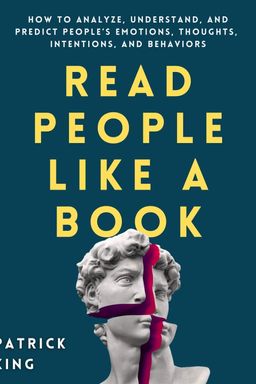
Have you ever met someone who seems to instantly understand others—who can anticipate reactions, sense hidden emotions, or detect a lie before anyone else notices? In Read People Like a Book, Patrick King reveals that this isn’t an innate superpower reserved for psychologists or detectives—it’s a learnable skill grounded in psychology, observation, and empathy. King argues that reading people combines both art and science: interpreting behavior objectively, understanding motivations, and aligning observation with emotional intelligence.
At its core, the book contends that human beings are incredibly complex, but not impenetrable. Every outward expression—from facial micro-movements to verbal cues—tells a story about inner drives, fears, values, and intentions. To truly read people, King emphasizes integrating multiple lenses of understanding: psychology, neuroscience, motivation theory, body language, and personality science. Together, these disciplines form a toolkit for grasping not only how others act but why they do so.
Seeing Beneath the Surface
King begins by acknowledging the inherent mystery of human behavior—each person’s inner world is a ‘black box,’ sealed yet constantly emitting clues through speech, gestures, tone, and actions. He introduces the concept of “theory of mind,” the mental model we create to imagine what others think or feel. But while we can never know a person completely, we can improve the accuracy of our interpretations by systematically gathering and analyzing data. Like engineers inferring the function of a machine, you can learn to infer a person’s internal operating system from observable signals.
This approach demands both detachment and empathy. Reading people isn’t guessing or judging from instincts alone; it’s an iterative process. You form a hypothesis about someone, test it through further observation, adjust it, and refine it until what you see aligns more closely with reality. As King notes, to truly understand others, you must also understand yourself—the fears, biases, and projections that can distort your perception.
Why You’re Probably Reading People Wrong
Most people rely on intuition, stereotypes, or confirmation bias. We “remember when we were right” and forget when we were dead wrong. King recounts how interviews, first impressions, and even casual conversations often mislead us because we focus on single cues (like nervousness) or ignore context. Reading people requires establishing a baseline—what’s normal for that person—and comparing deviations under different conditions. Without that baseline, any gesture or behavior could be meaningless.
He warns against one-size-fits-all interpretations. What means one thing in your culture may mean another elsewhere: direct eye contact could convey respect in America, yet rudeness in Japan. Context and cultural variation are crucial filters if you want to avoid misjudgment.
The Scientific Approach to Reading People
King situates his practical advice within psychological studies. He references Simon Baron-Cohen’s “social intelligence test,” which measures someone’s ability to infer emotions just from looking at a person’s eyes. This test, he explains, shows that emotional insight isn’t fixed—you can train your perception by improving observation and empathy. The book’s entire method rests on the assumption that objectivity improves accuracy. By learning structured models of human behavior, you avoid the trap of seeing only what your emotions want you to see.
He then breaks down behavior through multiple interconnected models. Chapter one explores motivation—why people act through pleasure, pain, or ego defense. Chapters two and three delve into physical and personality-based readings: body language, facial microexpressions (after Paul Ekman), and models like the Big Five, MBTI, and Enneagram. Later chapters apply this understanding to detecting lies, observing environmental clues (like homes or social media habits), and asking indirect questions that reveal someone’s deepest values. Each section builds a part of a holistic system for analyzing and predicting human behavior.
Why This Matters in Everyday Life
King makes clear that reading people isn’t manipulation—it’s understanding. It empowers you to communicate better, build stronger relationships, negotiate effectively, and detect deceit. Whether in interviews, friendships, parenting, or romance, these skills allow you to perceive motivations before they become conflict. Moreover, learning to analyze others mirrors learning to understand yourself. The biases you discover in others often reveal your own blind spots.
“The better you can interpret the inner world of others,” King reminds, “the better you can navigate your own.”
Ultimately, the book teaches that accurate people-reading transforms how you see humanity. Instead of reacting to surface behaviors, you start noticing the underlying patterns—fears driving defensiveness, insecurities cloaked in arrogance, motives hidden behind politeness. King’s conclusion is both practical and philosophical: learning to read others with compassion and precision makes you not only socially intelligent but emotionally wiser. Understanding others deeply, he suggests, begins with the courage to look honestly at the human complexity within yourself.