
Idea 1
Reason, Humanity’s Ultimate Survival Tool
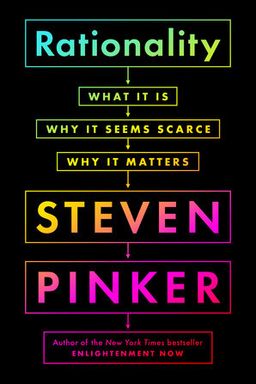
Why do people so easily believe nonsense, chase conspiracy theories, or misjudge risk? Steven Pinker’s Rationality: What It Is, Why It Seems Scarce, Why It Matters argues that reason is not merely an individual talent but a cumulative cultural achievement — a body of principles, habits, and institutions that help humans align beliefs with reality and actions with goals.
For Pinker, rationality means using knowledge to attain goals. It’s a toolkit comprising logic, probability, Bayesian inference, decision theory, and social feedback. The book challenges the notion that humans are fundamentally irrational and shows instead that our reasoning is deeply ecological — adapted to real-world contexts rather than lab puzzles. Errors arise when our evolutionary heuristics meet artificial conditions.
Rationality as a set of tools and norms
Pinker recasts rationality as a collection of normative models: systems of logic and mathematics specifying correct inference under uncertainty. Bayesian reasoning formalizes belief revision; decision theory encodes coherent preferences; and signal detection theory weighs evidence quality against the cost of false alarms. These frameworks are not arbitrary rules — they reflect centuries of testing ideas against experience, from Aristotle and Bayes to modern artificial intelligence.
The San trackers of the Kalahari embody this adaptive rationality. Without formal schooling, they infer unseen animal behavior using conditional logic and probability. Their example contradicts the caricature of premodern irrationality: humans evolved formidable reasoning adapted to ecological challenges, not to multiple-choice puzzles.
Why reasoning fails
Pinker examines cognitive illusions — mental shortcuts that misfire under artificial constraints. The Cognitive Reflection Test shows how intuition (System 1) yields seductive but wrong answers, and deliberate reflection (System 2) can override them. Visual illusions and Wason’s selection test demonstrate that content matters: our brains evolved to detect cheaters, not abstract violations of logic. These biases illustrate mismatch, not stupidity.
Probability confusions compound the problem. You overreact to vivid anecdotes because of the availability heuristic and violate logic in the conjunction fallacy (as in the “Linda problem”). Rationality requires reframing probabilities in concrete terms like frequencies or diagrams — a trick that restores intuitive logic.
Belief, action, and society
Rationality is more than math; it’s a social practice. Rational discussion, peer review, and adversarial institutions turn individual fallibility into collective progress. Pinker follows the lineage from William James to modern science: only through public justification can reason correct itself. Science, journalism, and democracy are cultural inventions that make society’s reasoning more objective than any individual’s could be.
Still, rationality is constantly threatened by cognitive traps, political polarization, and magical thinking. Pinker distinguishes our reality mindset — applied to practical daily life — from our mythology mindset, which attaches symbolic beliefs to identity or belonging. Many people compartmentalize both; falsehoods persist not because we can’t reason, but because the social rewards of allegiance often outweigh factual accuracy.
Why rationality still matters
Despite its fragility, reason has yielded enormous dividends: vaccines, democratic governance, and moral progress all emerged from rational discourse and evidence-based refinement. Pinker’s closing argument is pragmatic rather than utopian: you can’t make people purely rational, but you can design societies that reward truth and penalize deceit. Rationality, properly cultivated in education, media, and institutions, is both a moral and a practical engine of human flourishing.
(As Pinker echoes from Enlightenment thinkers like Hume, Kant, and Bentham: reason is humanity’s compass — imperfect but indispensable — guiding us from superstition and suffering toward progress enabled by shared evidence and open argument.)