
Idea 1
Range Wins in a Complex World
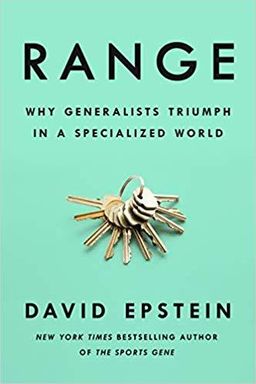
How do you thrive when the world refuses to give you clear instructions? In Range, David Epstein argues that the path to lasting success is rarely the straight line we’re sold. The Tiger Woods story—a child molded into a prodigy by ruthless focus—is the exception, not the model. Across sports, science, art, and business, Epstein shows that a broad base of experiences, curiosity, and the willingness to change direction trump early specialization. The book’s core claim is simple but deeply countercultural: breadth beats depth in most of the modern world.
The myth of the head start
Epstein opens with a contrast that defines the book’s thesis: Tiger Woods versus Roger Federer. Woods embodied narrow, deliberate practice from toddlerhood; Federer dabbled in many sports before choosing tennis. Research across athletic development, education, and careers shows Federer’s sampling pattern is far more common among elites. That sampling period—a span of experimentation before locking in—improves physical, cognitive, and psychological match quality. It gives future experts a chance to learn what fits them best before narrowing focus. (Note: Laszlo Polgar’s chess prodigies remain exceptions where early specialization matters.)
Kind vs. wicked learning environments
Epstein borrows the distinction from psychologist Robin Hogarth: “kind” environments (like chess or golf) provide clear rules and immediate feedback, reinforcing pattern recognition. “Wicked” environments (like business, medicine, or policy) are noisy, unpredictable, and slow to reward accuracy. Specialists excel in kind domains where repetition builds precise intuition; they struggle in wicked settings where flexibility and analogical reasoning win. In a world increasingly wicked—shaped by change, connectivity, and ambiguity—generalists are more adaptive.
Why broad learning feels slow but builds power
Effective learning looks inefficient. “Desirable difficulties”—spacing, interleaving, and generation—produce slower short-term gains but stronger transfer. Epstein connects experimental psychology (Bjork, Kornell) with real-world performance data, showing why students who struggle initially do better later. Struggle and diversity of problem types build mental flexibility—the same quality that lets people handle complex, evolving systems rather than memorized procedures.
Analogical and outside-view thinking
Breadth breeds inventive reasoning. Johannes Kepler’s analogies—comparing planetary motion to heat, smell, and magnets—illustrate deep structure extraction, not surface similarity. Experiments like Duncker’s radiation problem prove that exposure to diverse analogies triples problem-solving success. The “outside view,” championed by Daniel Kahneman and Philip Tetlock, reinforces the same principle: step outside your own case and compare across related precedents.
Breadth, creativity, and polymathy
Creativity often emerges where disciplines collide. Venetian figlie del coro musicians became world-class because they learned many instruments; jazz improvisers learned by cross-training; Nobel laureates disproportionately engage in arts. At 3M, polymaths like Andy Ouderkirk exploit “adjacent knowledge”—expertise in neighboring domains—to produce breakthrough inventions. The data show polymathic teams outperform specialists when uncertainty is high. Range enables recombination of ideas that specialists miss.
The outsider and the deliberate amateur
When insiders are trapped by assumptions, outsiders spot hidden connections. Jill Viles, a patient rather than a physician, identified an Olympic athlete’s rare genetic disorder through cross-domain observation. Crowdsourcing platforms like InnoCentive amplify this “outsider advantage,” matching difficult problems to solvers from distant fields. Similarly, Nobel laureates Oliver Smithies and Andre Geim exemplify “deliberate amateurs” who playfully experiment outside formal bounds—Saturday tinkering that births major discoveries.
Dropping tools and flexible identity
Epstein warns that specialization can harden habits until they endanger survival. Karl Weick’s wildland firefighter study and NASA’s Challenger case show experts clinging to tools, data methods, and processes long after conditions demand improvisation. “Dropping tools” means letting go of professional identity, a psychologically brutal move but crucial for adaptability. Leaders can design systems with deliberate cross-pressures—balancing rules and dissent—to preserve flexibility under stress.
Late bloomers and match quality
You don’t fall behind by exploring. Studies of students and professionals show that later specializers often earn the same or better outcomes because they find stronger fit—what Epstein calls “match quality.” Quitting poorly matched paths isn’t moral weakness; it’s discovery. Treat your career as an experiment: rotate assignments, prototype possible selves, and keep learning who you are. The lesson applies broadly—to education, parenting, and organizational design: encourage exploration, not linear lock-in.
Epstein’s message is ultimately hopeful. In a world of uncertainty, you win by learning widely, connecting ideas, and letting curiosity steer you. Range isn’t the opposite of depth—it’s the foundation that allows depth to matter. And if you sometimes feel late, remember his closing counsel: you’re not behind—you’re learning the world as it really is.