
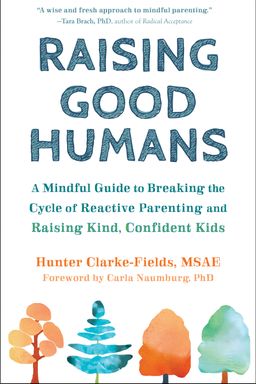
Raising Good Humans cover

Raising Good Humans

by Hunter Clarke-Fields

Raising Good Humans provides a practical, mindful approach to parenting, helping you break reactive cycles and nurture kind, confident kids. Learn to manage emotions, prioritize self-care, and create strong family bonds through proven strategies and insights.

Raising Present, Compassionate, and Mindful Humans

How can you raise children who are kind, confident, and emotionally balanced—without losing your own peace of mind in the process? In Raising Good Humans, mindfulness coach and parenting mentor Hunter Clarke-Fields argues that the path to raising grounded kids begins by transforming yourself first. Her message is both humbling and empowering: mindful parenting isn’t about controlling your children’s behavior—it’s about mastering your own reactions so that you can model the calm, compassionate humanity you hope to cultivate in them.

Clarke-Fields' central claim is that parenting is a mirror: your children bring out everything unresolved within you. Their meltdowns, resistance, and chaos often reflect not just their developmental state, but your own inner turbulence. The good news is that you can break reactive cycles passed down through generations by learning mindfulness, compassion, and skillful communication. This book blends neuroscience, mindfulness practice, and real-life stories into a practical guide for building deeper connections and fostering cooperation without threats or punishment.

From “Losing It” to Living Mindfully

Clarke-Fields begins with a deeply personal story—the moment she sat sobbing outside her toddler’s door after scaring her with anger. That breakdown became her breakthrough. The book asks you to start in this same space of honesty: recognizing the hard realities of parenting and forgiving yourself for not being perfect. From there, she invites readers to reframe parenting as a spiritual practice—one in which every moment of frustration is a chance to wake up and grow. She echoes the wisdom of Dr. Daniel Siegel and Tara Brach, blending brain science with compassion to help you reclaim control when your own inner child wants to yell, stomp, or give up.

Breaking the Cycle of Reactivity

Part I of the book explores how to move from autopilot to awareness. Clarke-Fields explains the neuroscience of stress: when your child refuses to put on shoes or throws a tantrum in public, your brain’s threat system—anchored in the amygdala and limbic system—hijacks your rational prefrontal cortex. In those moments, you literally can’t access your calmest self. Yet through consistent mindfulness practice—meditation, body awareness, and what she calls “beginner’s mind”—you can train your brain to respond instead of react. MRI studies even show that mindfulness shrinks the amygdala and strengthens neural pathways for empathy and reason. The more you meditate, the more you parent from wisdom rather than fear.

This isn’t abstract psychology. Clarke-Fields gives you micro-practices—a five-minute breathing session, a mindful dishwashing exercise, or even eating a single raisin with full attention—that retrain your mind to stay calm under pressure. As you learn to stay present, you model emotional regulation for your children, who mirror your nervous system. When you calm yourself, they co-regulate with you.

Transforming Communication

If the first half of the book is about inner transformation, the second half teaches you how to communicate so your kids actually listen. Clarke-Fields introduces “reflective listening,” “I-messages,” and “win-win problem solving”—methods grounded in nonviolent communication and supported by researchers like Thomas Gordon and Oren Jay Sofer. Instead of yelling “Pick up your toys!” or threatening time-outs, you might say: “When there are toys on the floor, I feel frustrated because I step on them.” The shift from blame to honest self-expression keeps connection intact. Without the shame and punishment that trigger resistance, children naturally want to cooperate. The focus moves from controlling behavior to cultivating empathy and responsibility.

Parenting as Emotional Healing

Clarke-Fields emphasizes that parenting is the ultimate form of personal growth. When your child triggers you, what surfaces are your own unhealed wounds—memories of being dismissed, punished, or unheard. As Dr. Siegel says, “The best predictor of a child’s well-being is a parent’s self-understanding.” By exploring your childhood stories through journaling exercises, mindful reflection, and self-compassion, you can disarm old patterns before they’re projected onto your children. This practice helps break generational cycles of yelling, shaming, and coercion.

Practicing self-compassion is not indulgence—it’s leadership. Clarke-Fields draws on Kristin Neff’s research to show that shame is paralyzing, while self-kindness is motivating. Instead of berating yourself after a meltdown, you can pause, breathe, and tell yourself, “Parenting is hard for everyone. I can begin again.” That simple phrase rewires your inner voice from judgment to support—creating the same compassionate environment you want your kids to internalize.

Building Cooperative, Peaceful Homes

Finally, Clarke-Fields moves from the inner world to the outer one—your home environment and cultural habits. She encourages simplifying schedules, reducing clutter, and prioritizing “special time” for mindful connection. The idea is to exchange chaos for rhythm, disconnection for presence. By slowing down, establishing routines, and setting boundaries without threats, you give your family the structure it needs to flourish. She even addresses modern pitfalls like digital overload, suggesting “screen-free Sundays” to help everyone reset attention and reconnect.

The end goal is what she calls a “mindful family ecosystem”: a home grounded in respect, compassion, and awareness. When you model calmness, listen reflectively, and communicate needs instead of demands, children learn emotional intelligence organically. They grow up not just to be “well-behaved,” but to be truly good humans—kind, confident, and self-aware citizens of a more compassionate world.

Ultimately, Raising Good Humans reminds you that parenting isn’t about perfection—it’s about presence. Your children don’t need a flawless parent; they need a mindful one who knows how to pause, apologize, breathe, and love through the messiness. The work begins not with fixing your kids, but with healing yourself.


Mastering Mindfulness to Break Reactivity

Clarke-Fields begins where most parents live—in the chaos of trying to get your child ready while your own stress spirals out of control. Her “8 a.m. meltdown” scenario shows that our reactivity isn’t moral failure; it’s biology. When your child refuses to get dressed and you feel your blood boil, your amygdala takes over, hijacking your capacity for logic. Reactivity, she reminds us, is an ancient survival mechanism. The key isn’t to suppress this response but to retrain it through mindfulness.

Mindfulness as the Parent’s Superpower

Mindfulness, defined by Jon Kabat-Zinn as “paying attention on purpose, in the present moment, and nonjudgmentally,” is the parent’s superpower. Clarke-Fields demonstrates how regular meditation—just five to ten minutes a day—rebuilds the neurological bridge between stress and calm. MRI research confirms that mindfulness literally reshapes the brain: shrinking the amygdala (our fear center) and strengthening the prefrontal cortex (the seat of empathy and reasoning). This biological upgrade helps you stay measured instead of explosive in heated parenting moments.

Everyday Mindfulness Practices

You don’t have to become a monk. Clarke-Fields offers practical exercises: start by eating a single raisin with your full attention, or wash the dishes slowly “as if each bowl were sacred.” These daily acts of presence interrupt autopilot mode—where stress and distraction rule—and pull you back into the now. The practice of beginner’s mind invites you to see your child anew each day, noticing their changes rather than labeling them as “difficult” or “shy.” This shift helps you respond to who they are in the moment instead of to past assumptions.

Acknowledgment is another key mindfulness tool. When you or your child feel upset, don’t rush to fix it—name it. Saying aloud “I feel frustrated right now” or “You wish you could stay and play” instantly defuses tension. By labeling emotion, you bring the prefrontal cortex online and model emotional intelligence. Over time, your child learns to do the same—to name emotions rather than act them out.

Making Mindfulness Habitual

Clarke-Fields compares mindfulness practice to athletic training: you wouldn’t send your child into a soccer championship without practice sessions. Similarly, you can’t expect to stay calm in a tantrum if you don’t exercise your mind daily. Meditation is mental fitness for parenthood. Start small—five minutes a day, focusing on the breath. When your thoughts wander, gently label “thinking” and return to your breath. Each return is a repetition that strengthens your “calm muscle.” With consistency, you’ll find that “the gap” between trigger and reaction widens, giving you room to choose patience over panic.

Because children mirror their parents’ nervous systems, your calm presence directly regulates theirs. As Clarke-Fields writes, “Your ability to be fully present naturally soothes your child.” This is echoed by Thich Nhat Hanh’s wisdom: “When you love someone, the best thing you can offer is your presence.” Mindfulness turns presence into your family’s daily refuge—a measurable, biological, and spiritual calm within the storm of parenting.


Disarming Emotional Triggers

Every parent has “buttons” that kids seem to push effortlessly—defiance, mess, attitude. Clarke-Fields reframes these not as annoyances but as mirrors of your unhealed wounds. When you explode over spilled juice, what’s being triggered may not be the mess—it’s the feeling of losing control, being unseen, or being disrespected, often rooted in your childhood.

Unearthing Old Patterns

Clarke-Fields cites Dr. Daniel Siegel’s finding that “the best predictor of a child’s well-being is a parent’s self-understanding.” She asks you to journal about your upbringing: How did your parents handle discipline, anger, or mistakes? Did you feel heard? Many of your current reactions, she says, are “autopilot scripts” inherited unconsciously. When you become aware of these stories, you can interrupt them instead of passing them down.

Taming Anger and Yelling

Yelling is the default reaction for countless parents, but Clarke-Fields dismantles its effectiveness. Research shows it triggers kids’ stress responses, shutting down the prefrontal cortex—the very part responsible for learning. Instead of compliance, yelling teaches fear, aggression, and resentment. To yell less, she prescribes tracking your triggers for a week and noting when, why, and how you lose your cool. This awareness allows you to preempt the pattern before it escalates. She reminds you: self-care—sleep, exercise, and supportive friendships—is not indulgence but “a parental responsibility.”

Cooling Strategies That Work

Clarke-Fields offers a “Yell-Less Plan” filled with real-time tools: step away briefly, repeat a calming mantra (“This is not an emergency”), or literally shake out anger from your body. Use breathing techniques like “five-eight breathing”—inhale to five, exhale to eight—to signal safety to your nervous system. Humor, whispering instead of yelling, and mindful mantras like “Still water” can interrupt reactivity mid-flow. The goal isn’t to suppress anger but to “take care of” it—to let the energy move through without harming yourself or your child.

When you handle your triggers mindfully, you model emotional regulation. Your child learns that emotions aren’t dangerous; they’re manageable signals that something needs attention. As mindfulness teacher Thich Nhat Hanh said: “When you love someone, you say, ‘Darling, I am angry, and I am taking good care of my anger.’” Your child will eventually learn to do the same.


Self-Compassion: Healing Before Helping

Shame, not anger, is often the most destructive force in parenting. When you snap at your child, the critical inner voice often attacks harder than anyone else: “I’m a terrible parent.” Clarke-Fields teaches that self-compassion—not guilt—is the antidote. Quoting Tara Brach, she writes, “Feeling compassion for ourselves doesn’t release us from responsibility; it releases us from the self-hatred that prevents clarity.”

From Shame to Self-Kindness

Drawing on Dr. Kristin Neff’s research, Clarke-Fields explains that self-compassion has three parts: self-kindness, common humanity, and mindfulness. When you make a mistake, treat yourself like a dear friend would—with warmth, not punishment. Replace “I’m the worst mom” with “Parenting is hard for everyone. I am learning.” Recognizing that all parents stumble connects you to the shared humanity of caregiving rather than isolating you in shame.

Practices for Compassionate Presence

Clarke-Fields offers the loving-kindness meditation as a daily habit—silently repeating “May I be safe, may I be happy, may I live with ease.” From there, you extend those wishes to your children, then even to people who challenge you. Over time, your inner critic softens, transforming into a coach rather than a bully. This new voice translates directly into gentler parenting. The more love you offer yourself, the more you can offer your child—even on the exhausting days.

Empathy and Patience in Action

Empathy, says Clarke-Fields, is the parenting superpower that turns conflict into connection. Practicing “beginner’s mind,” you can see your child’s tantrum not as manipulation but as distress: “She’s not giving me a hard time; she’s having a hard time.” Empathy doesn’t excuse misbehavior—it contextualizes it. Like Brené Brown’s reminders about vulnerability, Clarke-Fields insists that your presence, not perfection, is what teaches resilience. As she puts it, “When we allow ourselves to be human, we model healing for our children.”


Facing and Accepting Difficult Feelings

In many families, emotions are treated like intruders to be suppressed or ignored. Clarke-Fields flips that script: emotions are teachers. She cites psychologist Carl Jung’s idea that “what you resist, persists.” The goal is to feel feelings fully—but not be controlled by them.

From Avoidance to Acceptance

We tend to cope with painful emotions through two extremes: blocking (numbing with food, screens, distraction) or flooding (drowning in anxiety, anger, or sadness). Mindful acceptance offers a middle path—acknowledging feelings with curiosity rather than fear. Practices like RAIN—Recognize, Allow, Investigate, Nurture—guide you through difficult emotions with compassion. When anger arises, for instance, you can say, “I see you, anger,” as if holding a crying baby in your arms. This creates psychological distance and invites calm insight.

Feeling to Heal—For You and Your Child

Clarke-Fields’ “TIPI” method further helps: close your eyes, sense body sensations (tightness, heat), and let them evolve without interference. The emotion dissolves naturally once it’s felt. This capacity to process feelings healthily becomes a model for your child’s emotional literacy. When your child cries or throws a tantrum, your job isn’t to stop the feeling but to witness it safely. “You can cry. I’m here.” That phrase becomes a bridge to trust. Accept emotion, limit behavior.

Perhaps most radical of all, Clarke-Fields urges parents to tolerate their children’s crying—a natural, therapeutic release. Instead of punishing or distracting, she recommends simply staying present and breathing. This teaches your child that all emotions are survivable. In her words, “When we can sit with our children’s big feelings, we teach them to sit with their own.”


Listening That Heals and Connects

Few parents were ever taught how to truly listen. Clarke-Fields draws on Thomas Gordon’s Parent Effectiveness Training and Oren Jay Sofer’s communication models to teach the art of mindful listening—the type that makes children feel “felt.” The goal is to connect before you correct.

Reflective Listening

When your child says, “Nobody likes me,” resist the urge to advise (“That’s not true”) or dismiss (“You’ll be fine”). Instead, reflect: “That sounds really lonely.” This simple mirroring acknowledges their emotion and activates empathy. Clarke-Fields demonstrates that reflective listening helps children regulate themselves and develop insight without parents “fixing” them. She encourages asking yourself: “Who has the problem here?” If it’s your child, your job is to listen; if it’s you, express your needs calmly through I-messages.

She calls unhelpful reactions like blaming, ordering, and dismissing “barriers.” Removing them changes everything. When kids feel heard instead of judged, they are more honest, cooperative, and less reactive. The best way to listen? Put the phone away, make eye contact, and breathe. Silence can be the most healing response of all.

This approach is echoed by Dr. Dan Siegel’s concept of “mindsight”—helping children sense that they “exist within the mind of the parent.” Being seen and understood isn’t just emotionally soothing; it’s biologically regulating. Listening, not lecturing, builds the foundation for lifelong trust.


Speaking So Kids Listen

Once you learn to listen mindfully, Clarke-Fields teaches you how to speak effectively. When you have a problem—when your child’s behavior crosses your boundaries—you can express it without threats or shame using I-messages. These statements shift from blame (“You never listen”) to accountability (“I feel frustrated when I’m ignored because I want to feel heard”).

The Science of I-Messages

I-messages work because they communicate reality without judgment. They include three parts: (1) objective description of what’s happening; (2) how it affects you; and (3) how you feel. This transparency disarms defensiveness. Compare “You’re so messy!” with “When you leave your clothes on the floor, I feel irritated because I trip over them.” The latter invites empathy instead of resistance. It’s also how children learn to communicate their needs—respectfully.

Playfulness and the Friend Filter

Clarke-Fields warns that constant ordering (“Brush your teeth!” “Come here!”) breeds resentment. Her “friend filter” helps: speak to your child as kindly as you would to a friend’s child. Swap command for collaboration. And when all else fails, use humor. “Please don’t get in the bath,” said in dramatic fake protest, often gets better results than nagging. Inspired by Lawrence Cohen’s Playful Parenting, she shows that play defuses resistance and deepens connection. Laughter, she reminds us, is built-in regulation for stress.

Through these techniques, you teach your child that boundaries and respect can coexist with warmth. Authority no longer depends on dominance—it’s rooted in empathy and mutual regard. Over time, cooperation becomes voluntary rather than coerced.


Solving Conflicts the Mindful Way

Clarke-Fields dedicates an entire section to conflict—the heart of everyday family life. Instead of punishing or appeasing, she proposes win-win problem solving, drawn from conflict-resolution theory and mindful communication. The aim: meet everyone’s needs, not just one side’s demands.

Why Punishment and Permissiveness Fail

Authoritarian parenting (“because I said so”) enforces obedience through fear, eroding trust. Permissive parenting, on the other hand, denies children structure and accountability. Both extremes—one overpowered, one underpowered—block emotional learning. Instead, Clarke-Fields reframes conflict as shared problem solving: “We each have needs; how can we meet them both?”

The Win-Win Process

She provides five practical steps: (1) identify needs (not solutions), (2) brainstorm ideas, (3) evaluate together, (4) make a collaborative plan, and (5) check in later. For instance, your child resists bedtime because she wants independence; you need rest. Naming both needs leads to better options (“You choose one bedtime ritual”). Even young children respond to this fairness-based approach—it affirms their voice while maintaining boundaries.

Repairing After Conflict

When relationships rupture, Clarke-Fields borrows Thich Nhat Hanh’s Beginning Anew practice: offering appreciation, expressing regret, and sharing hurt in calm honesty. A simple, “I’m sorry I shouted. I was tired, and I love you,” rebuilds trust faster than lectures or punishment. Repair teaches children that mistakes don’t end love—they invite renewal. This process is preparation for adolescence, when influence matters more than control. As she writes, “The less you use power, the stronger your influence becomes.”


Creating a Peaceful Home and Simplified Life

The final section of Raising Good Humans zooms out from daily communication to the broader environment of your home and habits. Clarke-Fields sees the home as a living ecosystem shaped by rhythm, connection, and simplicity. The calmer the environment, the calmer the family.

Cultivating Connection

Connection is the glue of discipline. Clarke-Fields encourages “Special Time”—ten undistracted minutes where your child chooses the activity and has your full attention. In that space, cooperation blossoms naturally. Physical affection, playful roughhousing, and working side by side on chores build trust neurologically. Quoting Virginia Satir, she notes, “We need four hugs a day for survival, eight for maintenance, twelve for growth.” These gestures of touch and play are microdoses of safety that fill your child’s emotional bank account.

Rhythm, Responsibility, and Simplifying

She advocates predictable rhythms (“pasta Tuesdays,” “screen-free Sundays”), emphasizing that kids thrive on structure. Responsibilities before fun—homework, chores—teach self-discipline without threats. Simplifying clutter and cutting back on overscheduling are equally vital. Drawing on Kim John Payne’s Simplicity Parenting, Clarke-Fields argues that too many toys and activities overstimulate children’s nervous systems. Less stuff equals more peace. She even encourages reevaluating screen use: set public charging spaces, tech-free meals, and weekly digital detoxes. Modeling digital mindfulness speaks louder than any lecture.

A peaceful home doesn’t mean a perfect one—it’s a space where everyone’s needs are recognized and respected. Ultimately, Clarke-Fields wants you to see parenting not as control, but as guided compassion: raising good humans by being one.

Dig Deeper

Get personalized prompts to apply these lessons to your life and deepen your understanding.

Go Deeper

Get the Full Experience

Download Insight Books for AI-powered reflections, quizzes, and more.