
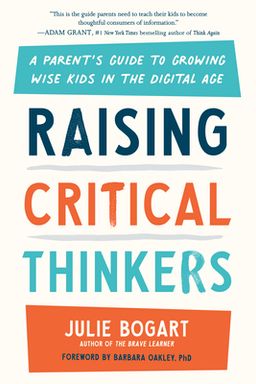
Raising Critical Thinkers cover

Raising Critical Thinkers

by Julie Bogart

Raising Critical Thinkers provides parents with science-backed strategies to cultivate independent, empathetic minds in their children. Through personal stories and engaging exercises, Julie Bogart guides families in navigating information overload and fostering wise, caring individuals in today''s digital age.

Critical Thinking as Self-Aware Living

How can you teach your children—and yourself—to think clearly in a world designed for reaction? Julie Bogart’s Raising Critical Thinkers proposes that true critical thinking begins not in argument but in awareness. You don’t start with pointing out others’ biases; you start with noticing your own. Bogart’s philosophy pulls together psychology, neuroscience, and pedagogy to reframe thinking as a moral and embodied act: noticing what you feel, what you assume, and what you care about before you claim certainty.

The Inward Turn: Thinking Starts With You

Bogart introduces the radical first step of critical thought—the “academic selfie.” Before analyzing any source, take inward inventory: what do you hope is true? What loyalties and emotional signals might shape your reading? Neuroscience agrees with her premise. Barbara Oakley’s foreword notes research showing subconscious patterning that masquerades as objectivity. When you name your reactions before judging, you slow down the automatic films running in your mind—the silent, half-remembered images that bias your conclusions. The goal is not neutrality but awareness: being able to say, “I feel defensive; let’s see why.”

From Facts to Interpretation

Bogart draws a crucial distinction between fact, interpretation, and evidence. Facts are atoms of reality; interpretations are the stories built around them; evidence links the two. Whether studying Hiroshima or a social media debate, you learn to separate raw data from opinion—that separation is the spine of rational inquiry. Her “Fact Strainer” activity teaches you and children to isolate facts from commentary and to notice which facts are emphasized or omitted across sources. You practice intimacy over certainty: know the complexity behind a story rather than treat a single account as complete truth.

The Outer Turn: Seeing Beyond Self

Once you’ve faced your own bias, you broaden attention through Bogart’s observation model, N2I2—Notice, Name, Identify, Interpret. Keen observation breaks stereotype shorthand. When Bogart’s youthful image of “gray communist Berlin” was shattered by sunlight at Checkpoint Charlie, she saw how language manufactures visual bias. By teaching kids to trace those mental films—for instance, listing images that arise when hearing words like “expert” or “immigrant”—you make prejudice visible and thus revisable. Observing carefully is both cognitive and moral discipline.

Education That Rekindles Curiosity

Critical thinking thrives in inquiry, not rote learning. Bogart adopts Paulo Freire’s idea of problem-posing education: instead of depositing information (“banking model”), provoke the itch of curiosity. Children’s wonder tends to shrink under test-driven schooling, but can recover when questions lead. Through play, word experiments, and failure-friendly challenges, learners discover that curiosity—not correctness—builds resilience and better understanding. (Like Dewey, she treats confusion as the birthplace of cognition.)

Attention, Experience, and Encounter

The second half of the book shifts to practice: sustained attention, embodied experience, and transformative encounters. Deep reading rebuilds the patience destroyed by the attention economy (as Maryanne Wolf and Nicholas Carr warn). When you mute notifications, read in print, and narrate before judging, you train the fusion of empathy and understanding known as “deep literacy.” Then, Bogart broadens learning to experience—direct (hands-on), indirect (mediated through museums or documentaries), and imaginative (literature, role play). Each kind embeds insight into durable memory. And sometimes, experience erupts into encounter: overwhelming events that overturn assumptions. You learn through disequilibrium—the shock of the Rankin House visit or facing cultural chaos in Moroccan taxi lines. Encounter invites courage: tolerating discomfort long enough to learn what your reaction hides.

Identity and Responsibility

Bogart closes with the social frame of thinking: identity, caring, and courage. Using thinkers like Pierre Bourdieu and Peggy McIntosh, she shows that worldview is invisible software—habitual expectations about normality. Teaching kids to write “I Am From” poems surfaces these inherited filters and empowers reflection. Caring connects knowledge with ethical action: when you care, you verify through methods like CACAO and lateral reading. Playful perseverance in games and serious research share a principle—voluntary effort toward truth. Finally, courage makes change possible. Bogart cites Peter Elbow’s “believing game” to balance skepticism with empathy; it’s the emotional skill of learning from those you disagree with and revising when evidence demands it.

Core message

Critical thinking is lived awareness—the disciplined habit of noticing self, separating fact from story, observing well, engaging curiosity, and acting with caring courage. You don’t raise skeptics; you raise learners who see their own minds clearly and revise them generously.

Across its pages, Bogart integrates insight from psychology (Kahneman’s bias traps), philosophy (Gadamer’s interpretation theory), and pedagogy (Freire’s anti-rote learning) into a family‑friendly training manual for discernment. Critical thinking, she insists, is not an academic trick—it’s how you live awake, relationally, and responsibly in a confusing world.


Seeing and Naming Bias

Bogart’s first actionable lesson is self‑aware thinking: you start by seeing how your own body and memories twist perception. This is the psychological ground zero of honest reasoning. From Aunt June misreading a love letter to the wolf’s unreliable narration in The True Story of the 3 Little Pigs, she shows that people believe what they wish were true. Practicing the “academic selfie” builds emotional distance between the thinker and the thought.

Three daily practices

  • Notice bodily cues—anger, delight, boredom—as diagnostic signals.
  • Pause before verdicts; let judgment incubate.
  • Verbally model self‑awareness for kids: say, “I feel defensive,” and explore why.

Walter Mischel’s marshmallow test and Kahneman’s “mere exposure” effect back her claim: those who delay reaction think better. Bogart converts decades of cognitive research into home routines for reflection. The goal isn’t detachment—it’s clarity before critique.

Compact instruction

Flip the lens: identify what you hope is true, notice bodily reactions, and ask how those reactions shape your reading. Do this before deciding.

Self‑awareness transforms defensiveness into curiosity. Once children learn this pause, they move from emotional reactivity toward genuine analysis—the foundation of moral and intellectual maturity.


Fact, Story, and Evidence

Bogart’s framework for separating fact, interpretation, and evidence gives families a vocabulary for truth-testing. The distinction prevents the common conflation of opinion and data. You and your child learn a ten-word toolkit—fact, interpretation, evidence, perspective, opinion, prejudice, bias, belief, story, worldview. Together they clarify that knowledge is structured, not chaotic.

Why the distinction matters

Treating interpretations as facts fuels miseducation. Textbooks often merge them, as do social feeds. Bogart’s example of Hiroshima illustrates the sensibility: the date and place are facts; judgments of justification are interpretations. Practicing this literacy trains analytical humility—facts are shared, stories differ.

The Fact Strainer exercise

Gather diverse sources, highlight raw data, then compare how each author arranges those atoms. When you notice which facts vanish or repeat, you reveal bias patterns. A child observing these differences learns to ask, “What added evidence supports this?” That habit inoculates against propaganda and uncritical reposting.

Intimacy over certainty

Bogart argues for depth of understanding instead of brittle knowing. Facts live inside stories; intimacy with complexity makes conclusions wiser.

Through systematic fact-checking practices, kids learn not just to detect bias but to appreciate nuance—the heart of adult discernment.


Curiosity over Compliance

Bogart indicts conventional schooling for draining curiosity by rewarding right answers over good questions. Borrowing from Paulo Freire’s critique of the “banking model,” she suggests replacing rote learning with problem-posing education. In this model, learning begins when students encounter a gap—a puzzle that invites exploration.

Why curiosity shrinks

By third grade, children learn that guessing what the test-maker wants outranks wondering why. Bogart’s tree‑measurement case—where a child logically used centimeters for a drawing but lost points—shows how systems punish independent reasoning. Math mnemonics absent of meaning lead to fragile understanding.

Creating the itch to fit

Loewenstein’s curiosity gap supports Bogart’s method: curiosity peaks when learners sense partial knowledge. Teachers should plant that gap and let students explore. Exercises—from Jabberwocky linguistic experiments to math puzzles—train discovery. The teacher becomes guide, not answer‑giver.

The outcome is lifelong learners who equate thinking with exploration rather than submission—kids who prefer understanding over memorization and whose resilience turns confusion into competence.


Seeing Clearly Through Observation

Critical thinking depends on seeing accurately. Bogart’s N2I2 method—Notice, Name, Identify, Interpret—distills the skill of mindful observation. You learn to pause between perception and judgment, to recognize how stored images dictate reaction.

Revealing the “silent films”

Her Berlin anecdote captures it: expecting gloom behind the Iron Curtain, she found sunlight and joy. Real observation dismantles ideological film-strips that language implants. Classroom exercises extend the insight: blindfolded Grab Bags, sensory hunts, or listing images tied to charged words like “immigrant” turn observation into conscious processing.

Training perception

  • For children—sensory exploration and sorting games.
  • For teens—reflective image journaling about social topics.
  • For adults—pause before labeling, trace where your mental image came from.

Observation, in Bogart’s world, is inquiry made visible. When you and your child practice seeing deeply, you turn reflexive opinion into learning that withstands emotional storm and stereotype.


Learning Through Caring and Verification

Bogart insists that caring precedes thinking. You investigate what you love. Quoting Toni Morrison—“What can I do where I am?”—she reframes intellect as empathy in motion. Caring drives persistence; indifference breeds credulity.

Games as models

Through games, kids learn voluntary struggle, iteration, and feedback—the qualities of disciplined inquiry. Noah’s gaming strategy studies echo Bernard Suits’s definition of play: “the voluntary attempt to overcome unnecessary obstacles.” Caring creates grit.

Caring through verification

Caring also becomes responsibility. Use Bogart’s CACAO checklist—Currency, Accuracy, Coverage, Authority, Objectivity—to vet sources. Add Stanford’s lateral reading: leave sites to search context. Include Joel Best’s advice—learn field benchmarks to catch spurious numbers. These checks embody respect for truth.

Family applications

  • For young kids—read author names aloud, note publishers.
  • For preteens—create quote libraries with citations.
  • For teens—research controversies using CACAO plus lateral reading.

Caring links heart and method. When children learn to verify because they care, thinking becomes ethical practice instead of competitive posturing.


Identity Shapes Interpretation

Bogart dedicates a section to identity as the filter of knowledge. Drawing on Pierre Bourdieu’s concept of habitus and Peggy McIntosh’s “invisible knapsack,” she argues that identity silently dictates what feels logical or threatening. The solution: teach students to name those influences.

Making the invisible visible

Through the “I Am From” poem exercise, learners catalogue foods, holidays, and stories—turning community inheritance into observable data. This practice builds interpretive humility: awareness that your views emerge from culture as much as evidence.

Analyzing lenses and filters

Bogart’s two‑by‑two matrix of lenses (individual vs. community) and filters (perception vs. reason) helps students map thinking origins. Are you reasoning from private intuition or communal logic? This grid becomes a diagnostic tool to untangle argument roots.

When identity work joins evidence evaluation, students grow capable of empathy across worldviews—vital preparation for democratic dialogue and media literacy.


Deep Reading and Attention Repair

In the digital age, attention itself becomes a moral choice. Bogart contrasts hyper focus—the scattered, dopamine-driven urgency of screens—with deep attention—the deliberate patience of reading, reflection, and synthesis. You must train the deep mode consciously.

Why deep reading matters

Maryanne Wolf warns that without practice, children lose the circuitry for inference; Nicholas Carr shows that notifications mimic slot‑machine patterns. Bogart turns these alarms into family ritual: phones in baskets, candles lit, physical books chosen, and short timed readings that stretch stamina.

Practices for attention

  • Start with 7–10 minutes of silent reading.
  • Alternate paragraphs aloud to involve sound and patience.
  • Narrate before judging—restate the author’s argument accurately, then respond.

Deep reading revitalizes imagination and empathy. It transforms reactive scrolling into thoughtful presence and teaches learners that wisdom takes time.


Experience, Encounter, and Change

Bogart classifies engagement through three ascending layers: experience, encounter, and transformation. Experience embeds concepts; encounter shatters them; transformation rebuilds thought.

Direct, indirect, imaginative experience

Hands‑on exploration rewires the brain (Dave Eagleman). Whether touching seashells to learn multiplication or visiting the Rankin House to feel history’s cold wind, sensation makes concepts real. When direct experience isn’t possible, indirect modes—films, interviews, experiments—or imaginative ones—stories and role play—fill the gap. The game Never Alone shows how storytelling drives cultural empathy.

Encounter that overturns

Encounters create disequilibrium. They overwhelm certainty, forcing reconstruction. Bogart’s taxi‑stand in Morocco taught tolerance as self‑discipline: enduring discomfort to learn. Classroom encounters—retelling colonization from missing voices—teach civic empathy. (Marcus Mescher calls this a “culture of encounter.”)

Experience grounds learning; encounter expands it. Together they turn theoretical knowledge into embodied wisdom that can survive challenge.


Interpretation and Courage

The culmination of Bogart’s method is interpretive courage—the resolve to read, listen, and if necessary, change your mind. Interpretation, guided by Hans‑Georg Gadamer’s “fusion of horizons,” connects the text’s world with yours. You learn to hear before arguing.

Disciplined interpretation

Using her Task of Interpretation Inventory, you annotate generously, note emotional reactions, contextualize authors, and compare interpretations. Exercises—like analyzing Judy Brady’s “Why I Want a Wife”—show how historical distance alters moral reading. The inventory forms empathy through structure.

Courage to revise

Changing your mind is emotional work, not failure. Bogart invokes Peter Elbow’s “believing game”: enter a claim empathetically before doubting. Families should celebrate revisions aloud. Ask: “What did I give up? What did I gain?” Identifying losses and gains normalizes intellectual flexibility.

Final aim

To raise thinkers who change when truth moves them. Integrity outweighs belonging; insight outweighs winning.

Bogart ends where she began: critical thinking as courage—a lived willingness to question self, revise belief, and act responsibly within community.

Dig Deeper

Get personalized prompts to apply these lessons to your life and deepen your understanding.

Go Deeper

Get the Full Experience

Download Insight Books for AI-powered reflections, quizzes, and more.