
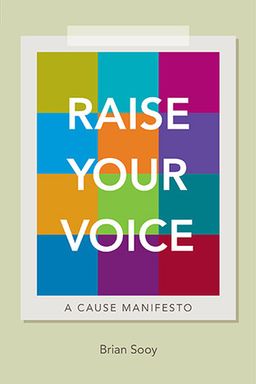
Raise Your Voice cover

Raise Your Voice

by Brian Sooy

Raise Your Voice is an essential guide for nonprofit organizations seeking to amplify their impact through effective communication. By focusing on strategic clarity, engaging storytelling, and mission-driven design, this book provides practical insights to help nonprofits inspire supporters and achieve their mission.

Finding and Raising the Voice of a Meaningful Cause

How does a meaningful cause rise above the noise of a crowded world? Every day, thousands of nonprofits and foundations struggle to be heard and understood—to express their values, mission, and impact in a way that moves hearts and minds. In Raise Your Voice: A Cause Manifesto, Brian Sooy argues that the answer lies in finding a clear, unified, and intentional voice that connects purpose, mission, and audience. He contends that lasting impact and trust come not from marketing tactics or fundraising campaigns alone, but from communication that flows from character, culture, and purpose—what he calls mission-driven design.

Sooy challenges nonprofit leaders to stop thinking and speaking like corporations that sell, and start thinking like causes that inspire. The book isn’t a ‘how-to manual’ on branding or marketing; it’s a manifesto for meaningful communication—one that calls organizations to align their words and design with their deeper reason for existence. To Sooy, design isn’t decoration; it’s the structure by which meaning is communicated. Communication is what you say; design is how you say it. When both reinforce each other, an organization speaks with one voice—and that voice becomes the recognizable sound of its cause.

The Core Argument: Clarity as the Foundation of Trust

At the book’s heart is a deceptively simple idea: clarity. Sooy explains that most nonprofits confuse their audience not because they lack passion, but because they lack precision. They may know their mission but can’t communicate why it matters. They may fill their websites and brochures with stories but fail to connect those stories to their audience’s values. Clarity, for Sooy, is the bridge between purpose and perception. It allows organizations to speak from the heart (emotion) and to the mind (rationale), creating both trust and inspiration—the combination necessary for true belief.

This clarity is discovered through reflective questions: What is your cause? Why do you exist? What difference do you make? Who do you serve? The answers define not just your mission but your “voice”—a unique combination of tone, imagery, and behavior that tells others what you stand for. Once that voice is found, it must be consistent across every “touch point,” from a tweet to a donor letter to the way volunteers are greeted at the door. Every such interaction, Sooy insists, is an opportunity to build or erode trust. In his words, “Design creates relationships. Culture creates ambassadors.”

Beyond Marketing: The Call to Mission-Driven Design

Unlike conventional marketing books that focus on conversion metrics or visibility, Sooy’s concept of mission-driven design is almost philosophical. Borrowing from design thinking (popularized by IDEO), he invites nonprofits to see communication as a human-centered process—where empathy, listening, and storytelling shape every design and message. Mission-driven design starts with purpose (“Why do we exist?”), flows into character (“What do we believe?”), manifests in culture (“How do we behave?”), and ends in voice (“What do our audience hear and see from us?”). Each element translates values into visual and verbal language.

Examples throughout the book—such as the story of the Samuel Szabo Foundation, founded in memory of a child lost to cancer—show how organizations can discover their voice through compassion and authenticity. The foundation’s clarity came not from branding exercises, but from the founders’ reflection on what their cause truly meant: helping families preserve normalcy during cancer treatment. Their mission began to speak to both reason (affordable healthcare support) and emotion (parental empathy). These dual dimensions—logos and pathos—combined to create ethos, or credibility. (Sooy’s trinity mirrors Aristotle’s rhetorical framework of persuasion.)

From Noise to Purpose: One Voice for One Cause

Sooy argues that cause-based organizations often lose focus because they try to be everything to everyone. His solution is radical focus: one cause, one mission, one purpose. Only by narrowing the message can an organization amplify it. This perspective leads to his “Cause Manifesto”—twelve timeless principles like Be Strategic, Be Meaningful, Be Engaging, Be Grateful, and Be Courageous. These are not tactical checklists but cultural commitments. For instance, Be Meaningful urges nonprofits to align values with audience motivations; Be Trustworthy demands transparent communication that reflects authentic character; and Be Courageous calls leaders to challenge board complacency and fund communication as an essential investment, not overhead.

Underlying the Manifesto is a broader moral claim: that communication is an ethical duty. To miscommunicate your purpose is not a harmless mistake—it’s a disservice to your cause, your donors, and the people you serve. As Sooy writes, “Your cause is not a brand.” Reducing it to branding language commodifies human need. Hunger, cancer, education, or justice are not products—they are calls to empathy. Therefore, a nonprofit’s task isn’t to market a brand, but to give voice to a mission that already exists in the hearts of its supporters.

Why This Matters Now

In a time when social media amplifies noise and organizations compete for attention, Sooy’s call for purpose-driven clarity feels prophetic. His framework resonates beyond nonprofits—it’s equally relevant for startups, churches, schools, and social enterprises. Like Simon Sinek’s Start with Why, Sooy reminds us that purpose is the strongest differentiator in a crowded world. Organizations that communicate clearly not only attract supporters—they create believers who give, serve, and advocate sacrificially.

By the end of Raise Your Voice, you understand that effective communication is not a skill—it’s a reflection of character. Every story you tell, every design you choose, every word you use is a declaration of who you are and what you value. Raising your voice, then, isn’t about being louder. It’s about being more truthful, intentional, and courageous in speaking the language of the heart.


Clarity: The Cornerstone of Communication

Sooy insists that clarity is the lifeblood of every cause. Without it, your message becomes background noise, and even the most compelling mission loses power. In his consulting experience with nonprofits, he discovered that many leaders understand their objectives but struggle to articulate them in ways that resonate beyond internal circles. Clarity is what transforms internal conviction into external credibility.

Purpose + Mission = Direction

Clarity starts with purpose—the organization’s ‘why.’ From there, mission defines the ‘what’ and vision defines the ‘where we’re going.’ Goals and strategies are simply the ‘how.’ When these layers are misaligned, confusion follows. Sooy emphasizes that your internal clarity must mirror your audience’s perception. If the board, staff, and donors can’t explain your cause in one sentence, communication has failed. This failure isn’t cosmetic—it fractures trust.

He recounts the story of a philanthropic couple who launched a foundation after losing their young son to cancer. At first, they were overwhelmed by paperwork and ideas but lacked a narrative that united their efforts. Only when they clarified how their mission (supporting hospital families) connected to their deeper cause (making childhood illness less isolating) did their organization gain strength and attract passionate supporters. Their clarity turned grief into a legacy of hope.

The Practical Side of Clarity

To achieve clarity, Sooy outlines a simple but powerful exercise: complete this sentence for your organization—“We are an organization that speaks on behalf of [cause]. We exist to serve [higher purpose], and we will make a difference through [mission]. The outcome will be [vision].” This formula bridges internal understanding and external messaging. It also centers communication on outcomes—the results your audience can see and believe in.

Clarity, in Sooy’s framework, does more than improve wording; it transforms culture. Staff become ambassadors who own the message. Donors sense integrity. Volunteers feel meaning. When clarity infuses all touch points—newsletters, events, websites—it becomes the organization’s true voice. As in design, simplicity is not the absence of detail but the presence of purpose.


Mission-Driven Design: Beyond Branding

Branding, Sooy argues, has become a noisy and often hollow word. Nonprofits rush to ‘rebrand’ when struggling but forget that no logo or tagline can compensate for an unclear mission. Instead, he proposes mission-driven design—a design philosophy that connects aesthetics, storytelling, and strategy directly to an organization’s purpose. Whereas branding seeks visibility, mission-driven design seeks meaningful engagement.

The Four Pillars: Purpose, Character, Culture, and Voice

Mission-driven design rests on four interdependent pillars: purpose (why you exist), character (your values and beliefs), culture (how you behave day to day), and voice (how you communicate through words and visuals). Each pillar must reinforce the others. For instance, a food bank’s warm color palette and photography of volunteers serving families visually express compassion, reinforcing its character and culture. If tone or imagery contradicted that warmth—say, through cold corporate language—the authenticity would erode.

Sooy draws a clear line between communication (what you share) and design (how you share it). Together, they form your unique organizational voice. Every ‘touch point’—from social media to signage—shapes perception and either stewards or sabotages relationships. Thus, design is not decoration; it is stewardship of meaning.

Why Your Cause Is Not a Brand

Sooy’s most striking provocation is that a cause can never be a brand. Hunger, cancer, or human trafficking are not commodities to be “marketed.” They are moral realities to be confronted. Treating them as brands trivializes suffering and discourages empathy. Organizations must see themselves not as brand owners but as voices speaking on behalf of causes. This reframing shifts focus from competition to compassion.

In practice, that means designing communications that are human-centered, emotional, and rationally grounded. It means telling stories that speak to the heart while demonstrating credibility through data and impact. Ultimately, mission-driven design ensures every interaction with your organization communicates your higher purpose—without ever needing to say the word ‘brand.’


Ambassadors and Believers: Building Culture Through People

Sooy likens a nonprofit to a sports team—its staff, board, volunteers, and supporters are players, coaches, and fans. The most effective teams have believers, not merely participants. Believers sacrifice, advocate, and bring others along. For them, the cause isn’t an external mission but a personal identity. This sense of belonging begins with leadership.

Inspiration Starts at the Top

Leaders and boards must model conviction. Sooy’s story of the small foundation founded after a child’s death illustrates this vividly: the board’s physician and attorney members weren’t symbols; they were grieving believers whose personal experiences connected directly to the mission. When leaders embody the cause authentically, inspiration flows naturally through the organization. When they don’t, apathy seeps in.

Sooy challenges boards to move beyond governance and become ambassadors. They must not only fund strategy but communicate it consistently. A board that knows its mission but fails to champion it publicly is, in his words, “aware but uninspired.” Leadership clarity, therefore, is cultural oxygen.

Creating Fans, Not Followers

Drawing from his sports analogy, Sooy describes how people become ‘fans’ through identity: they wear the colors, repeat the chants, and feel part of something greater. Similarly, nonprofits must cultivate ambassadors who wear the mission proudly—literally and metaphorically. They become walking embodiments of the cause, extending its voice into their communities. These ambassadors create trust through relationships, not slogans.

To nurture such engagement, organizations must design every interaction—staff meetings, volunteer training, donor events—with purpose. When communication is clear and values are visible, individuals become part of a movement, not merely members of an organization. That is how culture creates continuity.


The Cause Manifesto: Twelve Principles of Purpose

In the second half of the book, Sooy formalizes his philosophy into twelve resolutions called the Cause Manifesto. These are not marketing strategies but virtues that guide communication and behavior. They fall into four categories—Strategic, Inspirational, Relational, and Aspirational—and serve as a diagnostic framework for any mission-driven organization seeking clarity.

Strategic Principles

Be Strategic, Be Focused, and Be Meaningful remind leaders that clarity begins with focus. Strategy provides direction, but purpose gives it meaning. Sooy explains that strategy is not an option—it’s a requirement of mission. Without it, “mission has no focus; without focus, there is no clarity.” He offers simple frameworks for translating strategy into actionable steps, ensuring every communication aligns with long-term goals.

Inspirational Principles

These principles—Be Insightful, Be Inspiring, Be Engaging—shift focus from talking at your audience to listening to them. Being insightful means embracing data as a storyteller, not a statistician. Being inspiring means using stories that combine logic (logos) and heart (pathos). Being engaging means inviting dialogue, curiosity, and shared ownership of the mission.

Relational Principles

Be Social, Be Grateful, and Be Trustworthy form the cultural core of the Manifesto. Trust, Sooy writes, can’t be bought—it’s earned through transparency and gratitude. Every thank-you letter, volunteer experience, and social interaction is an act of relationship building. When gratitude and truthfulness become habits, trust and generosity follow.

Aspirational Principles

The final trio—Be Positive, Be Powerful, and Be Courageous—are calls to emotional leadership. Positivity fuels engagement; power expresses confidence in the cause; courage drives innovation and resilience. The courageous organization dares to challenge old habits (‘We’ve always done it this way’) and instead adapts to better serve its audience. These final values are personal as much as organizational—they demand boldness from every voice that speaks for a cause.


Gratitude and Trust: The Ethics of Relationship

Few books on nonprofit communication treat gratitude as a strategic discipline, but Sooy does. He contrasts impersonal year-end receipts with heartfelt thank-you notes, describing one church that transformed relationships by sending handwritten appreciation for every gift. Gratitude, he writes, is not a transaction—it’s a cultural posture that acknowledges the donor’s trust as the real gift.

The Gift of Trust

Money, time, or volunteering are visible expressions of an invisible trust. To ignore a gift or automate thanks is to devalue that trust. Sooy shares a personal story: after his design firm donated tens of thousands of dollars in pro bono work, the nonprofit responded with a form letter. The result was painful—his loyalty evaporated. In contrast, another organization’s new director personally called and thanked him by name, rekindling belief. The lesson: gratitude builds bridges, while indifference burns them.

True stewardship, he explains, begins when gratitude becomes habit. Leaders should systematize appreciation as much as they do fundraising: who thanks whom, when, and how. Whether by handwritten note or public acknowledgment, every thank-you reassures supporters that their values are shared and their impact is seen.

Transparency Builds Confidence

Gratitude and trust walk hand in hand. To be trustworthy means aligning words and actions. Transparency—publishing reports, acknowledging challenges, updating donors honestly—demonstrates respect. Boards and executives must remember that every inconsistency between message and behavior erodes credibility. As Sooy notes, “What’s on the label should reflect what’s in the bottle.” When culture, character, and communication align, trust becomes an organic outcome of authenticity.


Courage: Leading with Vision and Conviction

Courage, Sooy concludes, is the ultimate virtue of leadership—the one that makes all others possible. Courage means daring to reimagine communication not as overhead but as mission. It takes courage to challenge the board that resists investing in design or to educate donors who undervalue storytelling. It takes courage to dream beyond survival and envision lasting impact.

Dream Beyond the Horizon

Sooy urges leaders to “dream big dreams and plan for a future reality.” Courageous organizations see beyond the immediate fundraising goal to the transformation they hope to create. They think generationally, not transactionally. Colin Powell’s advice echoes here: leaders inspire people to reach beyond themselves. A courageous organization invites its followers to believe they can change the world—and then equips them to do so.

Action Through Adaptation

Courage isn’t bravado; it’s willingness to adapt. Programs, strategies, visuals—all must evolve as the world changes. Mission-driven design helps by providing a compass; courage provides the motion. Fear of failure is the enemy of evolution, yet even failed experiments yield insight. As Sooy remarks, “Your communications have the potential to succeed spectacularly or fail spectacularly—never strive to fall in between.”

To raise your voice well, therefore, is an act of faith. It’s believing your cause matters enough to speak bravely, to clarify relentlessly, and to communicate consistently. In a world of noise, courage is not being the loudest—it is being the most authentic.

Dig Deeper

Get personalized prompts to apply these lessons to your life and deepen your understanding.

Go Deeper

Get the Full Experience

Download Insight Books for AI-powered reflections, quizzes, and more.