
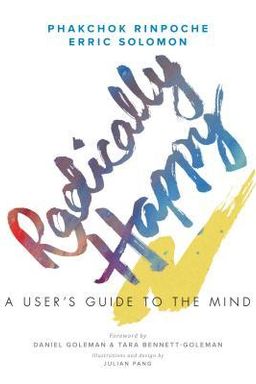
Radically Happy cover

Radically Happy

by Erric Solomon

Radically Happy blends the wisdom of a Tibetan Buddhist monk with modern insights to offer a practical guide for achieving lasting happiness. Through meditation exercises and scientific understanding, this book provides tools for cultivating mindfulness, gratitude, and interconnectedness, leading to a genuine sense of well-being.

Radical Happiness: Mastering Mind, Heart, and Dignity

What if happiness—real, sustainable happiness—has less to do with what happens to you and more to do with how you relate to your mind and the world around you? In Radically Happy: A User’s Guide to the Mind, Buddhist teacher Phakchok Rinpoche and Silicon Valley veteran Erric Solomon join forces to bridge ancient contemplative wisdom with modern psychology and neuroscience. Their central argument is simple yet revolutionary: lasting fulfillment doesn’t depend on external circumstances, but on learning to master the mind, open the heart, and live with dignity.

The authors divide happiness into three interlocking layers—Basic Happiness (mindful presence), Interconnected Happiness (warmhearted relationships), and Radical Happiness (dignified awareness that unites both). They guide you through a progression of reflection, meditation, and practical exercises designed to move you from reactive, self-centered striving to awake participation in the life that is already unfolding. Their approach invites you not just to chase happiness, but to discover that happiness was always within reach—if only you learn to stop chasing stones like a dog and turn your gaze, like a lion, toward the mind itself.

The Dog and the Lion: A New Metaphor for Awareness

At the heart of the book lies the metaphor of the dog and the lion. Rinpoche’s teacher once advised him: “Stop acting like a dog and behave like a lion.” A dog, when stones are thrown, chases the stones. A lion turns to face the thrower. This vivid image becomes a teaching on attention: most of us chase after our thoughts and emotions (the stones), never questioning their source. Radical happiness arises when we turn inward and look directly at the mind itself (the stone thrower), resting in the awareness that observes everything without being carried away.

This switch from reacting to observing is the pivot from ordinary happiness to radical happiness. Each part of the book builds on this metaphor, helping you transform reactive patterns into mindful, connected, and dignified ways of being. The lion’s dignity—quiet confidence in its nature and strength—becomes a model for how to live fully aware and unshaken by the turbulence of circumstances.

Three Layers of Happiness

1. Basic Happiness comes from mastering your mind. Through practices like breath meditation, “creating space,” and “relaxing the comparing,” you learn that contentment isn’t earned—it’s discovered by being fully present. This layer uses meditative awareness to transform anxiety, dissatisfaction, and distraction.

2. Interconnected Happiness arises when your heart opens to others. By contemplating interdependence and practicing compassion, you experience how your own joy is intertwined with others’ well-being. Chapters like “Relax the Judging” and “Be Attentive” teach that warmth and generosity are not sentimentality—they are the natural expression of understanding reality’s deep interconnection.

3. Radical Happiness is what emerges when mind mastery and heart mastery unite. It is characterized by dignity—a quiet, confident awareness untouched by external fluctuations. In this stage, you learn to “Relax the Clinging” and “Be Aware,” turning attention to the pure knowing quality of mind itself.

Why This Matters in Today’s World

The book’s timing couldn’t be more relevant. In a world of endless comparison, overstimulation, and polarization, the ancient skills of attention and empathy are radical acts. Solomon’s stories from Silicon Valley—like staring blankly at his pool after losing millions—illustrate that success without awareness leads to numbness. Rinpoche’s anecdotes from monastic life mirror the same insight from the opposite end of human experience. Whether on a mountaintop or in a boardroom, both authors arrive at the same conclusion: contentment arises not from control but from conscious presence.

Their approach aligns with findings in neuroscience (as seen in Daniel Goleman’s foreword)—meditation builds mental flexibility, compassion, and resilience. But the book’s deepest insight goes beyond science: happiness is an intrinsic quality of awareness itself. You don’t manufacture it; you reveal it by letting go of comparison, judgment, and grasping.

A User’s Guide to the Mind

More than a philosophical treatise, Radically Happy is a user’s guide, blending Tibetan Buddhist training with scientific nuance and everyday relevance. Each section offers reflective exercises—like “Creating Space,” “Experiencing and Sharing Joy,” and “Using Thoughts and Emotions as an Object”—each designed to be as natural as breathing, applicable in a New York office or a Kathmandu monastery.

In sum, this is not a book about escaping life’s challenges but about meeting them with awareness and compassion. It invites you to experiment with your own mind, to bridge the inner and outer worlds, and to cultivate the unshakable dignity of the lion within you. If you can integrate presence with compassion, you will find that what the authors call “radical happiness” isn’t extraordinary; it’s your mind’s most natural state.


Basic Happiness: Mastering the Mind

The first step toward radical happiness is cultivating basic happiness—learning to master your mind through awareness. Phakchok Rinpoche explains that our restless minds constantly chase thoughts, much like dogs chasing stones. Meditation, he says, teaches us to stop running, sit down, and look at the thrower—the mind itself.

Understanding the Mind

Rinpoche and Solomon demonstrate this through relatable stories. Erric, for instance, describes his road rage on Silicon Valley highways—exploding at reckless drivers until he realized a friend in the same situation remained calm. Nothing external had changed; only the interpretation in his mind differed. The same happening produced two radically different realities. As Rinpoche notes, “While circumstances contribute to what we experience, it is the mind that determines the quality of our experience.”

The authors invite you to observe your thoughts without immediately labeling them as good or bad. Through the Getting to Know Your Mind exercise, you sit still and simply notice each thought arise and dissolve. Doing so exposes how “I like/I don’t like” commentary dominates daily life and keeps you perpetually distracted from the present moment.

Creating Space and Mindful Presence

When you’re stressed, your mind feels like a cramped 10-by-10 room—any problem fills the space. The “Creating Space” meditation transforms it into a vast sky. You visualize an infinite blue expanse enveloping you in all directions. This imagery interrupts mental looping, giving problems room to breathe. Phakchok’s anecdote about calming down before a talk titled “The Key to Happiness” shows the transformative power of such simple spaciousness: anger becomes clarity when viewed within wide awareness.

This isn’t escapism. As Rinpoche emphasizes, creating space is not creating distance. You’re not pushing your problems away—you’re widening the frame so they no longer define you. Neuroscientific research (e.g., Daniel Goleman’s commentary) confirms this: spacious awareness downregulates emotional reactivity and opens access to creative insight, just as great thinkers like Newton and Archimedes discovered breakthroughs when relaxed.

Always React the Same Way

Once you’ve built spaciousness, the next practice is consistency—reacting to every thought the same way. During meditation, you rest attention on a simple object—like the breath or a flower. Whether joy or irritation appears, you treat each equally: acknowledge it and gently return to your focus. Over time, this trains the mind to remain stable amid changing internal weather.

Erric’s “monkey mind” metaphor makes this vivid. Like a restless monkey, your thoughts dart from topic to topic; meditation gives that monkey a banana—a job to stay focused on. Over time, this “mental gym” builds what the authors call pliability: the ability to direct attention deliberately. The goal is not absence of thought but non-distraction.

Relaxing Comparison and Enjoyment

Comparison, the authors warn, is “the greatest thief of contentment.” In “Relax the Comparing,” Solomon’s grandfather’s refugee story reveals how gratitude, not comparison, breeds resilience. Even after pogroms, he was thankful because hardship led him to family and safety in America. Similarly, contemporary Silicon Valley tales show how envy—even over IPO riches—creates stress and dissatisfaction. Gratitude practice reverses that spiral.

When you stop evaluating every experience, you rediscover joy in simplicity. The exercises “Happy with Who I Am” and “Appreciating Circumstances” train you to savor ordinary blessings without contrast. As the authors conclude, basic happiness is not a high—it’s the calm contentment of being here, now, without needing conditions to change.


Interconnected Happiness: Mastering the Heart

Once you’ve cultivated inner stability, the next stage is to expand outward: interconnected happiness. This arises when you experience yourself as deeply linked to others and to life itself. Solomon and Rinpoche argue that many of our daily miseries stem from living out of harmony with that reality of interdependence. We think we are separate, atomic selves—but everything about us, from our values to our gut microbiome, depends on countless others.

Seeing Interdependence Everywhere

Erric’s childhood thought experiment about time travel becoming impossible without disrupting his grandparents’ meeting illustrates that every event depends on countless causes and conditions. Our “individual” decisions, like buying a bottle of wine, rely on a vast web—farmers, builders, evolution, transportation, and culture. Recognizing this, you realize free will isn’t isolation; it’s participation in a cosmic network. The authors echo both Buddhist philosophy and systems theory in suggesting that real choice comes not from ego-driven control but from mindful alignment with reality.

Warmhearted Relationships

Building on this insight, Chapter 8, “Relax the Judging,” explores our tendency to make snap judgments in milliseconds. These biases—our “mental Maginot Lines”—block authentic connection. Experiments show how quickly we decide if we like someone, then cling to that opinion. The solution isn’t to suppress judgment but to relax it by cultivating loving-kindness and compassion. Stories of inmates practicing “sharing joy with enemies” reveal how warmth can dissolve even deep resentment. Bill, a prisoner learning to send joy to the partner who betrayed him, eventually shed years of bitterness, freeing himself from an inner prison even before parole.

Contemplating Kindness and Equality

Rinpoche offers moving exercises for seeing others as “another you.” In “Considering the Equality of All,” he reflects on his grandfather, Tulku Urgyen, whose empathy transcended hierarchy—treating villagers and monks alike with intuitive compassion. Through practices like “Resting in the Light of Kindness,” you visualize the infinite chain of kindness that sustains life—parents, teachers, strangers, even the plants producing oxygen. This contemplation replaces cynicism with reverence.

Living with Attentive Compassion

“Be Attentive,” the third key in this section, brings warmheartedness into everyday action. The authors distill four joyful supports—generosity, patience, consistency, and commitment—as pillars of relational happiness. Each transforms ordinary habits: Generosity means giving time and respect, not just resources; patience means offering spaciousness rather than suppressed irritation; consistency means practicing kindness daily; commitment means honestly acknowledging and improving your faults. These supports, complemented by practices like “Warmhearted Mini-Breaks,” turn interactions into opportunities for presence and care.

Interconnected happiness, then, is not self-sacrifice—it’s sustainable joy born of understanding that others’ well-being is inseparable from your own. When you live in this way, the walls between self and other grow transparent, and life begins to flow again with meaning.


The Power of Dignity: Mastering Confidence

After mastering mind and heart, the third stage—radical happiness—comes through dignity. Dignity is not pride or ego; it’s the calm, unshakable confidence that arises when you know your own strength without comparison. Phakchok Rinpoche likens it to a lion’s quiet assurance: a lion doesn’t need to roar to prove its power. It just knows.

This dignity emerges when basic and interconnected happiness are practiced together, like two wings of a bird. Mindful awareness stabilizes compassion, and compassion keeps awareness warm and human. Together, they lift us into radical happiness—a state beyond the conditional highs of ordinary pleasure or success.

Understanding Dignity Through Confidence

In Chapter 10, “Cultivating Dignity,” Erric revisits his teacher’s wake-up call during his financial crisis: “Right now everything is fine. Don’t think too much about yourself.” His teacher’s brevity expressed deep confidence in the methods themselves. When you internalize such confidence—not blind faith but experiential trust—practice transforms from striving into being. Rinpoche compares this to a lion knowing its strength. Unlike pride, dignity is humble stability: it doesn’t depend on praise or results.

Overcoming Subtle Clinging

Even meditation and compassion can foster subtle attachments: clinging to peaceful states or craving recognition for good deeds. Dignity dissolves these refined traps. When you practice the “two wings” together, clinging weakens naturally because awareness stays alert while compassion keeps it grounded. Free of dependence on outcomes, your happiness becomes unconditional.

The Bird with Two Wings

The authors’ metaphor of the bird with two wings captures this harmony beautifully: one wing is awareness, the other warmheartedness. To fly, you need both. Overdevelop meditation and you risk detachment; overemphasize compassion and you burn out or crave validation. But balanced together, they elevate life into graceful flight—where you act skillfully without anxiety about the result.

Practicing dignity means recognizing that the seed of happiness is already present within your mind. As you unite awareness with compassion, external circumstances lose their power to dictate your self-worth. You become, in Rinpoche’s phrase, “like a lion who knows his own strength.”


Relax the Clinging: Freedom from Grasping

In the later chapters, the authors turn to one of Buddhism’s most subtle psychological insights: clinging is the root of suffering, even when what you cling to seems positive. To move toward radical happiness, you must learn to recognize and relax this habit—not by rejecting desire or thought but by looking directly at them.

Using Thoughts and Emotions as a Support

Phakchok’s guidance from his teacher offers a practical method: observe anger or fear as it arises without getting swept away. “Don’t reject it, but don’t dwell on it either. Just turn your attention to look gently at the thought.” When you look directly, he says, it dissolves—revealing a brief space of awareness between thoughts. Meditation becomes about resting in that open space rather than suppressing emotion.

At first, the gap is fleeting, but with repetition it expands. In that gap you discover freedom—the awareness that thoughts are like waves on water: they rise, shimmer, and fall, leaving no trace. Using emotions as practice material transforms once-toxic reactions into gateways to presence.

Watching the River of Mind

Another metaphor offered is “watching the river.” Instead of fixating on each thought, you rest awareness on the river’s flow. Thoughts continue, but you no longer tumble into them. The authors caution: don’t wait obsessively for the “space between thoughts,” or you’ll fill it with craving. Relaxed curiosity, not control, reveals the mind’s natural clarity.

This shift marks the essence of non-grasping meditation. As Gampopa, a classic Tibetan master quoted here, said, “If you have a hundred thoughts pass through your mind in the space of a minute, it means you have a hundred supports for meditation.” Each distraction becomes a stepping stone toward liberation rather than an obstacle.


Awareness: The Heart of Radical Happiness

The culmination of the book arrives in “Be Aware,” where awareness itself becomes both method and goal. Here, meditation transcends any object—breath, thoughts, light—to rest directly in awareness noticing itself. This is “lion-level practice”: instead of chasing thoughts or even the gap between them, you rest as the knowing that sees both.

Awareness of Awareness

In Awareness Meditation, you drop all supports and allow awareness to be aware of awareness. The mind becomes like the sky—unmoved by clouds. This awareness, Rinpoche explains, is always stainless; even anger or confusion can’t taint it, just as dirt never stains open space. The realization that your mind’s essence is untouchable by circumstances is the defining insight of radical happiness.

Practicing Dignity Daily

The daily plan for radical happiness synthesizes all earlier methods: morning meditation combining awareness and compassion, mindful mini-breaks throughout the day, and reflective gratitude at night. Together they habituate awareness until it permeates ordinary life. Whether you’re waking, emailing, or falling asleep, you practice “Stop, Drop, and Be Aware.”

Rinpoche compares this to recognizing writing on water—thoughts appear and dissolve instantly. When you know this directly, dignity becomes effortless confidence in awareness itself. You are free in the midst of activity, resting in the luminous simplicity that was always present.

In the end, Radically Happy proposes not a mystical state but a reclaiming of your natural clarity. By living with mindful awareness and warmhearted compassion, you realize that nothing needs to be added or removed. Radical happiness is simply being awake, dignified, and kind—moment after moment, breath after breath.

Dig Deeper

Get personalized prompts to apply these lessons to your life and deepen your understanding.

Go Deeper

Get the Full Experience

Download Insight Books for AI-powered reflections, quizzes, and more.