
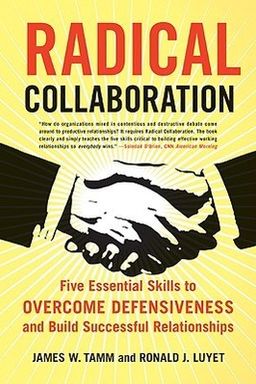
Radical Collaboration cover

Radical Collaboration

by James W Tamm and Ronald J Luyet

Radical Collaboration offers transformative strategies to build effective and high-functioning relationships and manage conflicts. By mastering five essential skills, you can become a better collaborator and enhance team dynamics, ensuring productivity and success in both personal and professional spheres.

Building Collaboration from the Inside Out

How can people move from hidden defensiveness to genuine collaboration? This book argues that effective collaboration is not achieved through organizational structures or new technology, but through personal transformation. You create lasting partnership from the inside out, by bringing five behavioral skills—Collaborative Intention, Openness, Self-Accountability, Self-Awareness, and Problem Solving—into everyday interactions. The authors show that collaboration is a learnable, measurable, and repeatable practice grounded in psychology and organizational research.

The Central Premise

The book’s thesis is that collaboration fails not because people lack desire, but because they lack internal tools to manage defensiveness and distrust. If you don’t cultivate certain personal competencies, systems for cooperation will collapse when stress rises. The five skills taught here train both your internal state (attitude, emotional regulation, self-awareness) and your external behaviors (listening, speaking openly, negotiating with interests rather than positions). In doing so, they transform teamwork into what the authors call “the Green Zone” — a space where people stay calm, creative, and committed to mutual success.

Why the Green Zone Matters

The Red, Pink, and Green Zone model anchors the emotional foundation of collaboration. You operate from one of three zones: Red (aggressive defensiveness), Pink (passive-aggressive avoidance), or Green (open and constructive). In the Green Zone, trust rises and learning accelerates. Neuroscience supports this: when the brain’s threat circuits calm down, the prefrontal cortex—the part responsible for creativity and empathy—comes back online. Social psychologist Daniel Goleman calls this avoiding “emotional hijacking.”

Organizations benefit profoundly from this shift. Kotter and Heskett’s research found adaptive cultures outperform rigid ones, and high-trust companies outperform low-trust peers by 186 percent in shareholder returns. The Green Zone culture therefore isn’t just nicer—it’s smarter and more profitable.

Learning to Manage Defensiveness

Defensiveness is the main threat to collaboration. It arises when old fears—of being insignificant, incompetent, or unlikable—are triggered. The authors introduce an “Early Warning System” that helps you name your defensive patterns and practice a recovery plan. You identify your warning signs (sarcasm, flooding with information, withdrawal), pause to breathe, reframe negative self-talk, identify the underlying fear, and take deliberate, calming action. This six-step process interrupts automatic reactivity and lets you re-engage from the Green Zone.

Unhooking from Triggers

When something hits a “hot button,” your reaction may be far stronger than the situation requires. The three-step unhooking method—describe facts and feelings, notice your story, explore your fear—lets you regain agency. A case example: Jane exploded at a colleague’s lack of attention but later realized she was reacting to old insecurities about competence. Once she recognized this, she could address the issue calmly instead of attacking. This practice helps you stop replaying old wounds and instead respond from the present moment.

Personal Mastery and Openness

Self-awareness is deepened through FIRO theory (Fundamental Interpersonal Relations Orientation), which measures preferences for inclusion, control, and openness. Understanding your own relational style helps you flex to meet others’ needs. Rigidity—being unable to flex—is the enemy of compatibility. The exercises to counter rigidity include parental-pattern reflection, mental rehearsal, body-mind coherence work, and tracking distortions in thinking. These tools rewrite old conditioning so that your current behavior becomes more deliberate.

Openness, in turn, is the outward manifestation of inner mastery. It means telling and hearing the truth in ways that build safety. Using tools like First Truth First (saying your deeper, vulnerable truth) and practicing authentic listening, you make it safe for others to be candid. Google’s Project Aristotle confirms that psychological safety is the single biggest predictor of team success—a direct consequence of openness and empathetic listening.

Practicing Interest-Based Problem Solving

The second half of the book applies these personal practices to concrete negotiation strategies. You learn to begin by agreeing on process and inclusion, then to define the problem jointly, uncover underlying interests, develop contingencies (BATNAs), invent options, and close with clarity. Unlike positional bargaining, this approach seeks mutual gain while preserving relationships. The research evidence—67 percent reductions in conflict across public agencies and up to 85 percent in the worst cases—shows how dramatically this model shifts behavior.

The Promise of Long-Term Green Zone Cultures

Once collaboration becomes habitual, defensive spirals shorten, trust becomes resilient, and performance measurably improves. SEB Bank saw measurable shifts in defensiveness and trust levels after adopting the model. In short, the book teaches a complete developmental arc: understanding threat patterns, managing reactions, cultivating openness, listening deeply, and negotiating with empathy. You learn that relationships become productive not by accident, but through deliberate, disciplined behavioral change.

Core Message

True collaboration begins when you manage your inner state as deliberately as your negotiation strategy. When you can stay centered in the Green Zone, every interaction becomes an opportunity to turn conflict into progress.

By mastering these skills, you don’t just get better outcomes; you build the invisible trust tissue that keeps teams, partnerships, and entire organizations healthy and innovative for the long run.


Reading and Regulating Your Zone

The Red–Pink–Green Zone framework gives you a visual and emotional map for navigating defensiveness. You live from one of these zones, and your first task is recognizing which one you’re in before reacting. Red is overt aggression and blame, Pink is hidden resistance disguised as politeness, and Green is the state of openness and curiosity. The most dangerous zone may be Pink, because its sabotage works quietly under a veneer of harmony.

What the Zones Reveal

In a Red Zone, conversations become debates over who’s right; in a Pink Zone, important issues never surface. Only in the Green Zone can you learn and collaborate. Biology explains this: stress hormones like cortisol shut down the brain’s creative functions. Deborah Tannen’s research on “argument culture” reinforces that Western workplaces often normalize Red Zone behavior, assuming contention equals competence. Learning to stay in Green means deliberately switching from threat to curiosity.

How to Spot Your Zone

Use inner and outer signals: your self-talk (“I must win”), your body (shallow breathing, tension), and behavior (sarcasm or withdrawal). These are early-warning signs that you’ve slipped out of Green. The goal is not to avoid conflict but to notice defensiveness early and recover quickly.

Insight

To build a culture of trust, name the zone you’re in and invite others to reflect on theirs. Simply saying “I think we’ve gone a bit Pink here” can disarm hostility and redirect focus toward collaboration.

Choosing Green Zone presence increases collective performance, creativity, and retention. It’s the foundation for all later skills: self-awareness, openness, and effective problem-solving.


Transforming Defensiveness into Learning

Defensiveness hides your best thinking. It limits creativity, narrows perception, and turns dialogue into combat. The key insight is that defensiveness always originates in fear—fear of being unworthy, incompetent, or unloved. These fears once protected you, but in adult collaboration they sabotage connection. The authors propose a clear, actionable model to detect defensiveness early and steer back toward choice.

Step 1: Name Your Defenses

List your typical signs—sarcasm, overexplaining, stonewalling—and treat them as warning lights, not flaws. The moment one flashes, pause. This awareness disrupts automatic limbic reactions and gives your rational brain a chance to re-enter.

Step 2: Apply a Recovery Plan

The six-step plan advises: take responsibility, breathe, ground yourself, name your emotion, challenge inner scripts, act intentionally, and acknowledge progress. The Karen example—learning to stop “flooding” her boss with data—shows that defensiveness can be retrained through repetition, not reprimand.

Step 3: Unhook Hot Buttons

When you explode out of proportion, a deeper wound has been touched. The unhooking process—describe facts, notice story, explore fear—helps you stop externalizing pain. Once you realize the trigger is internal, not caused by others, you regain freedom to respond constructively.

Eventually, defensiveness becomes an opportunity for insight: a doorway to discovering your hidden fears. Each episode, if used well, teaches you where you can grow.


The Practice of Openness and Listening

Openness is truth-telling that builds psychological safety. It’s risky but essential. People trust those who match words with genuine signals—tone, facial expression, and body language. The authors argue that openness turns conflict into clarity and prevents misunderstanding. Research from Amy Edmondson and Google’s Project Aristotle proves that psychological safety predicts performance more than skill, IQ, or experience.

How to Practice Openness

Use four tools: First Truth First (speak your underlying truth early), Honest Signals (align tone and body with intent), What I May Choose to Share (decide which elements to reveal), and Unhooking (turn triggers into disclosures rather than attacks). When an executive admits, “I’m private but will stretch to share more,” the statement builds credibility because it is congruent and vulnerable.

Listening as a Partnered Skill

True listening is active creation, not silence. Your responsibilities are to create safety and help the speaker feel understood. Use encouragers, summarize content and emotion, and avoid mind-reading or premature advice. Poor listening destroys trust faster than dishonesty because it signals disinterest. Practiced daily, deep listening raises information quality, emotional coherence, and mutual respect.

Remember

Honesty without empathy is brutality; listening without curiosity is performance. Both must work together to produce safety and progress.

By combining open disclosure and genuine listening, you cultivate environments where people risk truth without fear of ridicule—a prerequisite for innovation and lasting relationships.


Knowing Yourself Through FIRO

Collaboration begins with self-understanding. FIRO (Fundamental Interpersonal Relations Orientation) gives you a framework for how you relate to others through three dimensions: inclusion, control, and openness. Each is measured in what you express and what you want from others. Differences in preferences aren’t problems; rigidity about them is. This chapter teaches you to flex and reinterpret discomfort as data.

Mapping Your Profile

If you want high interaction but your teammate prefers solitude, you experience friction. By discussing these differences, you prevent misattribution (“he’s ignoring me”) and build respect. Monica and Hank’s case—one private, one highly social—shows how self-disclosure of preferences dissolves tension.

Addressing Rigidity and Its Fears

Each FIRO area links to a fear: being ignored (inclusion), humiliated (control), or rejected (openness). These fears can drive paradoxes—either over-control or total withdrawal. Through awareness and exercises (rewriting parental patterns, mental rehearsal, body-mind realignment), you rewire old scripts. Flexibility becomes the defining mark of maturity.

When you train flexibility, you make space for others to be different without threat. That is the psychological essence of collaboration: firm identity plus adaptable behavior.


Practicing Green Zone Leadership

Green Zone presence isn’t just a mindset—it’s leadership in action. Leaders who act collaboratively set emotional tone and behavioral boundaries. Every meeting or negotiation reflects your internal stance. Research by Amir Erez shows that small acts of incivility reduce creativity by 25–30 percent, illustrating how fragile group dynamics are under threat. Green Zone leaders consciously design environments that sustain trust under pressure.

Ten Strategies to Sustain Collaboration

  • Go first: Model cooperation before expecting it.
  • State your intent: Make collaboration explicit, not assumed.
  • Keep talking: Continuous dialogue prevents stalemate.
  • Forgive quickly: Anchor the relationship in progress, not punishment.
  • Agree on conflict systems: Predesign structures before crises occur.

Each of these practices is supported by real cases—from international impasses like the U.S.–Cuba deadlock to local business relationships improved through persistent dialogue. Choosing not to retaliate, to talk when silence would feel safer, and to codify dispute systems all stabilize the Green Zone culture.

Practical Formula

Ethics + Transparency + Structure = Durable Trust.

As a leader, your challenge is to make ethics and openness procedural, not aspirational. Regular “relationship reviews,” explicit behavioral norms, and tiered consequences for breaches build psychological safety at scale.


Negotiating with Interests, Not Positions

The book’s external skill set culminates in Interest-Based Negotiation, a repeatable six-step process that transforms adversarial bargaining into joint problem solving. The model echoes the philosophy of Fisher and Ury’s Getting to Yes: focus on the underlying “why,” not the surface “what.” By concentrating on interests, you often find better outcomes for both sides.

From Process to Inclusion

The first move is to agree on process and inclusion. Who needs to be at the table? How will decisions be made? Subtle cues—like meeting format or who rearranges chairs—signal respect or control. When everyone feels included, defensiveness drops and alliances form around shared purpose.

From Problems to Interests

Define the problem together without embedding preferred solutions. A one-sentence joint statement keeps discussions aligned. For example, “How can we design a system for handling receipts?” reframes blame into shared inquiry. Then, uncover interests by asking why something matters. The Ryan and Doug truck negotiation illustrates this: by exploring needs—budget timing, college expenses, business start-up—they found creative, mutual solutions.

From Contingencies to Closure

A realistic contingency plan (BATNA) sets your leverage and confidence. Strengthen it by preparation and honesty; never bluff. After exploring options, move to inventing solutions using methods like straw designs and pilot tests, which lower risk. Close only when both clarity and commitment are explicit—each person restates their agreement aloud. This ensures “compliance-prone” decisions that endure beyond the meeting.

In practice, organizations that applied this method saw conflict reduction up to 85 percent and measurable productivity gains. The ultimate mark of success: relationships that remain intact even after tough negotiations conclude.

Dig Deeper

Get personalized prompts to apply these lessons to your life and deepen your understanding.

Go Deeper

Get the Full Experience

Download Insight Books for AI-powered reflections, quizzes, and more.