
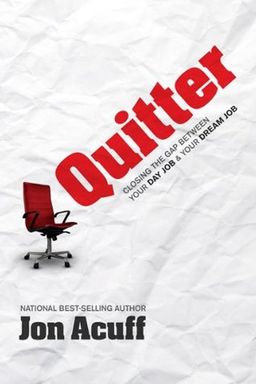
Quitter cover

Quitter

by Jon Acuff

Quitter by Jon Acuff is an insightful guide for anyone looking to transition from an unsatisfying job to their dream career. Through personal anecdotes and practical advice, Acuff offers strategies for leveraging your current job as a stepping stone, identifying life-changing moments, managing risks, and setting realistic goals to achieve career fulfillment.

Quitter: Building the Bridge Between Your Day Job and Dream Job

Have you ever looked up from your cubicle or daily grind and wondered if this is it? Jon Acuff’s Quitter: Closing the Gap Between Your Day Job and Your Dream Job begins exactly there—with the tension between doing work that pays the bills and longing to do work that makes you come alive. But contrary to what every motivational Instagram post preaches, Acuff’s central claim is radical: don’t quit your day job… yet. He argues that the best path to your dream is through your day job, not away from it.

Acuff insists that most people “quit wrong.” They leap without preparation, assuming that freedom and fulfillment automatically follow resignation. In reality, he argues, those who quit rashly end up shackled by financial panic, relationship strain, and an endless army of new bosses disguised as bills. True freedom, he says, doesn’t come from a single leap but from learning to close the gap between where you are and where you want to be with patience, purpose, and hustle.

The Myth of Instant Freedom

Acuff opens with stories of his own job-quitting addiction—eight jobs in eight years—and the cultural myth that quitting equals courage. In an age where Instagram glorifies entrepreneurship and burnout is mistaken for bravery, Acuff reveals the messier truth: quitting too soon can destroy your dream before it starts. He calls it the “Donnie dilemma,” where escaping a terrible boss only multiplies your “mini-Donnies”—credit card bills, mortgages, and family responsibilities. The illusion of freedom quickly becomes overwhelming obligation.

Instead, Acuff reframes the day job as a vital ally—a testing ground that funds, shapes, and protects your dream until it’s ready to stand on its own. Your paycheck, he says, buys you the freedom to say no to bad deals, poor clients, and exploitative opportunities that desperate dreamers often accept out of fear. Protect your “no’s,” and you preserve your integrity and leverage.

Dreaming Differently: Recovery, Not Discovery

Many of us treat our dream like a mystery we’ll stumble upon one day—a lucky revelation in adulthood’s fog. But Acuff flips that idea. Drawing on Simon Sinek’s concept of your “WHY” in Start with Why, he argues that your dream isn’t something you discover—it’s something you recover. It’s the spark you had as a child before practicality and fear dulled it. By revisiting past “hinge moments,” those small but pivotal experiences that shaped your joy and identity (like his third-grade teacher laminating his first poetry book), you can reconnect with your childhood loves and see their adult relevance.

To find what you’re meant to do, Acuff asks readers to reframe their questions—not “What should I do with my life?” but “What have I already done that made me feel fully alive?” Recovery gives direction; discovery only multiplies confusion.

From Impulse to Intention

Behind Acuff’s humor lies a pragmatic method. He offers a step-by-step picture of the emotional and practical journey from a day job to a dream job: start by falling in like with your current role, using it as your dream’s training ground. Then, practice excellence daily; what you cultivate at your desk travels home with you. Learn patience (“wait on the main stage”). Instead of craving overnight recognition, embrace invisibility as a gift—your rehearsal space to fail privately, learn risk-free, and sharpen your craft before you face the crowd.

And above all, hustle. Acuff doesn’t romanticize ease. He calls hustle the universal currency of dreamers. Your dream demands mornings, sacrifice, and focus. But hustle without burnout requires discipline—knowing when to rest, define “enough,” and protect what matters most—your relationships and future self.

Why It Matters

What makes Quitter different from typical self-help guides is its honesty. Acuff doesn’t sell fantasy or formulas. He builds bridges. He teaches readers that their current job is not the enemy of their calling—it’s the incubator of their destiny. In a world addicted to quitting, the truest quitters are those who trade impulsive escape for deliberate transition. Through stories, humor, and grounded advice, Acuff argues that you can pursue your dream job without torching your life. The goal isn’t to run away—it’s to grow ready enough, skilled enough, and wise enough to walk away well.


Don’t Quit Your Day Job—Yet

Acuff begins by dismantling the modern myth that quitting your job is the first brave step toward chasing your dream. In a culture that worships risk-takers, he confesses that his own eight-job exit streak wasn’t rebellion—it was immaturity. He was chasing freedom without foundation. Through stories of his horrible boss “Donnie,” Acuff illustrates how quitting out of frustration often makes life harder, not freer. When you flee a bad boss, you inherit a dozen new ones: rent, credit cards, groceries, children, and guilt. Bills become your new micromanagers.

Freedom Isn’t the Opposite of Stability

The idea that success equals escape—from cubicles, commutes, and corporate hierarchies—is a lie, Acuff warns. Real freedom is the ability to choose wisely, and you lose that power when you leap without a safety net. His story about a bad publishing offer reveals this truth: because he still had a day job, he could say “no” to an unfair book deal that would have owned his work and paid him nothing. Without a paycheck, desperation would’ve forced him to accept. The lesson? Your job gives you leverage. It funds your art without compromising your ethics.

The Power of Keeping Your “No”

Acuff calls “no” the dreamer’s most valuable word. When you quit prematurely, you trade away your ability to refuse. Bills silence your conscience faster than fear does. But when you’re stable at work, you can build wisely—say yes only to projects that fit your values. Stability fuels boldness. Acuff even lists his five criteria for accepting speaking gigs, including pay fairness, audience impact, and alignment of values—criteria he could afford to enforce because his day job still covered his basics.

Stay Dangerous

Ironically, job security breeds creative risk. Without financial panic, you can take artistic, ethical, or professional chances that might alienate others but honor your dream’s purpose. Acuff calls this “staying dangerous.” A day job protects your edge. When CNN invited him to write an article that could offend his Christian fan base, he accepted fearlessly because his mortgage didn’t depend on blog approval. In his view, having a day job doesn’t make you safe—it lets you be bold. That’s what real courage looks like.


Recover, Don’t Discover, Your Dream

Acuff argues that your dream isn’t a mystery waiting to be discovered but a truth that’s been buried by adulthood and distraction. Most people, he says, enter their thirties or forties thinking their dream will strike like lightning—sudden and divine, a new revelation of purpose. Instead, he insists that the best dreams feel like coming home. They’re old loves rediscovered, not fantasies invented.

The “42-Year-Old Beekeeper” Myth

Acuff mocks the fantasy that we’ll stumble into passion, like a bored accountant suddenly realizing he’s a beekeeper at heart. Citing Start with Why author Simon Sinek, Acuff says our 'why' always originates in our past. By examining life’s hinge moments—pivotal memories that changed our direction—you’ll see your dream’s fingerprints everywhere. His own hinge came in third grade, when Mrs. Harris laminated his first poetry book, affirming him as a writer before he knew what that meant. His second hinge arrived when his father sent him a mail-order “How to Publish a Book” kit in high school. Neither moment seemed grand, but both quietly confirmed who he was.

Questions to Uncover Your Hinge Moments

Acuff offers five diagnostic questions for recovering your dream: What do you love enough to do for free? When does time vanish for you? What energizes you even without applause? Would it still be worth doing if no one noticed? And do patterns repeat across your life’s highlights? These questions turn nostalgia into data—your history becomes your map.

Facing Fear and Doubt

Recovery also means confronting the soundtrack of self-doubt playing in your mind. When people dismiss your talents as “nothing,” you start believing it. Acuff calls this the “nothing lie”—the habit of shrinking potential to avoid risk. He urges readers to reject that false humility: if it’s something, treat it like something. Recovering your dream begins when you admit that the small delight you’ve sidelined might be a calling worth fighting for.


Fall in Like with a Job You Don’t Love

Instead of demonizing your current job, Acuff challenges you to “fall in like” with it. Why? Because your job isn’t imprisoning your dream—it’s training you for it. He calls the day job your dream’s “incubator,” a safe space for learning discipline, managing money, and practicing excellence without the pressure of survival riding on every mistake. He credits his years at AutoTrader.com for teaching him project management, writing discipline, and teamwork—skills that later powered his speaking and writing career.

Work Is a Mirror of Character

You can’t be lazy at work and focused at home. Habits don’t compartmentalize. Acuff realized that his inattentiveness in meetings bled into not listening to his wife. Excellence and discipline in one area strengthen the others; neglect spreads the same way. To love your dream well, you must first learn to respect your day job—it’s your public practice ground for private ambition.

Purpose and Parallels

To reframe dislike into purpose, Acuff advises identifying parallels between your role and your dream. A Starbucks barista aspiring to run her own accounting firm, for instance, is learning about customer service, cash flow, and time management. A stay-at-home parent wanting to return to project management is already managing complex operations daily. Parallels turn frustration into fuel—the more you notice them, the faster you grow.

The Platform vs. Prison Principle

Acuff distinguishes two mindsets: seeing your workplace as a platform or as a prison. Treat your job as a platform and it becomes a launchpad for your next chapter; treat it as a prison and you sabotage both your dream and your reputation. The discipline you practice “at work” determines the caliber of creator you’ll be when freedom finally arrives. Falling in like isn’t denial—it’s preparation.


Wait on the Main Stage

Dreamers crave fast-forward buttons. We want the movie montage—instant success, bestseller lists, and spotlights. Acuff instead quotes the serenity of David versus the flash of Cinderella. Cinderella’s story is instant fame: a magical transformation and a single dazzling night. David’s is patience: the future king going back to herd sheep after being anointed. Real dreams, Acuff says, grow through seasons of smallness, obscurity, and humble repetition.

Embrace the Nebraska Years

Using the metaphor of “Nebraska years,” he describes that slow, gritty middle ground between excitement and mastery—the years when you fly across the country for an audience of thirty or when your Etsy shop gets two orders a month. These years, he insists, aren’t punishment—they’re training. They measure your love for the work, not your applause for it. His friend Rachel Ramsey, daughter of Dave Ramsey, learned this humility traveling to speak to sparse crowds before earning national stages. Nebraska years stretch your patience and solidify skill before recognition multiplies vulnerability.

The Gift of Invisibility

Building on Google co-founder Sergey Brin’s insight that early obscurity allows perfection, Acuff calls anonymity “a creative laboratory.” Invisibility lets you fail privately, experiment freely, and stay authentic. Fame invites fear—you start creating for approval rather than truth. Like Jerry Seinfeld’s early unpaid sets, those quiet beginnings are where expertise is born. Keep showing up when nobody claps; that’s when your voice develops.

Quantity Before Quality

Acuff closes this section with an unromantic truth: quantity leads to quality. He wrote a million blog words before selling fifty thousand in print. “Practice your dream,” he says. Dreams, like crafts, mature with reps—every blog, song, draft, or pitch is a rehearsal for your future main stage. You earn visibility by surviving invisibility well.


Master the Art of Hustle—Without Burning Out

Acuff redefines “hustle” as more than grinding mindlessly—it’s purposeful effort aimed at long-term balance. Citing his cousin-by-marriage Charlie, a firefighter working double shifts to afford a vacation, Acuff concludes that hustle is simply this: ‘Do you really want to go to Colorado? Then go to work.’ Hard work isn’t complicated; it’s consistent. The gap between you and your dream isn’t mystery—it’s miles.

Morning Work, Not Midnight Guilt

Your dream’s best hours happen before the world wakes up. Mornings, Acuff says, are when excuses sleep. He wrote before work while his colleagues hit snooze. Evening dreamers lose energy to exhaustion, distractions, and Netflix. Morning hours, though scarce, multiply momentum throughout the day. Start your day doing what you love, and you’ll carry joy into what you merely like.

The “Like vs. Love” List

Busy people often say they lack time; Acuff argues they misuse it. Create a “Like vs. Love” list: trade passive entertainment for active construction. Replacing four hours of TV with writing or crafting changes both self-worth and output. Hustle isn’t exhaustion—it’s clarity about what matters most and refusal to spend it on what doesn’t.

Protect Against Burnout

Burning the candle at both ends, Acuff reminds readers, doesn’t prove passion; it predicts collapse. He recalls losing friendships during his rise and learning to define “enough.” Quoting Pat Riley’s “disease of more,” he notes that success often kills momentum by awakening greed. True hustle honors rest and relationships as much as grind. It fuels the dream—it doesn’t consume the dreamer.


Define Your Success Before Success Defines You

Perhaps the most sobering advice in Quitter is Acuff’s warning that success can be more dangerous than failure. Success tempts arrogance, overload, and distraction. Without boundaries, your dream’s platform becomes a prison. After turning his blog into a bestseller and national speaking career, Acuff nearly lost his family to overwork and travel. His wife’s tears forced him to ask: What does “enough” look like?

Write Yourself a Letter from the Future

Inspired by comedian Lanny Donoho, Acuff used FutureMe.org to email his future self. In it, he warned himself not to chase “more” at the expense of peace: “You’re sitting outside with your wife in the sunshine, and this is enough.” The letter arrived a year later—right as his book launched. It reminded him that success isn’t a destination but a decision: define your enough, or success will erase it for you.

Set Rules for Your Dream Life

When opportunity exploded, Acuff made a travel rule: no back-to-back weekends away from family. Still, he broke it and ended up speaking seven out of eight weekends. His wife cried in the laundry room; his daughters began to forget him. That experience birthed a principle—define rules before emotion clouds reason. Like financial budgets, relational boundaries prevent burnout before it starts.

Quit With Wisdom

When he finally quit AutoTrader.com to join Dave Ramsey’s team, Acuff did it strategically: he had savings, a clear opportunity, family support, and faith peace. He even made a “risk list” predicting stress points ahead—friendships lost, finances strained, transitions messy—so when they appeared, he could say, “We planned for this.” He teaches that quitting isn’t a cliff jump—it’s a calculated transfer from one kind of faithfulness to another. Defining success makes the landing far softer.

Dig Deeper

Get personalized prompts to apply these lessons to your life and deepen your understanding.

Go Deeper

Get the Full Experience

Download Insight Books for AI-powered reflections, quizzes, and more.