
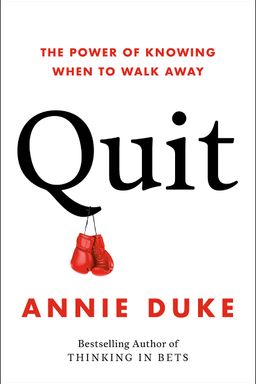
Idea 1
The Power of Knowing When to Quit
You’re taught that quitting is failure — that grit, endurance, and determination are always virtues. In Annie Duke’s Quit, this belief is turned upside down. She argues that quitting is not a moral weakness but a powerful decision-making tool—one that separates those who adapt successfully to uncertainty from those who gamble their futures away clinging to sunk costs. Quitting, in Duke’s view, is the key to good judgment in an unpredictable world.
Duke starts from a simple observation: all decisions are made under uncertainty. You never have perfect information, and no matter how confident you feel, the world can change. Quitting allows you to update your path when reality evolves. Rather than being the opposite of perseverance, quitting is part of intelligent persistence: it gives you flexibility, preserves resources, and keeps you aligned with new information.
Why We Stick Too Long
The book explains why people rarely quit on time. Several forces combine to keep you locked in. Loss aversion makes potential failure feel unbearable. Identity turns missions into reflections of the self, making retreat feel like self-erasure. And social stigma punishes those who abandon visible goals—whether a startup, a policy, or a mountain climb. Because the emotional cost arrives now but the benefits of quitting live in the future, quitting never feels urgent until it’s too late.
Muhammad Ali’s late career illustrates this tension. Grit and dedication made him a legend, but ignoring signals from his doctor and manager brought irreversible harm. Likewise, climbers on Everest who ignored turnaround rules in 1996 pushed past rational limits and died, while those who obeyed the pre-set quit time lived to climb again. The lesson is not about courage but discipline: quitting can save your life.
Decision Science and Expected Value
Quitting, Duke insists, is not emotional but probabilistic. Think like Stewart Butterfield, who ended his online game Glitch when its growth math looked untenable. He and his team used the insights and code to pivot into Slack, a product that dominated workplace communication. This was quitting as reallocation of bets, not abandonment. What mattered was expected value — how each option projected into the future across health, time, satisfaction, and money.
In studies by Steven Levitt, people who flipped a coin about major life decisions and “quit” their current paths were later happier than those who stayed. The takeaway: when a choice feels 50-50, it’s often already tilted toward quitting. The future benefit of leaving typically exceeds the comfort of staying.
Biases That Block Us
Prospect theory explains how people treat losses versus gains asymmetrically. When you’re down, you gamble more; when you’re ahead, you cash out too soon. That’s why cab drivers quit early on high-fare days and grind through low-fare ones—exactly the opposite of profit-maximizing logic. The same psychology infects investors who hold losers and sell winners. We focus on how we’ll look if we quit, not how our odds improve when we do.
Escalation and sunk costs then layer on top. Having invested time or money, you feel compelled to keep going so it “wasn’t for nothing.” Barry Staw’s research on decision escalation—from his father’s failed store chain to government megaprojects like California’s bullet train—demonstrates how people rationalize additional spending even when negative expected returns are obvious.
Turning Quitting into a System
The antidote, Duke says, is structure. Build precommitments called kill criteria—specific states and dates that define when you’ll exit. Define them early, when you’re objective, not during emotional crisis. Projects at X (Google’s moonshot factory) demonstrate this with Astro Teller’s “monkeys and pedestals”: test the hardest, riskiest element first (the monkey), and quit if it can’t be solved. Don’t waste months polishing pedestals for a doomed idea.
Similarly, Admiral McRaven’s raid on Bin Laden had built-in abort conditions: if one team was an hour behind, the operation would stop. Pre-specifying these “unless” conditions gives quitting legitimacy—it’s process compliance, not personal failure.
Identity, Coaching, and Public Life
Identity is the most stubborn barrier. You endow your projects with selfhood, like Sasha Cohen defining herself through skating or Sears clinging to “being a retailer” instead of embracing its thriving financial arms. The result: overcommitment to fading identities. The medicine is external truth-tellers. Ron Conway coaches founders through a four-step process that includes setting measurable benchmarks and revisiting them later. Quitting becomes a data-driven question, not an ego rupture.
Public figures face an added layer: social judgment. Alex Honnold’s decision to descend during his first El Capitan free solo attempt, despite cameras rolling, exemplifies courage over reputation. Naming quitting honestly—without euphemism—restores integrity to decision-making in public life.
A Framework for Adaptive Living
Life rewards adaptability, not endurance. Quitting is what gives you the confidence to start in the first place. By designing kill criteria, exploring like ants even while exploiting your successes, setting flexible “unless” conditions on goals, and celebrating process-aligned exits, you build a system for evidence-based persistence. Quitting becomes a skill—a way to reserve energy, recover autonomy, and evolve faster than the world changes around you.