
Idea 1
Remembering So It Never Happens Again
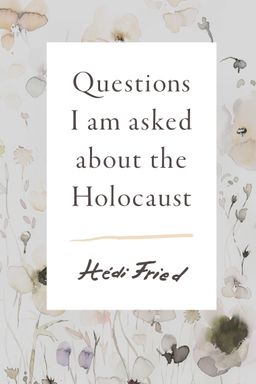
Can remembering the past truly protect us from repeating it? In Questions I Am Asked About the Holocaust, Holocaust survivor and psychologist Hédi Fried invites you to confront that question personally. Drawing on her experience in Auschwitz and Bergen-Belsen, and decades spent answering students’ questions, Fried contends that memory—if it is active, examined, and shared—is our most powerful moral safeguard. Forgetting, on the other hand, is the first step toward repetition.
Her book is structured simply: real questions asked by young audiences during her school visits (“Were you afraid?”, “Why did you not fight back?”, “Could it happen again?”) and her candid, reflective answers. Yet the result is not merely a memoir—it’s an ethical conversation between generations. Fried argues that the Holocaust is not just history; it’s a mirror for how prejudice, obedience, and apathy still work today. Understanding that psychology, she insists, is part of protecting democracy itself.
The Psychology of Ordinary People
Fried reminds us that the Holocaust was not executed only by fanatics. It was carried out by ordinary people—neighbors, teachers, policemen—who obeyed, adapted, or stayed silent. In speaking to students, she often hears, “Why didn’t people fight back?” or “Were there kind SS soldiers?” Her reply dismantles comforting myths: there were no real saviors among the oppressors. Evil, she explains, grew incrementally. People got used to injustice one step at a time, just as her own town of Sighet got used to wearing yellow stars and curfews before realizing they were trapped. Nazi rule blurred moral boundaries until most Germans—and many Hungarians—believed that cruelty was normal. Fried calls this the habit of adaptation, a human tendency to normalize the intolerable rather than resist it.
(Social psychologists have echoed this lesson since the 1960s. Stanley Milgram’s obedience experiments revealed the same instinct Fried describes: an unsettling willingness to harm when told to do so by authority.)
Life, Loss, and the Fragility of Moral Worlds
The book begins with her life in pre-war Transylvania, a multilingual, multiethnic world where coexistence seemed normal—until small exclusions piled up. Anti-Semitic school rules and whispered rumors preceded deportations. Then came the cattle cars and separation from her parents on the ramp at Auschwitz. The moment Mengele’s hand sent her mother to the right and her to the left remains, she says, the worst moment of her life. But even amid horror, chance and solidarity determined survival. Her sister Livi, younger but fiercely devoted, kept her alive through illness, hunger, and despair. In Bergen-Belsen, Livi saved her again when she lay unconscious from typhus after liberation.
Fried writes that she survived by luck and by love—the love of her sister, and the instinct to protect one another. The camps were engineered to erase both, yet tiny gestures of human warmth—a shared potato, a joke whispered at night—became acts of rebellion. She also credits childhood security for her resilience; early love from her parents had built an inner wire of trust that the Nazis couldn’t cut.
The Long Work of Healing
After the war, recovery was not instant liberation but another kind of struggle. When she arrived in Sweden as part of the rescue transport, she discovered both compassion and distance: locals offered cocoa and food but couldn’t grasp her story. Writing, she found, became her therapy. Recording her memories turned grief into comprehension—a forerunner of trauma processing long before psychology gave it a name. Her diary became self-analysis, and over decades she transformed pain into teaching. “I finally realized I had survived so that someone could tell,” she writes. Speaking publicly gave her life renewed meaning—and a mission that stretched well into her nineties.
Yet trauma, she admits, never vanishes. A barking dog or the sight of a chimney can still trigger the sensory memory of camp life. Processing, not forgetting, is the path forward. Fried redefines strength not as suppressing pain but as building meaning from it—similar to Viktor Frankl’s idea in Man’s Search for Meaning that purpose helps one survive suffering.
Lessons for a Fragile Democracy
From her vantage as a psychologist and educator, Fried connects her memories directly to our era. The same ingredients of destruction—economic frustration, charismatic leaders, and “us versus them” thinking—still appear in new forms. Every generation, she warns, must relearn democracy and examine its prejudices. Prejudice begins not with hatred but with an unexamined feeling: dislike, fear, or superiority toward the “other.” Once you name it and question it, you weaken its hold. If you do not, societies slide toward moral sleep. Being a bystander, Fried insists, is as dangerous as being a perpetrator. She challenges readers: in your own daily life—school, workplace, online spaces—will you speak up when someone is bullied or minimized? That’s where remembrance turns into action.
Why Her Questions Still Matter
Fried’s conversational Q&A form mirrors how history survives: through dialogue, not monologue. The questions students ask range from naive (“Were you hungry?”) to profound (“Do you still believe in God?”). Her honest answers make the Holocaust tangible, stripping away abstraction. She doesn’t lecture about evil—she demonstrates how small decisions create it, and how small decencies resist it. The book’s final chapters shift from history to moral philosophy, urging you to look inward: What prejudices do you harbor? What kind of citizen do you want to be in fragile times?
In essence, Fried’s message is both simple and immense: Each human being holds the line between cruelty and compassion. We cannot change the past, but by remembering it sincerely and interrogating ourselves, we can shape a more humane future. Her gentle authority comes not from theory but from surviving humanity’s collapse and choosing, over and over, to rebuild it through understanding. As she concludes, “The meaning of life is life itself.”