
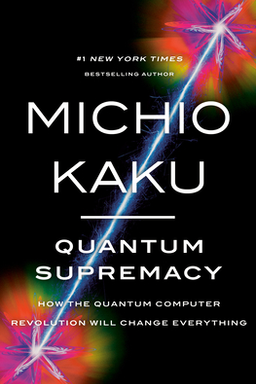
Quantum Supremacy cover

Quantum Supremacy

by Michio Kaku

Quantum Supremacy by Michio Kaku breaks down the complex world of quantum computing, tracing its history and exploring its potential to revolutionize everything from medicine to climate science. This book makes quantum theory accessible, showing how it could solve humanity''s greatest challenges.

Quantum Computing and the Human Future

You live at the turning point between two technological eras. For six decades, silicon chips defined progress, powered by Moore’s law—a predictable rhythm where computing power doubled roughly every eighteen months. That rhythm is ending. Quantum computing, the next paradigm, emerges not as an incremental improvement but as a fundamental transformation in how you model and understand the world.

This book argues that the Age of Silicon is collapsing under its own success. Transistors now approach atomic scales where electrons tunnel and circuits leak, forcing engineers to confront quantum physics directly. Instead of fighting those limits, physicists and computer scientists are harnessing them—turning uncertainty and entanglement into computation. The result is a new class of machines that can solve problems classical computers simply cannot, from deciphering molecular reactions to breaking cryptographic codes and simulating planetary climates.

From Moore’s Law to Quantum Supremacy

In 2019, Google’s Sycamore processor solved a sampling problem in 200 seconds—an operation estimated to take a classical supercomputer thousands of years. China’s Jiuzhang photonic experiment extended that advantage even further. These milestones demonstrated quantum supremacy, evidence that quantum systems can outperform classical ones on specific tasks. For governments and corporations, the implications were immediate: whoever masters quantum computing will control not just computation, but chemistry, security, and materials science.

How Quantum Computing Works

Unlike classical bits that store either 0 or 1, qubits store both simultaneously through superposition. When multiple qubits become entangled, their states are correlated across space—meaning calculations occur as a networked whole rather than as isolated parts. Add a single qubit, and the computational space doubles. A 300-qubit machine could explore far more possibilities than any classical supercomputer. Quantum computation is therefore about orchestrating interference patterns so that correct results emerge with high probability when the wavefunction collapses.

The Geopolitical and Economic Stakes

Quantum supremacy triggered a global race. The U.S. National Quantum Initiative Act poured hundreds of millions into research, while China invested billions in its Hefei laboratory. Startups like IonQ and PsiQuantum reached billion-dollar valuations before releasing commercial products. Corporations from Daimler to ExxonMobil bet on quantum chemistry for batteries and materials. These developments signal that quantum computing is no longer an academic pursuit—it’s industrial strategy, national security, and scientific destiny rolled into one.

Why It Matters to You

Quantum computing affects daily life more than it appears. Encryption standards—like RSA or AES—depend on problems that quantum algorithms such as Shor’s can solve exponentially faster. That means the digital infrastructure securing your bank, your health records, and your communications could become transparent to adversaries unless new post-quantum cryptography replaces current systems. At the same time, quantum simulators can accelerate discoveries in pharmaceuticals, catalysis, and renewable energy, reducing the time to develop medicines or climate solutions from decades to years.

The Narrative Arc

The book traces the human drive to simulate nature—from the Antikythera mechanism that predicted celestial events, through Babbage’s and Lovelace’s mechanical engines, to Turing’s universal machine. Quantum computing extends that lineage into the atomic realm, where the simulation itself dances with the fabric of matter. As computation and reality converge, you enter an era where quantum and AI cooperate to engineer life, energy, and even consciousness.

Core Thesis

“Silicon built the digital world; quantum will rebuild the physical and biological one.” You are witnessing the rise of machines that don’t just compute numbers but simulate atoms, cells, and stars—reshaping economies and redefining what it means to understand nature itself.

By the end of this journey, you see quantum computing not as an abstract physics concept but as a unifying story—linking AI, chemistry, medicine, energy, and cosmology under one ambition: to simulate and master complexity at its smallest and largest scales.


Building Quantum Machines

Quantum hardware is diverse, reflecting trade-offs among coherence, scalability, and error correction. You learn about superconducting circuits, trapped ions, photonic systems, and emerging approaches like topological qubits. Each pathway represents a distinct engineering philosophy—how to trap, control, and compute with fragile quantum states.

Superconductors and Cryogenic Logic

Google’s Sycamore and IBM’s Osprey exemplify superconducting qubits, which rely on Josephson junctions cooled near absolute zero. This design benefits from decades of microchip expertise but requires heavy refrigeration and constant calibration. IBM’s roadmap toward the Condor chip aims to scale hundreds of qubits into thousands by cloud-based integration.

Trapped Ions and Photonics

Trapped-ion systems (Honeywell, IonQ) suspend individual atoms using electromagnetic fields, achieving long coherence times and high gate fidelity. Photonic approaches, by contrast, encode qubits in light—eliminating the need for cryogenics. The Chinese Jiuzhang project and Canadian startup Xanadu explore entangled photons for scalable computing. PsiQuantum leverages silicon photonics to integrate optical circuits directly onto chips, targeting million-qubit architectures.

Error Correction and the Scaling Problem

Quantum states are delicate; noise quickly destroys coherence. To achieve fault-tolerant computation, engineers encode logical qubits using hundreds or thousands of physical ones. True scalability depends not just on qubit count but on achieving long coherence with minimal redundancy—a major challenge that keeps fully useful quantum computers years away.

The Competitive Landscape

The book predicts no single winner in the 2020s. Different architectures will dominate different niches—superconducting for universal computing, photonics for communication, ions for high-fidelity chemistry, and annealers for optimization. Each design embodies a philosophy: Is computation about raw qubit numbers or about error-corrected reliability?

Engineering Insight

"Quantum hardware success will be judged not by how cold the machine runs, but how reliably it scales." The race is thus less about physics brilliance than about engineering endurance—making fragile qubits practical enough for everyday computation.

In short, building quantum machines means translating theoretical possibilities into technological reality. Each prototype—whether IBM’s Osprey, Honeywell’s ion trap, or PsiQuantum’s photonic chip—reflects the ambition to tame quantum behavior and package it for the world’s next computing platform.


Quantum Algorithms and Digital Security

Algorithms transform hardware into usable power. The most famous, Shor’s algorithm, exposed the fragility of digital cryptography. It can factor large integers exponentially faster than classical algorithms, undermining RSA—the cornerstone of internet security. When Peter Shor proposed it, encryption’s foundation shook; now governments and industries scramble to replace vulnerable systems before quantum hardware matures.

How Shor’s Algorithm Works

Shor recast factoring as a quantum period-finding problem, solved efficiently through quantum Fourier transforms. A quantum computer using Shor's method could reduce a task taking billions of years classically to minutes. The book explains that once logical qubit counts reach sufficient thresholds, 2048-bit RSA keys would fall rapidly—rendering today’s encrypted archives transparent.

The Quantum Threat Timeline

NIST forecasts that certain encryption systems may become breakable around 2029. The real danger lies in harvest-now, decrypt-later attacks—where adversaries record encrypted data today to decrypt once capable machines exist. Financial records, military secrets, and health information all face exposure unless preemptive defenses arise.

Defending the Quantum Age

Three strategies dominate transition planning: (1) Post-quantum cryptography, classical schemes resistant to quantum attack; (2) increased key sizes in symmetric systems; and (3) quantum key distribution (QKD), which uses entangled photons to detect eavesdropping instantly. Governments and companies (Toshiba, Google, and national security agencies) already invest in QKD networks linking satellites and data centers.

Security Imperative

“Quantum readiness is not optional—it’s a deadline.” Organizations must migrate to quantum-safe encryption before attackers wield scalable quantum machines.

In summary, Shor’s algorithm turned quantum computing into a geopolitical asset. The quantum race is as much about safeguarding secrecy as about scientific progress—the future of cybersecurity will hinge on who secures information first.


Simulating Nature and Chemistry

Richard Feynman’s insight—that “nature isn’t classical”—guides quantum simulation. You can’t fully model molecules using classical bits because electron interactions explode computational complexity. Only a quantum computer, which obeys the same physics as atoms, can simulate them directly. This principle transforms chemistry, materials science, and energy research.

Chemistry and Energy Applications

IBM and ExxonMobil already use quantum prototypes to study carbon capture and new chemical reactions. Quantum simulation can design next-generation batteries by modeling ion movement through electrodes, enabling higher density and faster charging. Automakers (Daimler, BMW) collaborate on such virtual chemistry to accelerate electric transitions.

Photosynthesis and Carbon Recycling

Scientists found that photosynthetic molecules exploit quantum coherence. By decoding such mechanisms with quantum simulators, you can imagine artificial leaves converting sunlight and CO2 into usable fuels. Projects like JCAP and Akira Fujishima’s photoelectrochemical cells could mature into scalable carbon-recycling technologies.

Agriculture and the Green Revolution

The century-old Haber–Bosch process consumes 2% of the world’s energy to synthesize fertilizer. Quantum modeling of the nitrogenase enzyme might yield catalysts that fix nitrogen efficiently at room temperature—ushering in a second Green Revolution with less environmental cost.

Scientific Leap

Quantum simulation replaces trial-and-error lab work with computational exploration, shrinking research cycles from decades to weeks.

By learning to simulate molecules precisely, you gain the ability to design new drugs, catalysts, and materials before they exist—creating virtual laboratories where discovery accelerates and sustainability becomes computationally tractable.


Quantum Biology and Medicine

Quantum computing moves medicine from blind experimentation to mechanistic design. It models proteins, DNA, and cells at the quantum scale—so you can predict behavior, detect disease early, and create drugs tailored to molecular precision. This revolution fuses genomics, AI, and quantum simulation into a new form of biotechnology.

Protein Folding and Drug Discovery

AI tools like DeepMind’s AlphaFold mapped hundreds of thousands of protein structures, transforming biology’s dictionary. Yet AlphaFold relies on approximations—it ignores many electronic interactions. Quantum computers can extend that achievement by resolving chemical reactivity directly, enabling precise in silico drug design for diseases like Alzheimer’s and cancer.

Misfolding, Prions, and Neurodegeneration

Misfolded proteins cause prion diseases and likely drive Alzheimer’s and ALS. Quantum modeling can visualize folding dynamics atom-by-atom, illuminating where pathological forms arise and how to stabilize or neutralize them. German studies showing misfolded amyloid as a decades-early biomarker point toward preventive diagnostics.

CRISPR and Immunotherapy

CRISPR-based trials (Editas, CRISPR Therapeutics) already treat blood diseases and cancers. Quantum simulations can improve gene-editing precision by predicting off-target cuts and optimizing protein–DNA interactions. Similarly, immunotherapy can benefit from quantum-guided tuning of immune receptors and antigen binding.

Quantum Diagnostics

Liquid biopsies and sensor arrays detect molecular signals from blood or breath. When backed by quantum-enhanced analytics, they promise real-time disease surveillance. Combined with AI-driven pattern recognition, early warning systems could emerge for cancers, infections, or metabolic shifts long before symptoms appear.

Medical Paradigm Shift

“You design treatments from the mechanism outward, not by trial.” Quantum medicine transforms patients from subjects of experimentation to beneficiaries of simulation-driven care.

This synthesis of biology, computation, and quantum physics may become the defining force of 21st-century healthcare—where prevention and personalized therapy emerge from molecular insight rather than luck.


Quantum Control for Energy and Climate

Energy and climate are intertwined challenges of computation and control. Quantum systems offer solutions by improving fusion reactor designs, superconducting materials, and global climate modeling accuracy. They don't only promise cleaner energy—they increase your capacity to predict and manage planetary dynamics.

Fusion: Engineering the Sun on Earth

Tokamaks like ITER and SPARC aim for controlled nuclear fusion, an inexhaustible and carbon-neutral power source. Quantum computing assists in simulating plasma behavior, optimizing magnetic confinement, and modeling superconducting materials that sustain ultra-strong fields. When NIF achieved ignition in 2022, the milestone marked progress—but quantum simulation will be vital to scale it commercially.

Superconductors and Materials Discovery

High-temperature superconductors enable compact, efficient magnets. Yet their mechanism remains poorly understood. Quantum modeling of electron interactions promises breakthroughs in designing room-temperature superconductors—a leap that could revolutionize power grids and energy storage worldwide.

Climate Modeling and Geoengineering

Quantum climate models shrink computational grid sizes, capturing turbulence, cloud dynamics, and extreme events more realistically. You can perform “virtual weather experiments,” exploring scenarios of carbon emissions, aerosol injections, or reforestation decades ahead. Geoengineering proposals—from carbon sequestration to cloud brightening—are tested safely in simulation before application, reducing global risk.

Planetary Insight

Quantum modeling transforms climate science from retrospective analysis into proactive experimentation—letting humanity preview multiple futures and choose wisely.

Together, quantum control over fusion and planetary models could simultaneously supply clean power and sophisticated forecasting—two technologies the Anthropocene urgently demands.


AI Meets Quantum Intelligence

The book ultimately unites two revolutions: artificial intelligence and quantum computing. AI finds patterns; quantum computing expands the search space exponentially. Merging them yields systems that not only learn but also invent, tackling problems too vast for classical limits.

From Dartmouth to Deep Learning

AI began with ambition to replicate reasoning. After decades of rules and failures, learning-based systems (neural networks) took over. DeepMind’s AlphaGo and AlphaFold show that self-training machines, given enough compute, surpass human specialists in both games and science.

Quantum-AI Synergy

Quantum computers give AI the ability to search massive configuration spaces quickly. AI, in turn, optimizes quantum circuits and control variables. Sundar Pichai summarized this reciprocal promise: “AI accelerates quantum computing, and quantum computing accelerates AI.” Together, they enable faster training, better probabilistic reasoning, and new models of creativity—from molecular design to autonomous systems.

Commonsense and Embodied Learning

AI still lacks human-like commonsense—the capacity to reason through physical experience. By coupling quantum simulation with reinforcement learning, researchers can run richer virtual worlds where digital minds practice millions of lifelike interactions. This may bridge the gap between mathematical intelligence and embodied understanding.

Technological Convergence

When AI meets quantum computing, learning becomes exploration of all possible paths, guided by probability and coherence—an echo of Feynman’s vision of nature itself as computation.

This union doesn’t just build smarter algorithms; it crafts a new scientific instrument capable of reflecting intelligence at matter’s deepest level. The world that emerges—quantumly simulated and AI-optimized—may redefine creation, discovery, and thought itself.


Simulating the Cosmos

The final horizon of quantum computing reaches beyond molecules to the cosmos itself. By simulating matter, gravity, and energy at quantum precision, you can explore phenomena once confined to theory—black holes, dark matter, and the origins of the universe.

Astrophysical Applications

Quantum algorithms can refine asteroid-trajectory predictions (as with Apophis and DART deflection), model stellar fusion, and forecast solar flares to protect satellites and power grids. They also help catalog exoplanets by analyzing vast spectral and orbital data with unmatched speed.

Exploring Fundamental Physics

Simulating quantum gravity could illuminate what happens inside black holes, where general relativity fails. Quantum computers can test string-theory stability and model particle interactions beyond the Standard Model, searching for signatures of dark matter or exotic particles missed by colliders.

Philosophy and Simulation

The book closes by asking whether the universe itself might be a quantum computer. Seth Lloyd and Hugh Everett’s frameworks—the universe as computation and many-worlds interpretation—frame a paradox: simulation and reality may differ only in degree. Yet even perfect simulations remain constrained by memory and energy limits, ensuring the cosmos retains mysteries.

Cosmic Takeaway

Quantum computation unites the microcosm of biology and the macrocosm of astronomy. Mastering it means grasping the mechanics of existence itself—from atoms to galaxies.

Through this lens, quantum computing becomes the ultimate scientific mirror—capable of reflecting both the origins and the destinies of matter, life, and thought.

Dig Deeper

Get personalized prompts to apply these lessons to your life and deepen your understanding.

Go Deeper

Get the Full Experience

Download Insight Books for AI-powered reflections, quizzes, and more.