
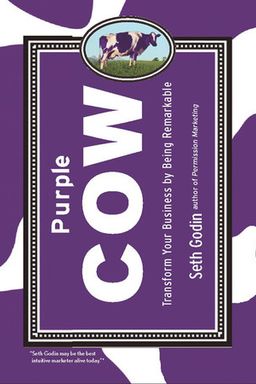
Purple Cow cover

Purple Cow

by Seth Godin

Purple Cow by Seth Godin reveals why traditional marketing fails in today''s market and how creating ''Purple Cows''-remarkable products and services-can capture attention and drive success. Learn to transform your business with innovative strategies and target audiences ready to amplify your message.

The Age of the Remarkable: Why You Must Be a Purple Cow

When was the last time you truly noticed a product or service? Seth Godin begins Purple Cow with this provocative question because, as he argues, most of what surrounds you is invisible—too ordinary to stand out. In a world where consumers are overwhelmed by choices and numb to advertising, Godin contends that the only way forward is to become remarkable. His metaphor for this kind of standout innovation is the “Purple Cow.” You’d notice a purple cow if you saw one grazing by the road, but not a brown one. The same goes for your business. If what you offer isn’t remarkable—if it’s not worth talking about—it essentially doesn’t exist.

The Death of the TV-Industrial Complex

For most of the twentieth century, success followed a predictable cycle that Godin calls the TV-industrial complex: companies created decent products, then fueled their growth with mass-media advertising. The flow of money between manufacturers, advertisers, and consumers built brands like Tide, Marlboro, and Crest into giants. But that system has collapsed. Audiences no longer pay attention to ads; the media landscape has fractured; and a generation of consumers already owns everything they need. The lesson? Traditional advertising now fails more often than it works. To thrive, you can’t rely on visibility alone—you must build remarkability into your product from the very start.

Remarkability as the New “P” of Marketing

For decades, marketers spoke of the classic Ps: product, pricing, promotion, positioning, and packaging. Godin adds a new one—Purple Cow. It’s not just a tactic but a philosophy: your product itself must be so compelling that people choose to talk about it. Remarkable marketing means baking innovation into what you create rather than applying clever slogans after the fact. Godin reminds readers that in this post-consumption economy, consumers are busy, skeptical, and uninterested in anything merely “very good.” What they notice are things that are new, different, and worth telling others about.

Ideas That Spread, Win

At the heart of Purple Cow thinking lies one radical truth: ideas that spread are more likely to succeed than those that don’t. Godin borrows from earlier models such as Everett Rogers’s diffusion of innovation and Malcolm Gladwell’s The Tipping Point, explaining how products move across a curve—from innovators and early adopters to the mass market. To cross that curve successfully, you must start by targeting the small, passionate audiences most eager for novelty. These early adopters, or “sneezers,” spread ideaviruses through word of mouth. The key is to design your product to be contagious—to make it irresistible to those sneezers so they’ll infect others with the idea.

Safe Is Risky

Ironically, the safer you play it, the greater your actual risk. Fear of criticism and obsession with consensus lead companies to produce bland offerings that nobody notices. Godin ties this fear back to school and corporate culture: we’re trained not to stand out, not to invite judgment. Yet in today’s crowded market, invisibility is failure. “In a busy marketplace,” he writes, “not standing out is the same as being invisible.” To succeed, you must embrace the possibility of rejection because controversy is a byproduct of being remarkable.

Why It Matters Now

Global competition, digital access, and saturated consumption have erased the margins that once protected average companies. Godin likens the modern consumer to someone driving past fields of cows: at first, they’re beautiful; soon, they’re ignored.


The End of Mass Marketing and the Rise of Innovation

Seth Godin’s greatest provocation is that traditional mass marketing is dead and innovation must take its place. For most of the twentieth century, the formula was simple: create a solid product, buy television space, and grow your brand. This approach built Procter & Gamble, Coca-Cola, and countless others into world powers, but it no longer works. The audiences have splintered, consumers are overloaded, and advertising now feels like background noise.

The TV-Industrial Complex Explained

Godin describes the old system—the “TV-industrial complex”—as a loop of mutual benefit. Companies produced goods, ran ads to generate demand, sold more units, and reinvested profits into more ads. People associated television exposure with credibility. “As seen on TV” was once a mark of legitimacy. But now, viewers skip commercials, ignore banners, and distrust corporate messaging. The core engine has seized.

The New Rule of the Market

Godin replaces the old rule—“create safe, ordinary products and combine them with great marketing”—with a new one: “create remarkable products that the right people seek out.” Attention is scarce, and the only way to earn it is to make something deserving of it. TV commercials entertained but didn’t sell more, as seen in Coca-Cola’s famous “teach the world to sing” campaign that generated no additional sales. The takeaway? Awareness alone doesn’t translate to action.

Who’s Listening?

In today’s market, consumers choose when—and whether—to listen. Godin highlights Google’s text ads as a prime example of modern relevance. They appear only when someone is actively searching, making them contextually perfect. Contrast that with an interruptive Yahoo! banner ad that tries to reach everyone at once. Reaching people who aren’t listening wastes resources. What works is targeting engaged individuals—especially sneezers who will help your idea spread.

Cheating and Breaking Rules

Companies like JetBlue, Starbucks, Amazon, HBO, and Google broke the rules of mass marketing entirely. They didn’t spend their way into public consciousness—they built experiences that people couldn’t help but discuss. Starbucks made coffee a lifestyle. JetBlue reimagined the flying experience by focusing on comfort and attitude. HBO decided it could compete by airing remarkable shows only once a week, pouring all its energy into quality over quantity. To their competitors, these moves looked like cheating. To consumers, they felt revolutionary.

Action Over Advertising

“Stop advertising and start innovating,” Godin urges. The message isn’t anti-marketing—it redefines marketing as invention, not persuasion. Every remarkable action—product design, policy change, user experience—is marketing. Rather than spend millions repeating old slogans, invest in creating things people can’t ignore. Each innovation seeds its own ideavirus, spreading naturally through the networks that now power our world.


The Power of Remarkable and Why “Very Good” Fails

One of Godin’s most striking ideas is that the opposite of remarkable isn’t “bad”—it’s “very good.” Very good products behave like beige wallpaper: competent but lifeless. They meet expectations without exceeding them. In an economy that rewards attention, competence doesn’t earn conversation; only the exceptional does.

Why “Very Good” Is Invisible

Consumers today assume that quality is the baseline. If your airline gets passengers safely to their destination, that’s not remarkable—that’s expected. Only when something is extraordinarily good or unbelievably bad do people talk about it. Remarkable, then, is about being worth remarking on. A shampoo like Prell succeeded when TV commercials showed the slow drop of a pearl through liquid, capturing attention with a visual metaphor rather than better cleaning power. When ads stopped working, the product faded. Meanwhile, Dr. Bronner’s soap flourished without traditional advertising because its packaging itself—dense with eccentric spiritual messages—was the marketing. People couldn’t resist talking about it.

Fear and Failure

Most organizations avoid risk because they equate criticism with failure. Godin reminds us that innovation must provoke disagreement. The people who don’t like what you do are the price you pay for those who love it. He compares this fear to school conditioning—coloring inside the lines and avoiding mistakes—which produces conformity. But sameness is death in the marketplace. The safest strategy (being uncriticized) is actually the riskiest because you’ll never be noticed.

Real Examples of Remarkable

Cadillac’s radically designed CTS was derided by critics as ugly yet sold powerfully because its distinctiveness attracted a segment that craved rebellion. My Big Fat Greek Wedding—a small film mocked for simplicity—became one of the most profitable movies of 2002 because it stood out from the blockbuster crowd. Bob Dylan going electric at Newport was heresy that changed music history. Remarkable wins not by pleasing everyone but by thrilling the few who matter most.

“In a crowded marketplace, fitting in is failing.”

—Seth Godin

The lesson is simple but hard to live: dare to stand out. Remarkability isn’t a stylistic flourish—it’s the only viable survival strategy. If your product draws critics, congratulations. You’re visible. You have a chance.


Ideaviruses, Sneezers, and Markets that Spread Themselves

Godin likens ideas to viruses that spread through social contact. The goal of marketing isn’t to shout louder; it’s to infect the right people. The concept stems from his earlier book Unleashing the Ideavirus, but here he explains how every successful product creates contagious enthusiasm among a specific subset of the population.

The Diffusion Curve

Borrowing from Geoffrey Moore’s Crossing the Chasm, Godin describes how new ideas move through populations. They begin with innovators—those who buy something simply because it’s new. Then come early adopters, motivated by a desire to gain an edge or express identity. Next follow the early and late majority, who only buy once they feel safe doing so. Finally, laggards purchase when no other option remains. Most companies mistakenly target the middle—the biggest segment—but these consumers aren’t listening. To start an ideavirus, you must focus on the edges—the innovators and early adopters who enjoy risk and communication.

Finding Sneezers

Sneezers are the carriers of ideaviruses—the people whose recommendations actually prompt action. They’re credible, passionate, and talkative. When they encounter something remarkable, they “sneeze” the idea across their networks. Godin advises targeting sneezers instead of mass audiences. For instance, Zespri’s new golden kiwifruit succeeded not by selling to the general public but by appealing to Latino foodies—a small community known for culinary enthusiasm and word-of-mouth influence. Once sneezers adopted the fruit, it spread organically.

Design for Spreadability

The most powerful viral ideas make sharing easy. Digital cameras replaced film not because of ads but because early adopters could easily demonstrate the benefit—taking and sharing instant photos. Curad’s printed bandages appealed to children who wore them to school and unintentionally advertised the brand to peers. The product itself was a conversation starter. Similarly, Krispy Kreme cultivated fanatic loyalty by giving away fresh donuts to spread the legend. They didn’t buy ads; they engineered evangelism.

Word of Mouth Beats Big Budgets

Purple Cow marketing isn’t free—it’s front-loaded into design rather than television buys. Making a product virus-worthy costs time, creativity, and sometimes failure, but it produces organic longevity. The success of permission-based and niche-focused strategies (like those in Permission Marketing or Gladwell’s Tipping Point) isn’t luck; it’s engineering. As Godin writes, “Ideas that spread, win.” The message is clear: make products talkable, not yellable.


Safe Is Risky: The Fear That Kills Innovation

Why is being remarkable so rare if it’s so effective? Godin’s answer: fear. Fear of criticism, fear of financial loss, fear of failure. Most people, trained since childhood to color inside the lines, seek safety over visibility. In school, we’re punished for standing out; in business, we’re rewarded for conforming. This cultural conditioning guarantees mediocrity.

The Psychology of Invisible Success

Godin notes that playing it safe once worked—during the era of mass markets and limited competition. But now, blending in guarantees invisibility. A restaurant on New York’s Amsterdam Avenue is one of seventy-four yet none remarkable enough to draw critics. Its owner avoids risk, avoids bad reviews, and therefore avoids large crowds. Contrast that with Dario Cecchini, the flamboyant Italian butcher who held a mock funeral for T-bone steak when it was banned in Europe. His theatrics made him famous worldwide. Safety yields average results; risk births fame.

Criticism as a Badge of Courage

Being remarkable means some people will hate what you do. Cadillac’s “ugly” CTS and Bob Dylan’s electric performance were both derided before they defined new eras. Godin urges you to detach criticism of the idea from criticism of yourself. Failure is inevitable in creative work—but it’s the only path to progress. “You do not equal the project,” he reminds readers. It’s not personal; it’s professional evolution.

Safe Is Risky in Careers Too

Remarkability isn’t just for companies; it’s your personal career strategy. Ordinary resumes are invisible. Exceptional work attracts job offers without applications. Godin tells professionals to focus on high-profile, risk-taking projects—the ones likely to draw criticism—because these create future opportunities. Playing it safe at work means you’ll be replaceable. Taking creative risks means you’ll be indispensable.

In short: being safe is the riskiest thing you can do. Embrace discomfort. Court criticism. That’s where growth lives.


Design Thinking: Marketers as Creators, Not Advertisers

Marketing used to start after the factory finished production. Not anymore. In the world of the Purple Cow, marketers are designers—architects of the product itself. Godin highlights the breakdown of old job boundaries: engineering makes, manufacturing builds, marketing sells. But in remarkable companies, marketing invents. It defines purpose, form, and audience simultaneously.

When Marketing and Design Merge

Companies like JetBlue, Starbucks, and Hasbro embody this hybrid model. Everything JetBlue does—from how flight attendants joke on board to how seats are arranged—is marketing. Hasbro sells pieces of plastic and paper yet dominates through creative imagination. Poland Spring turns ordinary water into a premium lifestyle brand through packaging and narrative design. Marketing in these cases isn’t an afterthought; it’s built into the product’s DNA.

Design Discipline

Godin showcases Jerry Hirschberg’s work at Nissan’s U.S. Design Studio. Hirschberg, initially invited to “observe” long-range planning, proved that designers should lead strategy, not just decorate it. His insight was that a car designed generically—“entry-level and safe”—could never inspire loyalty. Design-led organizations don’t just build what people say they want; they imagine what will make people talk. In this role reversal, marketers act as artists of attention.

Training for Remarkability

If you’re trained to sell rather than to design, Godin urges cross-learning: marketers should study design, and designers should study marketing. Each must understand the symbiosis between function and fascination. Great marketing is the art of invention. It’s turning design decisions into contagious stories. (In The Design of Everyday Things, Don Norman echoes this premise: usability and emotion combine to make products beloved.)

The redefining lesson is simple but radical: marketing is design. If what you create isn’t remarkable enough to sell itself, no amount of clever promotion can compensate.


The Magic Cycle: How to Sustain Remarkability

Creating one Purple Cow isn’t the end—it’s the beginning. According to Godin, every remarkable product follows a cycle: rise, saturation, decline, renewal. The challenge isn’t just inventing something worth talking about but maintaining momentum while preparing the next Purple Cow before the current one fades.

Step 1: Get Permission

When you delight early adopters, earn their permission to talk to them again. This doesn’t mean spamming; it means developing trust. They’ll listen when you have something new because you impressed them before. Starbucks earned permission from its coffee otaku before expanding globally. Pearl Jam gained permission from its fans by releasing seventy-two live albums directly to them—a brilliant model for engagement.

Step 2: Help Sneezers Sell

Once you have an audience, empower its influencers. Give them stories, samples, and reasons to evangelize. Krispy Kreme’s free-donut events are tools for sneezers—they make spreading easy and rewarding. Hallmark’s Gold Crown Club uses points and gifts to motivate heavy users to share e-cards and certificates with friends. Sneezers spread what makes them proud.

Step 3: Milk, Then Reinvest

After success peaks, let another team optimize profits while you focus on creating the next wave. Starbucks grew massive but became boring; its next challenge is rediscovering its Cow. Palm Pilot thrived, then coasted, and lost ground by playing safe. Reinvestment—creative and financial—is the only antidote to commoditization.

Step 4: Repeat

Fail often; learn faster. Each cycle produces better odds of finding a new cliff to leap from. This approach may seem chaotic compared to the predictable past of the TV-industrial complex, but it’s the only sustainable growth strategy left. As Godin puts it, “Milk the Cow, then invent a new one.”

Dig Deeper

Get personalized prompts to apply these lessons to your life and deepen your understanding.

Go Deeper

Get the Full Experience

Download Insight Books for AI-powered reflections, quizzes, and more.