
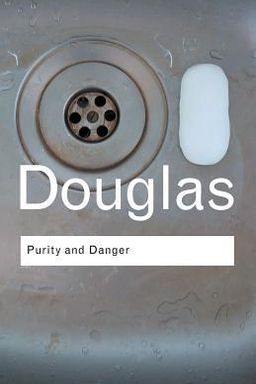
Purity and Danger cover

Purity and Danger

by Mary Douglas

In ''Purity and Danger,'' Mary Douglas explores how different cultures define purity and impurity, revealing the underlying structures that shape societal order and identity. By analyzing taboos and rituals, Douglas offers a fresh perspective on cultural differences and similarities, encouraging readers to rethink their own cultural assumptions.

Purity, Danger, and the Human Need for Order

What makes dirt “dirty”? Is it because it spreads disease—or because it threatens our sense of order? In Purity and Danger: An Analysis of Concepts of Pollution and Taboo, anthropologist Mary Douglas asks this deceptively simple question and turns it into one of the most revolutionary ideas in twentieth-century social thought. She argues that purity and pollution aren’t about hygiene. They are about how we make sense of the world. Behind every ritual of cleansing lies the deeper struggle to keep disorder—and danger—at bay.

Douglas’ central claim is that humans everywhere use taboos, prohibitions, and purity rituals to defend the categories that organize their experience. The fear of pollution arises not from germs or superstition, but from anxiety about what does not fit. Dirt, she famously writes, is simply matter out of place. It is a symbol of anomaly—of things that blur distinctions and threaten structure. Whether you recoil from spilled soup, forbidden touch, or impure behavior, you’re revealing your effort to protect a meaningful pattern in the world around you.

Primitive Fears and Modern Cleanliness

Douglas begins by challenging nineteenth-century ideas of “primitive religion.” Missionaries and early anthropologists saw non-Western rituals of purity as irrational, born of fear and ignorance. But Douglas shows that these so-called primitive practices mirror our own symbolic conventions. We may think we wash for hygiene, but our obsession with cleanliness also expresses social boundaries. A chipped cup or the wrong object in the wrong room can feel disturbing not because it’s dangerous, but because it breaks a pattern. The same logic guides taboos about bodily fluids, sex, and death across cultures—from African tribes to ancient Israel.

The Sacred and the Polluted: Not Opposites, but Twins

In her survey of world beliefs, Douglas observes that what’s sacred and what’s unclean often share a mysterious kinship. Both are set apart, hedged around by rules and danger. In the Hebrew Bible, as in Hindu India, holiness means separation—of pure from impure, of body from corpse, of clean from defiled. Yet holiness and uncleanness are not opposites but two sides of the same act of classification. When boundaries weaken, pollution surges forward. Societies then invent rituals to repair those categories—ritual cleansing, sacrifice, confession. The threat of impurity turns out to be a form of protection; it forces respect for order.

Pollution as a Language of Social Control

Throughout the book, Douglas explores how ideas of purity regulate morals and politics. Pollution beliefs often act as invisible laws of social hierarchy: they mark who may touch whom, who can eat with whom, who counts as dangerous or holy. Among the Nuer of Sudan, she notes, pollution rules decide uncertain moral cases—like incest or adultery—by calling divine punishment into play. When human justice is vague, pollution offers clarity. Each society, Douglas argues, positions its taboos to shore up fragile distinctions in gender, kinship, religion, and power.

Why This Matters Today

Douglas invites you to look at your own life through this lens. Why do you wince at dirty windows? Why do you distrust certain people, tastes, or regions as “polluted”? Her thesis reaches far beyond anthropology—it explains modern anxieties about contamination, exclusion, and danger. Later in life, she extended these insights to environmental fears and political conflicts (in Risk and Culture, co-authored with Aaron Wildavsky). Every society, from tribal villages to industrial democracies, uses the language of danger to protect its vision of purity. To understand taboo, Douglas insists, is to understand how humans build and defend meaning itself.

Douglas’ Core Insight

“Dirt is matter out of place.” With this single phrase, Douglas shifts the study of religion from superstition to structure—from fear of contagion to fear of chaos. Purity rituals, she shows, are creative attempts to impose system on the untidiness of experience.

What Douglas ultimately offers is not a theory of hygiene but a theory of meaning. Whether in Leviticus or your kitchen, humans use purity and danger to map the border between order and disorder, life and death, the known and the unknown. Her timeless question remains: what happens when those boundaries blur?


Ritual as the Architecture of Order

Douglas shows that ritual isn’t merely superstition—it’s the architecture of social order. Every rite, from washing to mourning, builds visible boundaries that give shape to experience. For Douglas, ritual is a “creative frame,” a way to focus attention and make chaos intelligible. Just as money stabilizes economic transactions, ritual stabilizes human relations.

Ritual Creates and Controls Experience

Borrowing from Durkheim and British anthropology, Douglas argues that rituals don’t simply express beliefs—they generate them. When a Dinka priest performs a rain ceremony, the goal isn’t to magically command the weather, but to transform the community’s perception of drought into moral experience. Ritual “frames” events, telling people how to feel and act within the pattern. Modern societies do the same in secular forms—graduations, weddings, cleaning sprees—each announcing what belongs and what doesn’t.

From Primitive Magic to Modern Meaning

Douglas dismantles the old idea that primitive rituals are “magical” attempts to control nature. Instead, she connects them to our own rituals of meaning-making. The Dinka herdsman who ties a bundle of grass to delay supper isn’t practicing superstition—he’s focusing his intention, turning a wish into an embodied symbol. Likewise, rituals in religion and daily life mediate between inner emotion and outer reality.

Ritual as Collective Therapy

Douglas draws on Victor Turner’s dramatic study of Ndembu healing—where villagers join in a symbolic cure that heals social rifts as much as physical ailments. She also cites Lévi-Strauss’s analysis of a Cuna shaman’s song for childbirth, where symbols reorder pain into meaning. Through ritual, people make suffering bearable, chaos comprehensible, and community possible.

Ritual doesn’t just mirror society—it keeps it alive. Without symbolic acts, Douglas warns, relations lose reality; society, like language without speech, collapses into silence.

For you, this reframes everyday habits: cleaning, celebrating, grieving—they’re not trivial, but ritual ways of maintaining coherence. As Douglas puts it, “Ritual separates, places boundaries, and makes visible statements about the world we intend to create out of the material we find.”


Purity and Pollution as Social Language

You might think cleanliness is about germs, but Douglas reveals it’s really about status. Rules of purity act as an invisible language that marks social hierarchy, respect, and inclusion. In India, the caste system is maintained through pollution taboos; touching leather or sharing cooked food can symbolize moral or political contamination. In Africa, similar attitudes define marriage, kinship, and moral duty.

Pollution Defines Boundaries, Not Germs

Douglas compares the Hindu Brahmin’s purity codes with those of the Nuer tribe in Sudan. In both, pollution rules articulate the limits of the social body. Bodily fluids—saliva, blood, semen—represent crossings between categories. In societies where physical boundaries are fragile, pollution taboos rise to defend them. When political or moral sanctions fail, invisible ones step in: “Where outrage goes unpunished, pollution beliefs supplement the lack of other sanctions.”

Pollution Reinforces Morality

Among the Nuer, moral confusion—like uncertain cases of incest—is settled by pollution rituals. Sacrifice, illness, or skin disease serve as “post hoc detectors” of wrongdoing. In such systems, Douglas shows, pollution is a moral shorthand for communal control. It simplifies murky ethics by converting guilt into ritual danger—making the abstract tangible.

Etiquette, Ethics, and Power

Douglas notes that most pollution rules map onto gender and kinship roles—wives avoiding certain foods, mothers purified after birth, daughters symbolizing the gate to family honor. As in many cultures from India to Africa, impurity aligns with social vulnerability: women, outsiders, and lower castes become symbolic carriers of danger. This pattern reveals how cultures project instability onto those least able to resist it.

For you, these insights turn ordinary discomfort—like shunning a stranger’s drink or recoiling from illness—into mirrors of your own hierarchy-making instinct. Pollution is society speaking in the language of purity and danger.


The Abominations of Leviticus Reinterpreted

Douglas’ reinterpretation of the biblical dietary laws in Leviticus is one of her boldest achievements. Rather than seeing these rules as irrational taboos or ancient hygiene, she reads them as a cosmological map—a way for the Israelites to express holiness through order. What animals were “clean” or “unclean” reflected not moral disgust, but symbolic structure.

Holiness as Wholeness

In Leviticus, holiness means completeness, the maintenance of categories God created. Cattle are clean because they fit perfectly—cloven-hoofed and cud-chewing. The pig and camel, which meet one test but not both, occupy an ambiguous middle and thus become “abominable.” This, Douglas explains, is not about dirtiness but anomaly: creatures that blur distinctions threaten divine order. Similarly, forbidden mixtures—wool with linen, seeds with diverse kinds—embody the anxiety of boundary confusion.

A System of Cosmic Classification

Douglas reconstructs the Old Testament worldview as a grand taxonomy. Just as Genesis divides creation into realms of air, water, and earth, Leviticus arranges creatures by their mode of movement—those that swim, fly, or walk. Animals that crawl or swarm defy this triadic order; they “confound the categories of creation.” Underlying every prohibition is the command “Be ye holy, for I am holy”—a call to preserve the structure of God’s cosmos by mirroring its purity.

Meaning over Morality

Douglas’ analytic method upends theology, choosing structure over sentiment. Modern interpreters saw these rules as irrational or moral allegories, but Douglas sees them as logical once you grasp their system. Holiness, she concludes, isn’t moral virtue but right order: the perfection of categories, the avoidance of confusion. Eating, for the Israelites, became a daily ritual of remembering creation, “a meaningful part of the great liturgical act of recognition and worship.”

This reinterpretation gives the ancient law its coherence—and gives you, as reader, a new lens to see how every act of separation, even choosing what to eat, echoes the deeper human desire to impose structure on chaos.


When the System Turns on Itself

Douglas explores a haunting paradox: what happens when the very system designed to impose order begins to contradict itself? In some societies, pollution rules become expressions of internal conflict—especially in gender and sexuality. When moral codes and structural needs clash, taboos proliferate to manage the tensions.

Sexual Pollution and Contradiction

Douglas compares several cultures—the Walbiri of Australia, the Nuer of Sudan, and the Lele of the Congo. Among the Walbiri, male dominance is absolute and direct; coercion maintains order, and pollution fears vanish. But among the Lele and Bemba, where women hold limited autonomy, sexual impurity becomes obsessively policed. The less physical coercion a society exerts, the more symbolic danger it invents. Menstrual blood, adultery, or childbirth become metaphors for moral instability.

The Social System at War with Itself

In societies where opposing principles—freedom and hierarchy, desire and duty—collide, pollution becomes the safety valve. The Lele, for example, structure male status around control of women, yet women can exploit their position to upset that hierarchy. Female pollution thus represents both the threat and the instrument of male control. Douglas interprets this as society symbolizing its internal contradictions on the body itself.

Purity as Impossible Ideal

The quest for purity, Douglas warns, can turn deadly. “To wish all women to be chaste at all times,” she writes, “must be literally barren.” When order hardens into dogma, it becomes sterile and oppressive. True ritual renewal requires accepting impurity, integrating chaos rather than denying it—a theme Douglas revisits in her stunning final chapters.

Her insight anticipates later anthropological and feminist critiques: every system of purity carries within it the seed of rebellion. When boundaries become too rigid, life itself finds ways to pollute them, forcing renewal.


Dirt, Decay, and the Cycle of Renewal

Douglas ends her book with a profound meditation on paradox: why do religions sometimes sacralize what they abhor? Dirt, she suggests, isn’t only destructive—it’s creative. The same forces that threaten order also renew it. Decay makes fertility; impurity makes purification possible. The holy and the unholy aren’t enemies but partners in transformation.

From Filth to Fertility

In cultures like the Bushong or Yoruba, polluting acts such as ritual incest or left-handed dancing don’t offend—they regenerate. By breaking rules in controlled ritual frames, people release symbolic power. Dirt’s danger comes from its ambiguity—neither one thing nor another—but that same ambiguity makes it potent for renewal. After disintegration comes reformation; after impurity, wholeness.

Purity through Death

Douglas links this idea to rituals confronting mortality. For the Dinka, the old Spear Master’s chosen death turns decay into social triumph; his sacrifice renews communal life. For the Nyakyusa, mourning rituals embrace filth as medicine against insanity. Each culture enacts the logic that only by touching death can one reaffirm life. In her most poetic passage, Douglas speaks of those who “freely embrace the symbols of death, and in so doing, keep their reason.”

The Wisdom of Embracing Disorder

Here, Douglas aligns with philosopher William James: the “completest religions” are those that accept suffering and impurity as part of life’s totality. The refusal to admit dirt, she says, leads to hypocrisy and sterility; the courage to incorporate chaos brings growth. To purify endlessly is to deny change; to compost filth, in her metaphor, is to generate the soil of renewal.

“The body is not a slightly porous jug. A garden is not a tapestry. If all the weeds are removed, the soil is impoverished.”

For Douglas, impurity is not failure—it’s life’s way of reminding us that perfection is impossible. Order must continually shatter and renew itself. The danger, she concludes, is not dirt itself but the fear of it.

Dig Deeper

Get personalized prompts to apply these lessons to your life and deepen your understanding.

Go Deeper

Get the Full Experience

Download Insight Books for AI-powered reflections, quizzes, and more.