
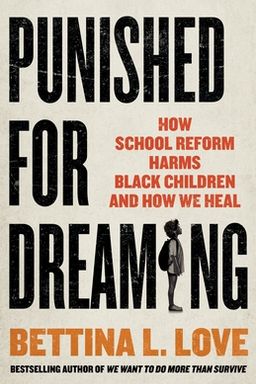
Punished For Dreaming cover

Punished For Dreaming

by Bettina L. Love

A professor at Teachers College, Columbia University, looks at the impact of some public-school policies on Black children over the last four decades.

White Rage, Schools, and Repair

What would it take to make schools life-giving for Black children? In Punished for Dreaming, Bettina L. Love argues that U.S. education since Brown v. Board of Education has not marched toward equality—it has absorbed and reproduced “educational White rage” through policy, markets, and policing. Love contends that reform after reform—testing, choice, philanthropy, alternative teacher pipelines—has reorganized schooling into a survival complex that punishes, surveils, and profits from Black children rather than educates them. To confront this, you must trace how White resistance remade the landscape, see how carceral and market logics permeate schools, and commit to educational reparations and abolitionist rebuilding.

Love’s frame keeps you honest about cause and effect. The 1954 Brown ruling triggered not a completed desegregation but a long backlash that displaced tens of thousands of Black educators, carved metropolitan boundaries that quarantined resources, and normalized privatized “solutions” (Milliken v. Bradley’s 1974 ruling limited inter-district remedies; think James Buchanan and Milton Friedman supplying theory for vouchers and privatization). Your present—underfunded schools, concentrated poverty, White-dominated governance—is not accidental; it’s engineered.

From crisis talk to a survival complex

A Nation at Risk (1983) declared a schools “crisis,” just as the War on Drugs and “broken windows” policing scaled punishment. Love shows how this synergy birthed what she calls the educational survival complex: politicians, philanthropies, testing firms, police, and real estate actors turn compulsory schooling into a marketplace of surveillance and scarcity. After Hurricane Katrina, New Orleans became the showcase: 7,500 mostly Black teachers were fired; the Recovery School District converted the city to charters; and philanthropies declared victory while communities lost power and jobs. Students like Love’s classmate Zook are cheered for athletic wins, then discarded when they’re no longer profitable—an emblem of a system that measures worth by utility, not humanity. (Note: Michelle Alexander traces similar logics in The New Jim Crow; Love centers their schooling consequences.)

Testing and predictive control

High-stakes testing, Love argues, has been the complex’s favorite instrument. From No Child Left Behind’s Adequate Yearly Progress to state exit exams, tests label students, trigger closures, and open avenues for privatization. The Atlanta cheating scandal illuminates how impossible targets and market pressure criminalized educators like Shani Robinson and shook students like Dre, who questioned whether his valedictorian scores were even real. Tests extend older eugenic projects (from IQ to The Bell Curve’s revival of racial hierarchy), and now algorithms upgrade that logic—ZIP code becomes destiny in admissions and policing heat lists. (Compare Wayne Au’s critique of high-stakes testing and Diane Ravitch’s policy analysis; Love keeps race at the center.)

Segrenomics and philanthrocapitalism

“School choice” looks like freedom but often monetizes segregation—segrenomics. Charters and vouchers siphon funds from neighborhood schools and subject families to instability. The KIPP story is Love’s parable: Harriett Ball, a Black master teacher, created a magnetic pedagogy. Two White TFA alumni, Mike Feinberg and David Levin, learned from her and co-founded KIPP, scaled by Fisher and Walton family millions, Reed Hastings, and Broad pipelines. Ball saw her methods nationalized while recognition and wealth bypassed her. The industry promises “disruption,” but families like Ace and Val’s navigate churn, closures, and hidden for-profit edges.

Carcerality, erasure, and the limits of DEI

Police in schools do not equal safety. SROs escalate minor behavior into arrests; Black girls face suspensions at staggering rates; districts fund officers over counselors. Kia’s assault by an officer, Sam’s bus-to-jail story, and Illinois ticketing expose how schools and courts now interlock. Meanwhile, a coordinated panic about CRT and “wokeness” erases truth and targets Black women educators—Cecelia Lewis forced out of a DEI post before she began; Nikole Hannah-Jones attacked for the 1619 Project; even the federal “error” of citing the Abolitionist Teaching Network. DEI—often a solo office with no budget—cannot remedy structural harm. (See Sara Ahmed on institutional diversity and Olúfémi Táíwò on elite capture.)

From truth to repair

Love’s answer is not piecemeal reform but educational reparations and abolitionist rebuilding. She and collaborators conservatively cost direct K–12 harms at $56 billion and lifetime earnings losses at $1.5–2.0 trillion for Black students entering kindergarten 1985–2005. She proposes federal responsibility (Darity & Mullen) and local Community and School Reparations Collectives to steward truth-telling, redistribution, and transformation—counselors over cops, advanced coursework access, infrastructure repair, and the return of Black educators. White readers are asked to “save yourselves” by breaking with conspiracism and the racial contract (Charles Mills), becoming co-conspirators who take risks—like James Tyson supporting Bree Newsome as she removed the Confederate flag. Finally, Love commands that you protect Black joy—modern hush harbors of music, community, and love—as fuel for the long work ahead.


The Undoing of Brown

Love explains that Brown v. Board did not end segregation; it catalyzed a sophisticated counterrevolution. White rage organized through courts, housing markets, and policy design to preserve advantage. If you look closely, you see how law and local politics converted a civil rights victory into a blueprint for resegregation and dispossession.

(Parenthetical note: Carol Anderson’s White Rage theorizes the backlash; Love shows its specific educational mechanics—teacher firings, boundary-drawing, and the pivot to market “choice.”)

Backlash by design

After Brown, districts closed schools (Prince Edward County) rather than integrate, while White families fled to suburbs and private “segregation academies.” Courts then narrowed remedies: Milliken v. Bradley (1974) blocked inter-district desegregation, sanctifying district lines that mapped neatly onto race and wealth. Economists James Buchanan and Milton Friedman supplied privatization blueprints that would later translate into vouchers and charters—policies that promise freedom but drain public systems.

Displacing Black educators

Desegregation often meant removing Black authority, not sharing it. Love highlights data: more than 38,000 Black teachers lost positions; roughly 90% of Black principals were displaced. Mrs. Victoria Ali’s testimony details how communities lost elders who knew children and families; Bettina’s mother, Patty, was bused into a hostile White school and then returned to an all-Black environment stripped of trusted adults. The price of “access” was the loss of professional Black knowledge rooted in care.

Geography as policy

Resegregation did not require explicit racial law; it relied on boundaries, zoning, and finance. White flight, exclusionary housing covenants, and suburban fiscal policy consolidated resources while city districts absorbed concentrated poverty. In Rochester, where Love grew up, early efforts to recruit Southern Black teachers helped, but housing discrimination and school assignment rules resegregated classrooms over time. Today’s map of opportunity—AP courses clustered in wealthy zones, decaying buildings in redlined neighborhoods—results from these choices.

What this history changes for you

If you want to fix schools, you must name architects and mechanisms. Love insists on accountability: call out markets pushed by Friedman and Buchanan, donors and foundations channeling segrenomics, and courts and legislators protecting segregation’s scaffolding. Without naming, you chase symptoms—test performance, attendance—while ignoring the political economy that produces them.

Patterns that persist

The undoing of Brown also explains why later reforms feel familiar. “Choice” reproduces separation under new labels; testing ranks and sorts; philanthropy funds technocratic fixes over redistribution. When you see a city with dozens of charter brands but crumbling neighborhood schools, or a state that lauds “parental rights” while slashing district budgets, you are seeing the throughline from Brown’s backlash to today’s marketplace of inequality.

Holding systems to account

Accountability starts by restoring power where it was stripped. That means reinvesting in Black educators, revisiting district borders and funding formulas, and confronting housing segregation as education policy. It also requires rejecting the convenient amnesia that frames inequality as culture or motivation rather than policy outcomes. When you remember the undoing of Brown, you stop asking why schools “fail” and start asking who benefits from their failure—and how to reverse the design.


The Educational Survival Complex

Love names a system you feel but may not have language for: the educational survival complex. It fuses schools to carceral and market institutions so thoroughly that punishment and profit feel natural. When you hear metal detectors, SROs, data dashboards, emergency takeovers, and charter conversions, you’re hearing its vocabulary.

(Note: Think of it as the education counterpart to the carceral state described by Michelle Alexander; Love traces the pipeline from classroom to courtroom and boardroom.)

Crisis as pretext

A Nation at Risk primed the public to equate “rigor” with more tests and stricter discipline. The War on Drugs then normalized surveillance and zero tolerance as “safety.” Together, they let policymakers frame deprivation as a discipline problem and sell market fixes. The result is schools that look like airports: scanners in the foyer, police in the halls, and cameras on ceilings—safety theater that breeds fear while neglecting counselors, nurses, and arts.

Disaster capitalism in practice

Hurricane Katrina’s aftermath in New Orleans is the complex’s exemplar. The Recovery School District seized the “opportunity” to replace a public system with a charter market, firing 7,500 mostly Black educators. Philanthropies and reformers called it innovation; families experienced displacement and disempowerment. Similar “shock doctrine” timelines unfolded in Newark, where a $200 million philanthropic windfall (Mark Zuckerberg et al.) advanced outsider agendas over community voice.

Children as metrics and markets

When test scores become currency, children become commodities. Companies—from Pearson and ETS to ed-tech platforms—grow by manufacturing scarcity and measurement. Athletes like Zook are recruited to win games and generate brand value; once injured or inconvenient, they’re discarded. Love’s phrase “auction block” stings because the incentives echo extraction, not education.

Who benefits and who pays

Politicians gain “results” narratives. Philanthropists shape policy without democratic checks, often gaining tax advantages and influence. Real estate interests benefit from school ratings tied to property values, further segregating opportunity. Meanwhile, students endure suspensions, closures, bus commutes across town, and curricula narrowed to what’s testable. Teachers face impossible metrics and churn, especially in charter or takeover environments.

How you resist the complex

You resist by refusing its terms. Don’t accept more tests, more police, or more charters as inevitable. Demand restorative justice over zero tolerance, community boards over private operators, and budgets that privilege human supports (counselors, social workers, nurses). Push for democratic governance with parent and educator majorities—structures that can say no to profiteers and redirect resources to joy, arts, and learning. Love’s north star is abolitionist: shrink the footprint of punishment and market extraction until schools are spaces of care and collective power.


Testing and Predictive Control

You’ve probably heard tests described as neutral yardsticks. Love shows you they are racial technologies that rank, sort, and punish. From A Nation at Risk through No Child Left Behind’s AYP to today’s algorithmic models, testing has been the hinge that swings schools toward closures, criminalization, and privatization.

(Parenthetical note: Wayne Au argues high-stakes testing maintains white supremacy; Love demonstrates how testing choices translate directly into punitive governance and market openings.)

From crisis to compliance

Once policymakers tied funding and legitimacy to standardized scores, schools converted time and relationships into test-prep drills. Subgroup rules incentivized gaming: special education placements to exclude scores, attrition of students less likely to pass, and “credit recovery” schemes with little learning. Adequate Yearly Progress thresholds triggered cascades of firings, closures, and charter takeovers—especially in Black communities.

Cheating scandal as systemic indictment

In Atlanta, prosecutors indicted educators across the district, including Superintendent Beverly Hall and teachers like Shani Robinson. Love argues the scandal was not bad apples; it was rotten incentives. If your job, your school’s existence, and your students’ dignity all hinge on a single score, the system has already cheated children—by narrowing learning to what’s measured and threatening relationships that make teaching possible. Dre, a valedictorian, wondered if his achievements were genuine; that psychic harm exposes how testing corrodes trust.

Eugenics upgraded

Standardized tests descend from IQ sorting and eugenics; The Bell Curve rebranded racist hierarchies as science to rationalize inequality. Today, predictive algorithms extend this logic: third-grade MAP scores predict elite admissions; ZIP code proxies race in risk scores; Chicago’s “heat list” imported actuarial suspicion into neighborhoods. Data becomes destiny when models reinforce the very conditions they claim to measure. (Compare Dorothy Roberts on the racialization of risk in child welfare and health.)

Follow the money

Testing fuels a multi-billion-dollar ecosystem: publishers (Pearson, HMH, McGraw Hill), scoring vendors, test-prep firms (Kaplan), and ed-tech platforms. Gates-funded Common Core aligned content and devices, expanding vendor markets. As schools chase metrics, private providers cash checks, while communities absorb closures and displacement.

Assessment without punishment

Assessment can inform practice if decoupled from sanctions. Love urges context-rich evaluation rooted in relationships—portfolios, performance tasks, teacher-led moderation—combined with investments that address the real variables of learning: stable housing, class size, experienced teachers, and culturally affirming curricula. The question for you is simple: does a test result trigger support or punishment? If punishment, it’s not an educational tool—it’s a control device.


Segrenomics and School Choice

“School choice” promises empowerment; Love shows how it often monetizes segregation—what she and others call segrenomics. When public dollars follow students into private or quasi-private entities without repairing neighborhood schools, you get a marketplace that profits from inequality and leaves families with costly, fragile options.

(Note: For broader critiques of charter expansion and privatization, see Diane Ravitch; Love spotlights racial dynamics, community disempowerment, and extraction through philanthropy.)

Harriett Ball to KIPP

Harriett Ball, a Black master teacher, built a multisensory pedagogy that made classrooms sing—“Knowledge is power, power is money.” Two White TFA alumni, Mike Feinberg and David Levin, learned from her and launched KIPP, amassing scaling capital from the Fisher family (Gap), Walton Family Foundation, Reed Hastings (Netflix), and Broad pipelines. Ball reportedly never received royalties; KIPP honored her with an award but institutionalized her craft in ways that bypassed her and her family’s economic security. This is segrenomics’ signature move: extract Black genius, rebrand it, and route power upward.

Market logics, disciplinary cultures

Charter growth often pairs longer school days with strict discipline and data regimes. Studies show many charters suspend Black students and students with disabilities at higher rates than district peers. Families like Ace and Val’s cycle through charters that promise “innovation” but deliver instability—teacher absences, leadership churn, and opaque governance. Aja’s story—bused to an 87% White suburb for advanced classes—captures the social cost: academic gains paired with alienation and tokenization.

Who funds and who decides

Billionaire philanthropists (Gates, Zuckerberg, Walton, DeVos) design choice ecosystems with little democratic input. They shape state policy, underwrite advocacy, and capitalize buildings through real estate deals. Meanwhile, for-profit operators (K12, White Hat/Accel, Charter Schools USA) and management organizations extract fees via “nonprofit” fronts. Federal start-up grants routinely fund schools that never open or close quickly—public risk, private control.

Costs pushed to families

Choice shifts burden onto parents: long commutes, multiple applications, and the emotional labor of navigating systems designed for insiders. Teachers pay too: non-union contracts, lower job security, and performance metrics tethered to tests. Neighborhood schools lose enrollment and dollars, spiraling into austerity and closure. The market calls that “efficiency”; communities call it loss.

Reclaiming public education

Ask different questions: Whose choice? For what end? With what safeguards? Love urges community-governed, well-funded public schools as the equity route—transparent budgets, elected boards, living-wage staffing, and curricular richness. Limit for-profit extraction, demand equity audits of philanthropic influence, and center parent–educator coalitions that can veto predatory deals. Real choice is a great neighborhood school, not a lottery for a scarce seat.


Deprofessionalizing the Teacher

You’ve heard reformers celebrate “disruption” and “flexibility.” Love asks: flexibility for whom? Often it means relaxing standards and experimenting on the most marginalized students. Teach For America (TFA) is her case study: a leadership pipeline that treats classrooms as two-year proving grounds, not professions built on deep preparation and community trust.

(Parenthetical note: Linda Darling-Hammond’s research documents lower initial effectiveness and higher turnover among underprepared novices; Love connects those outcomes to racialized experimentation.)

TFA as business strategy

Wendy Kopp’s TFA recruits elite grads, gives them five weeks of boot camp, and places them in high-need classrooms for two years. Districts save on pensions and benefits; TFA alumni populate reform orgs, foundations, and charter C-suites. Love’s line is blunt: “TFA is better understood as a business reform strategy that happens to involve education.” The arrangement devalues teaching as a craft while consolidating a network loyal to market reforms.

Human costs in classrooms

Turnover destabilizes learning. Students cycle through novices who may leave just as trust forms. Alternative certification programs (Teachers of Tomorrow, online pipelines) compound the problem, replacing clinical practice and mentoring with checklists. Shani Robinson’s arc—from TFA recruit to an educator indicted in the Atlanta testing scandal—shows how deprofessionalization and punitive accountability intersect, exposing teachers to criminalization for systemic failures they did not design.

The rhetoric of “innovation”

Startup mantras—“fail fast,” “move fast and break things”—sound exciting in a pitch deck. In schools, failure is borne by children, not investors. The normalization of experimentation in majority-Black districts would never be tolerated in wealthy, White suburbs with unionized, veteran staffs and rich enrichment. That double standard reveals the racial contract at work (Charles Mills’s “invisible ink”).

Rebuilding the profession

If you want better outcomes, invest in the people closest to students. Fund residency models, paid apprenticeships, robust mentoring, and time for collaboration. Protect due process and pensions to stabilize the workforce. Recruit and retain Black teachers and principals with loan forgiveness, housing supports, and leadership pathways. Tie accountability to supports, not attrition; measure what matters—relationships, culturally responsive pedagogy, and rich tasks—rather than just test deltas.

Ending the revolving door

Close districts’ dependence on short-term corps by creating grow-your-own pipelines and HBCU partnerships. Require transparency from alternative cert vendors and charters on training, attrition, and outcomes. Most of all, treat teaching as nation-building work, not a policy hack. As Love shows, communities thrive when experienced Black educators are present—and collapse when they’re displaced.


Carcerality Inside Schools

Many districts sell police-in-schools as safety. Love demonstrates that carcerality inside schools is a choice that criminalizes children, especially Black children, for behavior that educators could address with care. When you put armed agents and surveillance at the center, you get arrests for adolescence and pipelines to court, not learning.

(Note: ACLU, Justice Policy Institute, and Learning Policy Institute research corroborate higher arrest and suspension rates where SROs are present and large racial disparities in discipline.)

From D.A.R.E. to daily patrols

D.A.R.E. trained kids to surveil themselves and their families. Now SROs patrol halls nationwide, often without youth-specific training. Love cites an average SRO cost around $80,099 when you add salary, benefits, and gear—funds that rarely come with proportional investments in counselors or nurses. In some states, there are more officers than mental health staff in schools.

Disparities and damage

Black girls are suspended up to six times the rate of White girls; Black students lose an estimated fifty-one more days to suspension than White peers. Love tells Kia’s story: assaulted and handcuffed by an officer, then suspended—trauma compounded by punishment. Sam’s ride from school to jail on a bus blurs the line between institutions, teaching children that education is antechamber to incarceration.

Criminalizing poverty

Truancy enforcement and district boundary prosecutions (Kelley Williams-Bolar, Tanya McDowell) criminalize families seeking safety and opportunity. In Illinois, districts ticketed students for minor infractions, generating fines and court entanglement. Add JROTC and police magnet programs, and you see schooling that normalizes militarized authority rather than democratic participation. Love even notes a training “accident” where a deputy shot a student—proof that embedding weapons carries real risk.

Redefining safety

Safety is relationships. Replace SRO line items with counselors, social workers, nurses, and restorative justice facilitation. Publish disaggregated discipline data; end zero-tolerance policies; install student and parent advisory councils with veto power over security contracts. Build crisis response teams with mental health professionals and community mediators. Where schools have taken these steps, suspensions and arrests fall while belonging rises.

From surveillance to sanctuary

Your goal is to transform schools from quasi-jails to hush harbors for youth—places of joy, music, art, and care. That shift requires courage: saying no to fear-based politics and yes to investments that prevention demands. As Love insists, the carceral turn was a policy choice; so is its reversal.


Erasure, CRT Panic, DEI Limits

Even as schools harden, a parallel campaign narrows what can be taught and who can teach it. Love connects the panic over critical race theory and “wokeness” to a broader strategy of erasure that targets Black women educators and neuters institutional change by confining it to underfunded DEI offices.

(Parenthetical note: Sara Ahmed calls this the “non-performativity” of diversity—institutions perform commitment while resisting transformation. Olúfémi Táíwò names the “elite capture” of justice language.)

Manufacturing panic

Groups like Moms for Liberty and Parents Defending Education turn complex scholarship into scare words—CRT, indoctrination—and statehouses follow with bans. Florida’s Stop W.O.K.E. Act, “Don’t Say Gay,” and the blocking of AP African American Studies shrink curriculum and signal to Black students that their histories and identities are suspect. The U.S. Department of Education’s labeling of the Abolitionist Teaching Network citation as an “error” shows how quickly officials retreat under pressure.

Targeting Black women

Cecelia Lewis was hired to lead DEI in Cherokee County, GA; organized backlash eliminated her role before day one. Nikole Hannah-Jones’s tenure fight and public vilification sent a message: speak truth about race, pay a price. Love documents doxxing, threats, and campaigns to oust Black women who hold institutions accountable.

The DEI trap

DEI roles often lack budget, authority, or access. Lia, an equity director at a Virginia private school, spends her days insulating Black students from microaggressions and tutoring White colleagues in “being less racist,” not changing hiring, curriculum, or discipline policy. Mya, a district DEI lead in Kansas, has no budget and spends only 10–15% of time on proactive work. These stories show DEI as a holding pattern that produces optics, not redistribution.

Protecting truth and power

Erasure is not neutral; it is governance. To counter it, demand transparent curriculum review with public input; pass academic freedom protections; and require any DEI office to control budgets, data, and policy levers (hiring, discipline, course access). Pair curricular truth-telling with material investments in teachers, libraries, and student supports. Without budget and authority, diversity talk is a velvet rope around the status quo.

Memory as infrastructure

Teach Tulsa’s Greenwood massacre and Philadelphia’s MOVE bombing not as anomalies but as examples of the racial contract (Charles Mills) operating in daylight. Truth is infrastructure: it anchors reparations claims, inoculates against conspiracism, and equips students to read policy as power. Love’s message is clear: protect the right to remember, or you will repeat what unaccountable power prefers you forget.


Educational Reparations Blueprint

Reform is not enough because harm has already been done. Love proposes educational reparations—a concrete, costed plan to repair losses inflicted on a specific cohort of Black students and to restructure systems so harm does not recur. This is not symbolic; it’s a fiscal and governance program with line items, eligibility, and implementation architecture.

(Note: Grounded in work by William Darity Jr. and A. Kirsten Mullen on reparations, Love’s plan adapts national principles to K–12 with local governance via Community and School Reparations Collectives.)

Who is owed and why

The cohort: Black students who entered kindergarten between 1985 and 2005—11,945,000 children educated during the high tide of punitive reform. Their K–12 and early labor outcomes are largely fixed; so are the harms. This cohort endured building disrepair, police saturation, suspension disparities, loss of Black educators, and restricted access to advanced coursework.

What is owed

Conservative K–12 direct harms total about $56 billion: $33B for capital inequities; $16B for school policing costs; $6B for lost instructional time to suspensions; $1.1B for denied AP/IB credits. The largest losses are lifetime earnings—$1.5–2.0 trillion—driven by reduced college attainment and the displacement of Black teachers whose presence correlates with higher graduation and college-going.

Who pays and how

The federal government bears principal responsibility (Darity & Mullen). Mechanisms include congressional appropriations, Federal Reserve facilities, and tax policy changes. Love also proposes a philanthropic–corporate superfund, recognizing that foundations and vendors profited from testing regimes, charter expansions, and technology contracts. Administration would sit with an Educational Reparations Supervisory Board inside the U.S. Department of Education, with independent oversight.

How to govern repair

Create Community and School Reparations Collectives (CSRCs) composed of parents, students, educators, and community members with binding authority over spending, hiring, and safety policy. CSRCs run local truth-telling processes, set priorities (counselors over cops, arts funding, building modernization), and audit results publicly. Eligibility centers self-identified and school-identified Black students; Love rejects genealogical exclusions that would erase Black immigrants and multiracial youth.

From payout to transformation

Reparations are not only checks; they are structural investments: rebuild facilities; restore and expand Black educator pipelines; guarantee access to advanced coursework; eliminate police contracts; fund restorative justice; and ensure culturally sustaining curricula. Pair cash redress for individuals with community infrastructure so benefits compound. The outcome to aim for is simple: schools where Black children thrive, and all children benefit from systems designed for the most marginalized.


Abolition, Co-Conspiracy, Black Joy

Ending punitive schooling requires more than policy swaps; it requires a different imagination. Love’s abolitionist lens asks you to shrink violent systems and build life-affirming alternatives—restorative justice, counseling, arts, and community care—while practicing a solidarity that is willing to risk comfort. The fuel for this long project is Black joy.

(Parenthetical note: Ruth Wilson Gilmore defines abolition as presence, not absence—the presence of life-sustaining institutions. Love translates that principle for schools.)

What abolition means in schools

Abolition is not an overnight shutdown; it’s a phased replacement. Defund police contracts, build community crisis response, institutionalize restorative and transformative justice, and invest in mental health and material supports (meals, housing partnerships, transit stipends). Design safety as prevention and belonging rather than surveillance and force.

Co-conspiratorship over allyship

Allies agree; co-conspirators act. Love cites Bree Newsome’s removal of the Confederate flag and James Tyson’s visible protection as a model: use your privilege as a shield, not a stage. White readers must “save yourselves” by confronting conspiracism (Love recalls White graduate students denying Sandy Hook), breaking with the racial contract (Charles Mills), and taking risks in families, unions, churches, and school boards to defend truth and repair.

Hush harbors for the future

Love’s memories of weekend parties—music, food, laughter—are more than nostalgia. They are contemporary hush harbors: protected spaces where Black life is fully itself, replenishing people for struggle. Joy is refusal—the refusal to be defined by deprivation or control. Schools should mirror these spaces: fund arts and music, create rituals of celebration, and build classrooms where children see their beauty and brilliance daily.

Practices you can start now

Audit your school’s safety budget and reallocate to counselors and restorative teams; implement student-led truth-telling forums; expand culturally sustaining curricula and AP/IB access; build partnerships with local therapists and mutual aid groups; and create visible, regular celebrations of student culture and achievement. At the personal level, curate your media diet, challenge disinformation in your circles, and commit to a role in a CSRC or school governance body. Joy and justice require infrastructure; build both.

The horizon

Abolition and reparations together sketch a horizon where schools stop punishing children for dreaming and start resourcing those dreams. You don’t get there by tweaking metrics; you get there by choosing relationship over surveillance, truth over panic, and collective care over market logic. Love’s charge is clear: make schools hush harbors for every child—and defend them like your future depends on it, because it does.

Dig Deeper

Get personalized prompts to apply these lessons to your life and deepen your understanding.

Go Deeper

Get the Full Experience

Download Insight Books for AI-powered reflections, quizzes, and more.