
Idea 1
How Minds Make Meaning
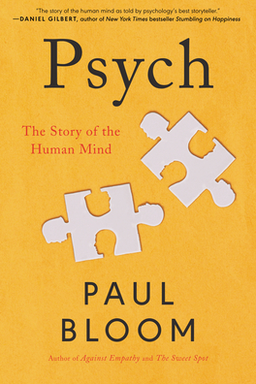
Psych: The Story of the Human Mind by Paul Bloom asks a thrilling question: how does an organ made of meat produce thought, emotion, morality, and culture? You begin with that startling premise—your joys, fears, and sense of self all arise from biology—then travel through psychology’s grand arc from neurons to morality, from babies to social reform. Bloom’s guiding idea is that mind and behavior are deeply biological yet irreducibly psychological: you need both brain science and mental-level explanations to understand the self.
The biological foundation of mind
Early chapters anchor you in materialism: the mind is what the brain does. Clinical stories—from Phineas Gage’s personality change after a tamping iron to Oliver Sacks’ neurological case studies—prove that altering the brain alters the person. You learn how neurons integrate inputs, fire via all-or-none spikes, and transmit signals across synapses via neurotransmitters like dopamine and acetylcholine. These details aren’t trivia; they show that every pattern of thought is grounded in electrochemical rhythms. Yet Bloom insists that even if neurons are the hardware, psychology still needs software-level explanations—language, mental representation, and decision rules—to describe human life.
Consciousness and the puzzle of experience
Materialism reaches its limit at consciousness—the subjective 'what it is like' to be you. Bloom reviews theories from Descartes to Chalmers, distinguishing easy problems (map the neural correlates) from the hard problem (why brain states feel like something). EEG patterns, fMRI signatures, and clinical cases like Patient 23’s imagery communication show you that consciousness can be empirically detected, yet its essence resists full explanation. You come away humbled: science can measure awareness but cannot yet explain its intrinsic feel. (In context, this parallels Nagel's 'bat' thought experiment and modern debates on AI consciousness.)
The unconscious, learning, and behavior
Freud enters as provocateur—mostly wrong in detail but right that unconscious motives shape life. His legacy, reframed through modern cognitive science, lives on in findings about implicit attitudes and automatic biases. The next steps—conditioning and learning—show psychology’s turn toward experiment: Pavlov’s dogs and Skinner’s pigeons prove associative principles; Tolman’s rats reveal cognitive maps, demonstrating that animals form internal representations. That discovery collapses strict behaviorism and ushers in the cognitive revolution, joining observable learning with internal modeling.
Development and the origins of thought
Bloom then guides you through the child’s mind. Piaget’s stages (sensorimotor to formal operations) set the template, but modern research revises it: infants, studied with habituation and violation-of-expectation methods, show early object permanence and numerical intuition. Elizabeth Spelke’s core knowledge thesis and Susan Carey’s 'child-as-scientist' model together show that growth is not just accumulation—it’s conceptual change. Children come equipped with innate structures and reconstruct the world through theory-like reasoning.
Language, thought, and symbolic life
Language ties biology to culture. Bloom explains phonology, morphology, and syntax as hierarchical systems enabling generativity—finite elements yield infinite meanings. You learn how babies track statistical patterns to parse words and how social cues aid word learning. Language shapes thought subtly: not deterministically (against strong Whorfianism) but through categories that frame perception and memory. (Color terms and spatial metaphors are tested examples.) Language emerges from both genetic endowment and cultural scaffolding, showing the unique synergy of nature and nurture.
Emotion, motivation, and evolution
Bloom’s evolutionary lens illuminates desire and emotion. Drives like fear, disgust, and lust serve adaptive purposes—avoiding harm, pathogens, and inbreeding (via the Westermarck effect). Yet emotions extend beyond survival: they organize social life through attachment, guilt, and pride. You read Naomi Eisenberger’s research showing social exclusion activates brain areas for physical pain, proving emotional pain’s biological realism. Evolution builds the foundation, but culture and cognition refine emotions into moral guidance and cooperation.
Morality, cooperation, and reputation
Kindness and justice flow from both genes and culture. Kin selection explains why you sacrifice for relatives; reciprocal altruism and punishment stabilize cooperation among strangers. Bloom uses Haldane’s famous quip and Trivers’ reciprocity theory to illustrate evolutionary logic, then shows that 'ugly' emotions like anger and revenge can sustain fairness by deterring cheats. Over time, moral emotions like guilt and outrage fuse with philosophical principles—from Kant’s universalism to Singer’s expanding circle—to generate impartial ethics. Reputation and signaling complicate motives but also make goodness socially valuable.
Human diversity and mental health
The latter chapters broaden scope: personality (Big Five traits), intelligence (g factor), and heritability studies prove that variation is partly genetic but malleable through context. Bloom cites Turkheimer’s laws and the Flynn effect to show that genes influence individuals, not destinies. Mental health discussions then address suffering—schizophrenia, depression, anxiety—and the limits of current treatments. Yet psychology also offers guidance on flourishing: strong relationships, freedom, and meaning matter more for happiness than wealth alone. Bloom blends skepticism of overpromised neuroscience with optimism about gradual scientific progress.
Social psychology in crisis and renewal
Finally, Bloom confronts psychology’s own failings. The replication crisis, p-hacking, and WEIRD sampling distort the field. Yet reform—preregistration, open data, broader cultural sampling—reflects science’s self-corrective strength. Classic studies (Asch’s conformity, Milgram’s obedience, Tajfel’s minimal groups) retain value not as indictments of human depravity but as lessons in context-dependent influence. Likewise, the priming controversies remind you to prize robust evidence over sensational claims. The closing message: psychological science is evolving toward humility, transparency, and truth, mirroring the complex minds it studies.
Core message
Your mind is nature plus history—a biological machine endowed with meaning, emotion, and morality. To understand it, you must integrate levels: neurons and narratives, genes and justice, evolution and culture. Bloom’s Psych teaches you not only how the mind works but how psychology, when disciplined and humble, uncovers what it means to be human.