
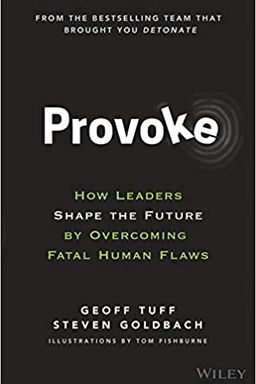
Provoke cover

Provoke

by Geoff Tuff and Steven Goldbach

Provoke by Geoff Tuff and Steven Goldbach reveals how leaders can shape their future by identifying and acting on emerging trends early. Learn strategic provocation techniques to outmaneuver competitors, capitalize on new opportunities, and drive your business to unparalleled success.

Provoking the Future: Acting Beyond Human Flaws

When was the last time you hesitated to act because you didn’t have all the information? In Provoke: How Leaders Shape the Future by Overcoming Fatal Human Flaws, Geoff Tuff and Steven Goldbach challenge the paralyzing tendency to overanalyze and delay. They argue that in a world of accelerating uncertainty, hesitation is the biggest risk. The only way for leaders to shape the future is to provoke it—to take deliberate, informed action even when data is incomplete.

Tuff and Goldbach contend that most organizations fall prey to predictable human flaws—cognitive biases, fear of being wrong, and bureaucratic inertia—that keep them stuck in analysis cycles. Meanwhile, bold actors who move quickly, test ideas, and learn through action—like Netflix, Warby Parker, or Rosalind Picard at MIT—create the future that everyone else will have to adapt to. The authors’ central claim is simple but profound: action is learning. Waiting for certainty means watching opportunity pass by.

From If to When: Shifting the Leadership Mindset

At the heart of Provoke lies the insight that most leaders misjudge trends because they treat them as uncertain “ifs” rather than inevitable “whens.” Whether it’s cord-cutting in media or decarbonization in energy, trends shift from possibility to inevitability over time. The ability to spot that inflection point—what Tuff and Goldbach call the phase change—separates reactive managers from forward-shaping provocateurs. Those who act when a trend is still forming set the rules of the new game; those who wait until it’s obvious are left scrambling.

Using vivid metaphors, the authors compare this dynamic to a rollercoaster ride. When you’re climbing the first steep slope (the “if” stage), potential energy builds—but if you wait too long, you’ll be dragged along helplessly once the descent begins (the “when” stage). Leadership today, they argue, is about recognizing when that tipping point is approaching—and having the courage to throw your hands in the air and ride the energy, not cling to the safety bar.

Fatal Human Flaws: Why We Miss What Matters

Before leaders can act, they must first conquer their own minds. The book’s first section, “Predictable Patterns,” dissects the biases that routinely derail progress. The availability bias makes you rely on what’s most familiar. The egocentric bias filters new data through old beliefs. The status quo bias convinces you that change is riskier than doing nothing. Combined with organizational dysfunction—meetings where people fear embarrassment, politeness mistaken for progress, and a scarcity of open disagreement—these “fatal flaws” ensure that companies miss emerging trends until it’s too late.

Tuff and Goldbach encourage leaders to use techniques like the devil’s advocate role, anonymous meetings, and diverse teams to widen their organization’s sightline. When everyone sees the world the same way, it’s like driving with blinders on—you might feel safe, but you’ll miss the turns ahead.

The Core Prescription: The Provoke Quintet

The second half of the book lays out five interlocking provocations—called the Provoke Quintet—that show leaders how to turn uncertainty into strategic advantage:

  • Envision: Imagine multiple future scenarios and use them to inform decisions now.
  • Position: Place bets and frame experiments to test how trends might unfold.
  • Drive: Take bold, direct action to shape outcomes when you have influence.
  • Adapt: Reconfigure your strategy when the game changes—before it forces your hand.
  • Activate: Build an ecosystem of partners who multiply your reach and speed.

These five moves form a playbook for acting in the face of ambiguity. Together, they help organizations progress from cautious analysis to purposeful experimentation—learning, adjusting, and accelerating forward. Success, the authors insist, comes not from having the perfect plan, but from making a series of minimally viable moves that build knowledge with each iteration (a nod to the lean-startup mindset popularized by Eric Ries).

Provocateurs in Action

To make these principles tangible, Tuff and Goldbach’s final section profiles real “provocateurs” who exemplify courage and foresight. Deborah Bial, founder of the Posse Foundation, redefined college access for underrepresented students by acting before systemic inequities were broadly acknowledged. Ryan Gravel envisioned the Atlanta BeltLine, transforming abandoned railways into a thriving urban loop. And Valerie Irick Rainford, formerly of JPMorgan Chase and the U.S. Federal Reserve, challenged corporate complacency around diversity and helped CEOs turn aspiration into measurable equity. Each story shows how mindful risk-taking—anchored in values and vision—creates a ripple effect that reshapes industries and institutions.

Why It Matters

In an era where every business, government, and social system faces compounding uncertainty—from climate change to automation—Provoke argues that waiting for perfect information is self-defeating. The future belongs to those who recognize that doing something—even something small—is often less risky than doing nothing at all. Leaders who embrace provocation cultivate organizational learning, creativity, and resilience. And perhaps most importantly, they make it fun again: intellectual play, curiosity, and action, not fear, become the default mode.

Bottom line: To shape the future, leaders must think less like analysts and more like experimenters. In the words of Tuff and Goldbach, “Action creates potential energy.” The choice is simple—you can passively ride the rollercoaster, or you can raise your hands, open your eyes, and provoke the future.


Predictable Patterns: Why We Wait Too Long

In one of the book’s most memorable stories, a dismissive media executive in 2009 shrugs at research showing a small percentage—just 1.75%—of Internet users streaming content on a new service called Netflix. “Why would I care?” he scoffs. That arrogance cost his company billions as cord-cutting reshaped the entertainment world. This vignette is Tuff and Goldbach’s vivid demonstration of pattern blindness—the tendency of organizations to follow predictable mistakes when trends appear on the horizon.

The Four-Stage Trap

The authors identify four recurring ways leaders mishandle emerging trends:

  • Miss the Trend: Cognitive filters prevent us from even seeing anomalies. Like the cord-cutting youth segment, disruptive shifts often appear small and easy to ignore.
  • Deny the Trend: When evidence mounts, people defensively question the data or attack the messengers. Denial protects ego but destroys foresight.
  • Overanalyze the Trend: Faced with threat, companies bury themselves in endless research and meetings. Periodic “updates” replace decisions. Analysis becomes a way to postpone action.
  • Respond Meekly to the Trend: When forced to act, the response is slow, small, and too late—think of brick-and-mortar retailers’ timid moves against Amazon.

Together, these behaviors form a corporate loop of inaction. Every missed opportunity strengthens inertia. By the time the “if” becomes a “when,” the disruptors have already rewritten the rules.

The Cost of Waiting

The authors use “wind-down firms” to illustrate the price of delayed response. These are once-viable companies coasting on legacy models, profitable but doomed—like traditional media conglomerates or department stores that waited out e-commerce. Recognizing you’re a wind-down firm can be wise if you choose to cash out intentionally, but most arrive there by accident, paralyzed by historical success.

The lesson is clear: avoiding failure requires an active stance toward change. Leaders must train their perception to notice weak signals early, debate trends constructively, and make what the authors call “minimally viable moves”—small, testable actions that prevent paralysis and keep learning continuous.


The 'If' vs 'When' Leadership Shift

When toilet paper vanished from shelves in 2020, it wasn’t rational panic—it was human psychology in motion. Tuff and Goldbach open their discussion of uncertainty with this unlikely symbol of the pandemic era to show how people misjudge change. The difference between an 'if' and a 'when' trend, they argue, defines how you should act.

From Possibility to Inevitability

In the 'if' phase, it’s still unclear whether a trend—like remote work or bidet adoption during quarantine—will stick. Once a trend proves desirable, feasible, and viable, it crosses into the 'when' phase. The uncertainty isn’t whether it will happen, but how soon. Waiting for more proof beyond that point wastes time and forfeits leadership.

The authors borrow the “Balanced Breakthrough Model” from design innovation: a successful trend satisfies desirability (people want it), feasibility (it can be delivered), and viability (it can make money). Cord-cutting, for instance, was more desirable than scheduled TV, equally feasible with high-speed Internet, and increasingly viable for Netflix. The moment all three aligned, the 'if' became a 'when.'

How to Spot the Phase Change

Spotting an “if-to-when” transition requires scanning the edges of your business model. Watch for customer behaviors that threaten your revenue logic—like unbundling products or new consumption habits. Companies should pay extra attention to weak signals that could upend their foundation. The 1.75% group of early streamers was enough to announce a seismic industry shift, had leaders been curious enough to listen.

The trick is to widen your aperture early. In ambiguous times, it’s better to observe too many signals than too few. Even red herrings teach you what doesn’t matter—knowledge equally valuable for shaping future moves.


Fatal Human Flaws and Organizational Blindness

Even brilliant leaders falter because they’re human. In “Personal Patterns,” Tuff and Goldbach show that our brains are wired against proactive change. These 'fatal human flaws'—biases and social dynamics—create systematic blindness, narrowing our organizational peripheral vision.

The Mind’s Traps

The availability bias makes visible only what’s familiar; the egocentric bias favors data confirming our worldview; the affect heuristic dulls reaction to small signals because they don’t trigger emotion. In groups, this blindness compounds. Leaders discount warnings until trends become personal threats—by which time, options have vanished.

The Organization’s Amplifiers

Companies amplify these flaws through culture and structure: endless meetings with no dissent, risk-averse “status quo” thinking, and the cult of busyness that leaves no time to reflect. Tuff and Goldbach satirize corporate theater sessions where disagreement is taken 'offline'—a ritual that ensures nothing truly changes. Fear of embarrassment and the scarcity of genuine debate make organizations less intelligent over time.

To counter this, the authors propose practical interventions like the 'HBD' game—inviting participants to label ideas as Hunch, Bias, or Data. This tags reasoning tracks and encourages clarity. When people understand which kind of thinking they’re using, honest disagreement becomes productive, not personal.


Expanding Peripheral Vision Through Diversity

Diversity, according to Tuff and Goldbach, isn’t just moral—it’s mathematical. Drawing on Professor Scott Page’s work, they show that diverse groups solve complex problems more accurately because their different perspectives cancel out individual errors. Formulaically: Group Error = Average Individual Error – Diversity.

Why Variety Beats Expertise

Homogeneous expert teams excel at efficiency but fail at discovery. Adding varied thinkers—different genders, ethnicities, disciplines, and lived experiences—unlocks “adjacent possibilities,” new ideas that wouldn’t exist without cognitive friction. This mirrors portfolio diversification: more viewpoints reduce total risk.

How to Harness the Benefits

  • Teach Productive Interaction: Pair advocacy with inquiry so everyone’s reasoning is visible and testable.
  • Staff Beyond Experts: Include cross-functional novices with 'beginner’s minds' to uncover blind spots.
  • Avoid the Siren Call of Sameness: Redesign hiring and networking systems that unconsciously prefer familiarity.
  • Reward Flexible Thinking: Leaders who change positions based on new information should be celebrated, not mocked as flip-floppers.

Ultimately, diversity expands what the authors call “organizational peripheral vision”—the ability to see trends early, argue constructively, and make smarter, faster moves when facing uncertainty.


The Provoke Quintet: Five Moves That Create the Future

After diagnosing our flaws, Tuff and Goldbach turn practical. The “Provoke Quintet” outlines five modes of action—Envision, Position, Drive, Adapt, and Activate—that leaders can apply depending on whether a trend is still uncertain (“if”) or inevitable (“when”).

1. Envision: See Before Others See

Like a skilled sailor scanning the horizon, envisioning means continuously imagining multiple possible futures. The authors’ energy sector case study contrasts sensitivity analysis with true scenario planning, showing that simplistic metrics (like average temperature) hide complex interactions. Real foresight requires narrative scenarios, quantitative models, and leading indicators that tell you when a world is becoming real.

2. Position: Prepare for the Change

When uncertainty still dominates, build positions that let you pivot. Warby Parker, for instance, tested—and proved—the viability of selling glasses online before the industry caught up. Zuora did the same with subscription billing, patiently building a beachhead while evangelizing the “subscription economy.” Positioning is about setting up small experiments to learn cheaply.

3. Drive: Shape the Trend

When you have control, push transformation aggressively. Billy Durant’s creation of General Motors consolidated a chaotic car market into a standardized industry. In tech, Pony Ma’s WeChat unified how Chinese consumers live and pay. These leaders didn’t follow momentum—they created it.

4. Adapt: Redefine Before Collapse

Sometimes survival means reinvention. Andy Grove’s pivot at Intel—from memory chips to microprocessors—epitomizes Adapt. It’s not capitulation but foresight: seeing the phase change before others accept it. Paula Gold-Williams of CPS Energy embodies this mindset, urging her utility to 'embrace ambiguity' to anticipate the energy industry’s inevitable decentralization.

5. Activate: Mobilize an Ecosystem

Ecosystem thinking multiplies a provocateur’s impact. The Pittsburgh turnaround combined Carnegie Mellon’s robotics research, universities, and public policy to reposition a collapsing steel town. Mozilla’s open-source community turned collective passion into a browser that challenged Microsoft’s monopoly. Whether by design or signal, ecosystems extend your reach and resilience.

Each move is a deliberate form of learning through doing. Success lies in executing minimally viable steps that provoke reaction, reveal new data, and lead to smarter subsequent actions.


Profiles of Modern Provocateurs

Part III of Provoke showcases three living examples—Deborah Bial, Ryan Gravel, and Valerie Irick Rainford—who demonstrate the mindset across social, civic, and corporate fields.

Deborah Bial: Diversity as Leadership Design

Bial’s Posse Foundation was born from a simple question: what if talented students from underrepresented backgrounds attended elite colleges together? Acting on an intuition before diversity became mainstream, Bial proved that collective belonging drives performance—over 90% of Posse Scholars graduate versus 62% nationally. Her gift is seeing “if-to-when” moments—whether securing Nobel laureate funding or pivoting to virtual programs during COVID-19—and putting something on the calendar to make them real.

Ryan Gravel: Designing a City’s Evolution

Gravel’s Atlanta BeltLine began as a student thesis inspired by Parisian urban life. By envisioning rail corridors as pedestrian loops, he redefined what modern infrastructure means. His evolution from dreamer to shepherd mirrors the 'Adapt' provocation: flexible, patient, and human-centered. The BeltLine shows how grassroots design and persistence can revitalize a city through connection rather than concrete.

Valerie Irick Rainford: Turning Equity into Measurable Change

Rising from deep hardship to lead diversity strategy at JPMorgan Chase, Rainford embodies relentless provocation against bias. Her formula—Data + Supportive Leader + Agent of Change—turns good intentions into outcomes. Under her guidance, Black executive representation rose by over 40%. Now, through Elloree Talent Strategies, she holds CEOs accountable for measurable impact, shifting leadership from performative allyship to systemic equity.

These portraits prove that provocation transcends industry or title. Whether you’re shaping education, urban design, or corporate culture, leadership today means daring to act first, learn fast, and invite others along for the ride.

Dig Deeper

Get personalized prompts to apply these lessons to your life and deepen your understanding.

Go Deeper

Get the Full Experience

Download Insight Books for AI-powered reflections, quizzes, and more.