
Idea 1
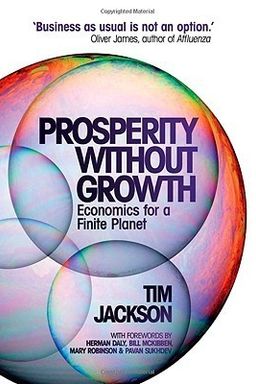
Prosperity Without Endless Growth
How can you build prosperous lives without destroying the ecological foundations on which they rest? In Prosperity Without Growth, Tim Jackson argues that modern prosperity is colliding with physical limits and cultural contradictions. The central claim is moral and practical: economic growth, once the engine of progress, has become the main threat to future wellbeing. Yet abandoning growth seems politically and institutionally impossible. Jackson’s project is to navigate this dilemma by reimagining prosperity as the ability to flourish within ecological boundaries.
The dilemma of growth
Jackson opens with the paradox that defines our age. Growth delivers stability and jobs, yet the material throughput that fuels it undermines planetary systems. Using Malthus’s warnings, the Club of Rome’s Limits to Growth models, and today’s planetary boundaries research (Rockström, Steffen, and colleagues), he traces how human activity already exceeds several critical thresholds—climate change, biodiversity loss, and nitrogen cycles among them. You quickly see the problem: a 3% annual growth rate makes the economy dozens of times larger by 2100, an arithmetic incompatible with finite biophysical resources.
What the science and arithmetic demand
Modern Earth-system science gives quantitative urgency to the argument. The global carbon budget—about 2,350 gigatonnes CO2 since 1870—has nearly been spent, leaving a decade’s worth of emissions before surpassing a safe limit. Jackson uses this climate arithmetic to illustrate why technological optimism alone cannot rescue the growth narrative. Efficiency and innovation have lowered carbon intensity by roughly 35% since 1965, yet absolute emissions tripled because scale outpaced savings. You become aware that relative decoupling (efficiency) is not enough; the numbers prove that only an unprecedented absolute decoupling could square growth with sustainability.
The 2008 financial crisis as symptom
Jackson’s work is shaped by his experience during the 2008 crisis while serving on the UK Sustainable Development Commission. The crisis exposed how deeply modern economies depend on growth: credit expansion, speculative bubbles, and political hostility to questioning growth were all outcomes of this dependence. When growth faltered, debt cascaded and governments responded with stimulus followed by austerity—both reinforcing instability. Jackson sees the meltdown not as a failure of capitalism alone, but as a demonstration that the growth imperative drives fragility throughout the system.
Reframing prosperity
The solution begins by replacing GDP with a richer concept of human capabilities. Drawing on Amartya Sen and Martha Nussbaum, Jackson defines prosperity as the ability to flourish—having the real freedoms to live meaningful lives of participation, creativity, and care. Material goods matter, especially for basic needs, but beyond a threshold they cease to add wellbeing. Empirical studies (Easterlin, Layard, Inglehart) demonstrate these diminishing returns. Prosperity thus rests on social and psychological goods—health, trust, community, fairness—rather than sheer consumption.
Transforming the moral and institutional order
Flourishing within limits requires cultural and structural change. Consumer capitalism exploits our evolutionary bias for novelty and status, creating what Jackson calls an ‘iron cage’ of consumption. Advertising, credit, and planned obsolescence make restraint difficult. Escaping this cage demands altering institutional incentives—tax structures, product standards, and urban design—not just individual moral exhortation. Experiments such as São Paulo’s ads ban, Transition Towns, and cooperative enterprises illustrate how policy can shift behavior toward sufficiency and community values.
A post‑growth economy
Jackson’s macroeconomic reconstruction revolves around four foundations: enterprise designed as service, work valued as participation, investment committed to long-lived assets, and money reformed for stability. He and Peter Victor use stock‑flow consistent models to prove that a steady-state economy can remain stable with interest-bearing credit if fiscal and monetary policy support low-growth conditions. The goal is pragmatic: achieve full employment, stability, and equity in a stationary economy. Work-sharing, public provisioning, and long-term ‘slow capital’ investments become essential instruments.
The role of governance
Finally, Jackson calls for a progressive State—democratic but decisive—to establish ecological limits, tackle inequality, and mobilise investment in green infrastructure and social wellbeing. He aligns with thinkers like Mariana Mazzucato (on mission‑oriented public investment) and Elinor Ostrom (on polycentric commons governance) to show that coordinated public purpose can make prosperity without growth achievable. The book ultimately reframes hope itself: true progress means flourishing communities sustained by stewarded assets, not perpetual expansion.