
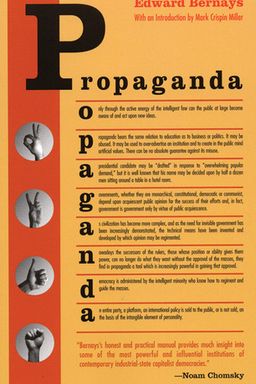
Propaganda cover

Propaganda

by Edward Bernays

Edward Bernays'' ''Propaganda'' explores the surprising necessity of strategic manipulation in modern democracies. Far from being a tool of dictators, propaganda shapes public opinion and guides societal behavior, revealing the blurred lines between advertising and political persuasion. This book is essential for understanding the power dynamics at play in contemporary society.

Propaganda as the Invisible Power of Democracy

Have you ever wondered who truly shapes your opinions—whether about elections, fashion trends, or the products you buy every day? In Propaganda, Edward Bernays, often called the “father of public relations,” argues that modern society is ruled by what he calls an invisible government—those who understand how to manipulate public opinion and social habits. These men and women, unknown to most of us, control the levers of collective consciousness using psychology, media, and messaging. The book contends that propaganda is not merely a political tool of deception—it is the very organizing force that keeps democratic societies functioning amid mass complexity.

Bernays wrote this in 1928, after World War I demonstrated the staggering power of propaganda to mobilize entire nations. With millions of literate citizens, mass media, and complex interdependent systems, Bernays believed that democracies could not operate smoothly without leaders who strategically manage public opinion. His idea is paradoxical yet pragmatic: if the masses are overwhelmed by information, persuasion becomes a necessary instrument of order.

The Central Philosophy: Organized Influence in a Chaotic World

Bernays begins by asking how modern societies—enormous, pluralistic, and dispersed—can possibly function without chaos. In earlier centuries, kings or church elites guided social consensus. But when political power shifted to the people, the new rulers—the masses—proved too fragmented and emotional to manage complex issues. Thus arose the need for what Bernays calls the “invisible governors”: those who shape the public mind through systematic persuasion. These invisible actors range from industrial magnates and advertisers to reformers, educators, and politicians who use language, symbols, and psychology to align public sentiment with chosen objectives.

For Bernays, propaganda is not inherently sinister. He distinguishes between propaganda used for manipulation and propaganda used for social alignment. Just as advertising helps consumers make choices in a sea of similar products, political communication helps the public navigate complex policy questions. In his view, organized influence provides the necessary simplification that allows democracy itself to survive.

From Chaos to Cooperation: Why We Consent

Bernays insists that the manipulation of opinion is not an aberration—it is how consensus is built. He argues that each person is a member of countless overlapping groups: occupational, religious, cultural, and recreational. By understanding how these groups function and who leads them, the “engineers of consent” can efficiently transmit beliefs throughout society. For example, if a government agency wants to promote vaccination, it need not persuade every citizen individually. It can convince medical associations, clergy, and community leaders who, in turn, influence their followers.

This dynamic explains how you come to trust some sources more than others and why your attitudes often reflect group opinions rather than personal research. The process is not always obvious—propaganda often operates through cultural symbols, emotional appeals, and repetitive exposure that normalize certain ideas. In Bernays’s framework, persuasion is not the enemy of freedom but its organizing mechanism: the tool that enables complex societies to act collectively without authoritarian control.

The Methods: Science Meets Suggestion

The book goes far beyond abstract theory. Bernays outlines how modern propagandists combine psychology, sociology, and media strategy to influence groups. Drawing from thinkers like Gustave Le Bon and Sigmund Freud (his uncle), Bernays explains that humans are largely driven by unconscious desires rather than rational analysis. The propagandist, therefore, speaks to emotions, habits, and cliches rather than logic. Through images, associations, and the authority of trusted figures, messages bypass critical thinking and become self-evident truths. Propaganda, he asserts, “rules the masses by creating circumstances that compel them to think and act alike.”

Bernays uses vivid examples: fashions launched through Paris designers, political reforms timed for maximum press attention, or corporate causes promoted by celebrity endorsements. Whether it’s women’s clubs campaigning for child welfare or industrial giants shaping investor confidence, each instance shows the same blueprint—create emotional appeal, align with authority, and control the environment of thought.

Why It Matters to You

Understanding Bernays’s concept of invisible government is crucial in the twenty-first century, where digital media saturates daily life. The same mechanisms he described—selective framing, group psychology, and emotional conditioning—now operate with unprecedented precision through algorithms and global networks. Bernays believed education and ethical standards could guide propaganda toward public good, transforming manipulation into “enlightened persuasion.” For readers today, his work serves as both a manual and a warning: persuasion can either educate or enslave, depending on who controls the narrative and to what ends.


The Psychology Behind Mass Persuasion

Bernays builds his methodology on psychological research by pioneers like Gustave Le Bon and Wilfred Trotter, who explored crowd behavior, and on Freud’s insights into unconscious motivation. He argues that individuals in groups do not think—they feel. Intelligence gives way to instinct. The masses, he wrote, “react to stereotypes rather than reason.” This recognition reshaped how businesses, politicians, and reformers would approach persuasion.

Crowd Mentality and Group Leadership

When you belong to a group—be it a church, fan base, or political party—you unconsciously adopt its emotional tone. Bernays calls this the herd instinct: the tendency to imitate leaders rather than think autonomously. Influence, therefore, works not by reaching every individual directly but by shaping the leaders who guide your group identity. By persuading a trusted authority—a pastor, doctor, editor, or influencer—the propagandist indirectly persuades thousands.

(Modern parallel: marketing strategists and political campaigners still focus on influencers and micro-leaders rather than undifferentiated audiences. Bernays anticipated this almost a century ago.)

Symbols and Emotional Shortcuts

Bernays demonstrates how group behavior is steered through emotional triggers rather than factual analysis. He explains how certain words—like “freedom,” “progress,” or “patriotism”—carry symbolic meaning that bypasses rational resistance. For example, during World War I, propaganda posters didn’t argue national policy; they invoked images of family, honor, and duty. These emotional associations compel action far more effectively than logic or statistics.

He gives the example of how changing the label of a wartime “hospital” to an “evacuation post” altered public perception. The new term sidestepped negative connotations, proving the extraordinary power of language engineering.

Freudian Drives and Hidden Desires

Drawing upon Freud, Bernays asserts that modern propaganda succeeds when it appeals to unconscious desires—security, love, status, and belonging. In a classic example, he reveals how consumers may buy a car not for transport but for prestige or sexual symbolism. By identifying and amplifying hidden motivations, propagandists turn ordinary objects into emotional symbols. This principle, which he dubbed “engineering consent,” powered much of twentieth-century advertising and remains foundational to persuasion in digital culture today.


Business as Propaganda Laboratory

Bernays shows how business became the proving ground for modern propaganda techniques. After the Industrial Revolution, mass production created a new challenge: producers had to generate continuous demand for their goods. The result, he writes, was a shift from waiting for customers to creating customers. Companies began to study psychology, social habits, and media influence with scientific precision.

From Salesmanship to Social Engineering

Business, Bernays explains, discovered that it must sell not only its products but also its identity and ideals. A bank’s reputation depends on public confidence; an oil company’s success depends on appearing socially responsible. Public relations thus became a continuous process of shaping perception through stories, events, and symbols. For instance, a bakery might host factory tours to communicate cleanliness and modernity, or a utility company might sponsor art exhibitions to signify cultural refinement.

Bernays believed that authentic propaganda aligns business aims with public welfare. He even claimed that wise corporations serve democracy by interpreting the needs of the people—as long as they remain honest.

Examples: Luggage, Shoes, and Electric Light

He draws numerous examples: luggage makers improved sales not through ads but by persuading travel companies and governments to ease baggage restrictions; shoe manufacturers advanced foot health campaigns; electric companies promoted art in lighting design. Each success rested on creating shared interest—what Bernays called identifying the “common denominator” between public good and private gain.

Public Relations as a Social Function

For Bernays, the business leader is a social engineer who must foresee and adapt to public opinion. He warned that if companies ignore their moral obligations or deceive the public, backlash will follow. “Once you have the good will of the general public,” industrialist Judge Gary said (as Bernays quotes approvingly), “you can go ahead in constructive expansion.” Propaganda, used ethically, converts business strategy into democratic education.


Politics and the Manufacture of Consent

Bernays places politics at the heart of modern propaganda. In a democracy, leaders must not only lead but also interpret public will. Yet most politicians, he argues, remain trapped in outdated methods—speeches, parades, and slogans—while business had already evolved scientific persuasion. Political success now requires not shouting at the people but orchestrating their attention.

From Oratory to Organization

To Bernays, effective political leadership means creating emotional engagement before policy arguments even begin. A “born leader,” he said, connects with voters’ subconscious hopes and fears through carefully staged circumstances. The example of Thomas Masaryk, who timed Czechoslovakia’s independence announcement on a Monday—when global press coverage would peak—illustrates the marriage of symbolism and timing. Modern statesmen, Bernays warns, must be as skilled in propaganda as in economics or law.

Trial Balloons and Policy Design

He documents the “trial balloon” tactic: politicians leak ideas anonymously to test reactions before committing publicly. Yet Bernays calls this inefficient. A true leader uses propaganda positively—not to follow opinion but to shape it. By studying group minds and crafting emotional resonance, the propagandist enables government to teach the people rather than merely mirror them.

Government by Education

Bernays concludes that democracy must be a “leadership democracy” guided by an intelligent minority capable of educating the majority. He proposes institutionalizing a “Secretary of Public Relations” within government—someone who interprets citizens to government and government to citizens. This official, he believes, would sustain trust through transparency and constant communication. In essence, he reframes governance as an ongoing persuasion campaign designed to align public sentiment with national goals.


The Feminine Power of Organization

One of Bernays’s most striking chapters analyzes women as emergent political actors. He praises women’s organizations for mastering propaganda better than many male politicians. Movements like the League of Women Voters, Women’s Christian Temperance Union, and Federation of Women’s Clubs, he writes, learned during the suffrage campaigns how to mobilize collective emotion for legislative change.

Harnessing Group Energy

Women’s organizations learned to dramatize issues visually and morally. The Consumers’ Committee of Women, for instance, fought a tariff bill by displaying everyday goods in a store window—showing how prices would rise under new duties. Thousands of onlookers were persuaded without speeches. Such actions translate abstract policy into tangible experience—a quintessential Bernays technique.

From Clubs to Collective Authority

Bernays catalogues how women’s clubs, numbering over 13,000, influenced everything from public health to art education. They campaigned for playgrounds, milk programs, and protective labor laws, often achieving results where lone politicians failed. By aligning moral appeal, organization, and storytelling, they became central channels of democratic influence.

He predicts that women, conscious of their persuasive power, will reshape public life just as they reshape the home. Their focus on “social housekeeping”—creating cleaner, healthier, more just communities—demonstrates propaganda’s power to uplift rather than exploit human instincts.


Education as a Propaganda Problem

Bernays laments that education, though vital, fails to engage the public’s imagination. Teachers, he argues, are trained to address classrooms but not the wider community. They lack the very communication tools—media literacy and psychological insight—that could make learning civic and exciting.

Teacher as Educator and Propagandist

He urges normal schools (teacher colleges) to prepare educators who see themselves as public communicators as well as lecturers. Education must sell itself as a social necessity, using campaigns, storytelling, and alliances similar to health or safety movements. “The teacher’s job,” Bernays wrote, “is twofold: education as teacher and education as propagandist.”

Universities, Endowments, and Perception

He contrasts state universities—dependent on legislative goodwill—with endowed colleges beholden to wealthy industrialists. Both require public trust to survive. When business sponsors research or scholarships, critics may suspect hidden bias. Hence universities must maintain transparent relations with the public, dramatizing their discoveries in ways that invite admiration rather than suspicion. His examples—Harvard’s Mayan archaeology or Columbia’s Casa Italiana—show that academic prestige itself requires public relations.

For Bernays, educational reform begins with perception management. Knowledge must be publicized just as products are marketed, and universities must learn to “broadcast knowledge” if they wish to remain relevant. In this sense, he makes a bold claim: education, like politics or business, ultimately depends on propaganda.


Social Service, Science, and the Art of Persuasion

Bernays expands his scope to include social progress movements—health campaigns, racial equality, public welfare, and scientific research. Even humanitarian causes, he argues, depend on publicity. Without organized communication, moral appeals remain whispers in a noisy world.

Building Moral Momentum

He recounts how the NAACP’s 1920s anti-lynching campaign used strategic location and dramatization. Its conference in Atlanta—deep in the segregated South—symbolically challenged prejudice. By inviting Southern ministers and press leaders, organizers reframed racial justice as a Southern, not Northern, concern. The event’s success lay not only in its message but in the setting that made it newsworthy.

Propaganda as Social Education

Public awareness, Bernays asserts, evolves only through “scientific publicity.” He cites campaigns for public health, sanitation, and education that transformed habits through persistent messaging. Even governmental reforms in prison systems or health departments progress only when the public is persuaded to care. “Social service,” he concludes, “is identical with propaganda.”

Art, Beauty, and Industry

In later chapters, Bernays extends this logic to art and science. Museums, once static “morgues,” must become living teachers through publicity and collaboration with industry. A pottery vase replicated in mass-produced china could elevate every home; a museum exhibition publicized through stores could democratize taste. Beauty, science, and humanitarianism advance not in isolation but through orchestrated public relations that make values visible, desirable, and contagious.


The Media Machine and the Mechanics of Influence

Bernays closes his treatise by dissecting the machinery that spreads ideas: newspapers, magazines, radio, motion pictures, lectures, schools, and personalities. Each medium, he insists, has its rhythm, audience, and psychological impact. The propagandist’s genius lies in synchronizing them into a consistent symphony of message delivery.

News as Manufactured Reality

Press publicity, Bernays maintains, is not deception but creation. A skillful public relations counselor doesn’t distort facts but orchestrates events that generate news appeal. “Cables make history,” he quotes from his experience with statesmen. The modern press, hungry for stories, becomes both vehicle and validator of planned events. He urges propagandists to respect journalistic integrity while understanding editorial priorities—what qualifies as news is partly shaped by them.

The Power of New Media

Radio, film, and emerging technologies broadened the scope of persuasion beyond print. Bernays foresaw the rise of multimedia storytelling, where entertainment doubles as influence. Motion pictures “standardize habits and ideas,” he writes, while radio unites millions in shared emotion. He imagines future “scientific coordination” among these tools—a prophetic anticipation of mass culture and digital convergence.

The Eternal Logic of Propaganda

Bernays ends optimistically: propaganda will never die. As long as humans seek meaning and direction, persuasion will organize chaos into coherence. He calls it “government by education,” insisting that enlightened propaganda—rooted in truth and public interest—can reconcile democracy’s contradictions. For readers today, his closing warning rings louder than ever: regardless of medium, intelligent men must decide whether to use propaganda to liberate thought or to enslave it.

Dig Deeper

Get personalized prompts to apply these lessons to your life and deepen your understanding.

Go Deeper

Get the Full Experience

Download Insight Books for AI-powered reflections, quizzes, and more.