
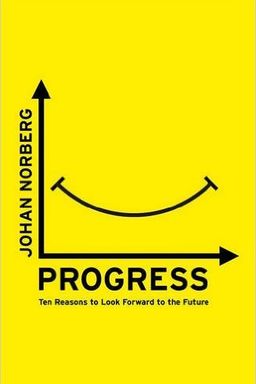
Progress cover

Progress

by Johan Norberg

Progress invites readers to challenge the pessimistic narratives of decline by showcasing significant improvements in health, wealth, peace, and freedom. Johan Norberg draws on compelling evidence to argue that humanity is on an upward trajectory, offering a hopeful vision for the future.

The Astonishing Story of Human Progress

When you look at today’s headlines — war, disease, inequality — do you ever feel the world is spiraling out of control? Johan Norberg, in Progress: Ten Reasons to Look Forward to the Future, challenges that reflex of despair. He argues that while our attention naturally gravitates toward disasters and dangers, the long arc of history tells a radically more hopeful story: for the first time, most of humanity is healthier, safer, freer, and more prosperous than ever before.

Norberg’s central claim pivots on a simple observation: progress isn’t a lucky accident — it’s the cumulative result of freedom, reason, and global cooperation. The Enlightenment’s commitment to science and individual liberty set in motion a chain reaction of improvements that continue to this day. Yet, he warns, progress is fragile; our collective amnesia about how far we’ve come may be its greatest threat.

How the Enlightenment Changed Everything

Humanity’s turning point came with the rise of rational inquiry in the seventeenth and eighteenth centuries — what Norberg calls the first great escape. When people began questioning authority and applying reason to nature and society, they unleashed new forms of problem-solving. The result was the scientific revolution, which rapidly translated into the Industrial Revolution — the era that began to lift billions out of destitution and reshape human life.

Before this, almost everyone lived in extreme poverty, prey to famine, disease, and arbitrary power. The Enlightenment introduced the idea that human welfare could improve through knowledge, trade, and open exchange of ideas. Norberg connects these principles directly to modern advances — from vaccines and sanitation to democracy and education — that expanded the circle of human dignity.

Why We Feel Worse Even as Life Improves

Given such extraordinary gains, why do most people feel pessimistic about the world? Norberg dissects this paradox in his epilogue: our brains evolved to pay attention to threats, not trends. News outlets amplify the dramatic and the exceptional — wars, crashes, crimes — while ignoring the slow, silent revolutions in prosperity. As a result, we underestimate progress and overestimate peril. Studies like the Gapminder surveys (inspired by Hans Rosling) show that a majority of people in wealthy nations believe poverty and hunger have increased, when the opposite is true.

Norberg sympathizes with this bias but insists it leads to dangerous nostalgia and populist backlash. When we forget progress, we search for culprits instead of causes. We offend the truth that human freedom and science have already proven to be humanity’s most powerful problem-solving tools.

The Ten Frontiers of Progress

Norberg organizes his argument around ten frontiers — food, sanitation, life expectancy, poverty, violence, the environment, literacy, freedom, equality, and the next generation — each a story of how reason and openness have transformed conditions once seen as permanent. He follows a common narrative structure: first, he paints a vivid picture of the old world’s misery, then documents humanity’s rise through innovation, cooperation, and reform. It’s not just a chronicle of numbers; it’s a celebration of moral progress — of widening empathy, dismantled hierarchies, and expanded rights.

From the invention of antibiotics to the abolition of slavery, from women’s suffrage to the internet revolution, the book reveals a constant pattern: as societies free minds and markets, they thrive. Where oppression, superstition, or authoritarian control chokes creativity, suffering persists.

Why This Matters Now

Norberg doesn’t write to make readers complacent — his mission is the opposite. Seeing progress clearly, he says, empowers us to defend it. Knowledge of our trajectory inoculates against cynicism and fatalism. Our ancestors fought diseases, famines, tyrants, and prejudices once thought invincible. Remembering their victories helps us face modern challenges — from climate change to inequality — with informed optimism rather than despair.

“If you are looking for a monument, look around you.”

— Norberg’s closing line, echoing Sir Christopher Wren’s epitaph, reminding us that progress is all around us, if only we choose to see it.

In essence, Progress is both a history of the modern world and a manifesto for open societies. Norberg’s message resonates deeply in an age of anxiety: pessimism can paralyze, but optimism — grounded in evidence — compels us to act, innovate, and continue the extraordinary human story of advancement.


From Famine to Full Plates

Norberg opens his tour of progress with the most fundamental human need: food. For most of history, scarcity defined daily life. In Sweden, his own ancestors mixed bark into bread during the famines of the nineteenth century. Across Europe and Asia, famine was a recurring catastrophe — millions starved when crops failed, and the poor subsisted on monotonous diets of gruel and herring. Fernand Braudel’s chronicles of medieval France documented more than twenty major famines per century. Hunger wasn’t exceptional; it was routine.

Breaking the Malthusian Trap

In 1798, the cleric and economist Thomas Malthus predicted that population growth would always outpace food supply, leaving humanity trapped in a cycle of famine. Norberg shows how Malthus underestimated human ingenuity. The Enlightenment’s faith in science soon produced innovations that shattered this trap: mechanized farming, synthetic fertilizers, and later, the global diffusion of agricultural knowledge.

The true revolution came from two chemists — Fritz Haber and Carl Bosch — who in 1909 devised a method to extract nitrogen from the air, creating affordable fertilizer. Vaclav Smil calls this invention “the most important of the twentieth century,” since it feeds more than three billion people today. Later, American agronomist Norman Borlaug’s “Green Revolution” spread high-yield seeds and modern techniques through Asia and Latin America, allowing countries like India and Mexico to escape chronic famine in a single generation.

Borlaug’s wheat virtually ended mass starvation, earning him the Nobel Peace Prize for saving what historian Rudy Boschwitz estimated as “a billion human lives.” Norberg notes that this revolution also saved nature itself, by increasing yields without expanding farmland — preventing forests and wetlands from being plowed under.

Abundance and Its Critics

Despite these triumphs, mid-twentieth-century pessimists revived Malthusian fears. Books like Paul Ehrlich’s The Population Bomb (1968) warned that hundreds of millions would starve by the 1970s. Instead, global calorie intake rose sharply, and food prices fell by half over the century. Norberg underscores the irony: famine, once a natural disaster, is now almost entirely man-made — the result of war or dictatorship, not scarcity. As Amartya Sen observed, no democracy has ever suffered famine.

While hunger remains in pockets of conflict-torn Africa, chronic malnourishment has fallen from over one-third of humanity in the 1940s to around ten percent today. For Norberg, this is a moral as well as material victory. It shows what happens when freedom, science, and trade converge — and refutes every prophecy of collapse.

“Strange as it sounds, democracy has become our best weapon against famine.”

From bark bread to supermarket abundance, Norberg’s account of food captures the book’s entire spirit: every time humanity faced an existential limit, knowledge and openness expanded that limit. The next challenge, he reminds you, isn’t producing enough — it’s producing responsibly, sustainably, and ensuring everyone can afford the feast.


Freedom and the Fall of Tyranny

Freedom, Norberg insists, is the engine behind every other advance. His survey of history shows how liberty — economic, political, and individual — dissolves oppression and violence over time. By tracing the abolition of slavery, the collapse of autocracy, and the rise of democracy, he reveals how moral ideals become global norms once freedom of thought and trade are unleashed.

The Long War Against Slavery

Slavery, as Norberg stresses, was once a universal institution, existing in every known civilization. It took the Enlightenment to challenge its legitimacy. Philosophers like Adam Smith and Voltaire denounced the practice as incompatible with natural rights. Religious and political reformers — William Wilberforce in Britain, Frederick Douglass in America — transformed these words into sweeping action. Britain outlawed the slave trade in 1807 and used its navy to enforce abolition worldwide. In the U.S., the Civil War and Lincoln’s Emancipation Proclamation completed the moral revolution.

Today, slavery is formally illegal everywhere, though forms of human trafficking persist. Yet the cultural shift remains stunning: what was once deemed natural is now universally condemned. “No one argues for slavery anymore,” human rights advocate Kevin Bales told Norberg — proof that moral progress can be irreversible once reason and empathy enter law.

Democracy’s Great Leap

In Norberg’s narrative, democracy is the second emancipation. In 1900, not a single nation fully allowed its citizens — men and women, rich and poor — to vote. By 2000, more than half the world lived under elected governments. The transformation was neither smooth nor inevitable. The 1989 revolutions that toppled Soviet communism — from Poland’s Solidarity movement to the breach of the Berlin Wall — epitomize liberty’s contagious power. Even authoritarian China, he notes, has quietly expanded the freedoms of everyday life, letting citizens choose jobs, travel, and marry more freely than ever before.

Freedom House data, which Norberg cites, confirm this: the number of “free” countries has nearly doubled since 1973. As Milton Friedman once observed, two centuries ago slaves outnumbered free men twenty-three to one; today, the ratio has reversed — and keeps improving.

The Moral Engine of Liberty

Why does freedom work so consistently? Norberg, following thinkers like Michael Shermer and Steven Pinker, argues that liberty fosters moral growth: when people must justify their opinions in open debate, empathy and reason spread. Tolerance takes root not through decrees but through dialogue and prosperity, as people see one another as partners rather than enemies in zero-sum struggles.

“The long arc of history does bend toward justice,” Norberg writes, “but only because free people keep pulling it that way.”

For Norberg, freedom is both cause and consequence of progress. Each generation’s fight for it — against slavery, censorship, apartheid, or tyranny — pushes humanity closer to universal dignity. Protecting it, he warns, remains our greatest moral duty.


Expanding Equality and Empathy

Equality, once the dream of a few philosophers, has become a defining feature of the modern moral landscape. In perhaps his most moving chapters, Norberg charts humanity’s expanding “circle of empathy” — from tribes to nations to humanity as a whole, extending finally to women, minorities, and sexual minorities once excluded from their rights.

Overcoming Racism and Ethnic Prejudice

Racism, Norberg reminds you, was historically entrenched even in liberal democracies. He recounts moments of deep hypocrisy: Allied leaders who fought Nazi racism yet excluded Black soldiers from the liberation of Paris; U.S. presidents Roosevelt and Wilson endorsing segregation; Churchill’s colonial arrogance. But history bent toward justice through relentless activism — from Rosa Parks’s defiance in 1955 to Martin Luther King Jr.’s nonviolent marches. With economic growth and education, attitudes shifted dramatically: interracial marriage approval among white Americans rose from 5% in the 1950s to nearly 90% today.

The Revolution of Women’s Rights

For most of recorded history, women were legally subordinate, denied property, education, and autonomy. Enlightenment thinkers like Mary Wollstonecraft and John Stuart Mill sowed the seeds of feminist philosophy, arguing that observed female “inferiority” was a product of exclusion, not nature. Through suffrage movements — from Elizabeth Cady Stanton and Lucretia Mott’s Seneca Falls Convention (1848) to Emmeline Pankhurst’s militant suffragettes — women gradually claimed the vote and public voice. By the twentieth century, they secured rights to divorce, contraception, and protection from domestic violence. As late as 1976, marital rape was legal in every U.S. state — a reminder, Norberg notes, of how recent this progress truly is.

Today, according to data from the World Economic Forum, 95% of the global education gap and nearly all health disparities between men and women have closed, though politics still lags behind. In regions with higher development, Norberg shows, gender equality rises — evidence that wealth and human rights reinforce each other.

From Shame to Pride: The Gay Rights Transformation

Few shifts have been swifter than the acceptance of homosexuality. In the early 1960s, same-sex relationships were criminalized in every U.S. state; gay bars were raided, and figures like Alan Turing were persecuted to death. The 1969 Stonewall uprising ignited a movement that by 2015 culminated in legalized same-sex marriage across the United States. As Norberg observes, what once caused scandal now inspires celebration — Pride parades that span the globe, even in former bastions of intolerance.

“Bigots can no longer rely on the silence or the sanction of the majority,” Norberg writes. “That is astonishing progress indeed.”

The moral of Norberg’s equality chapters is clear: intolerance thrives on fear and scarcity, but prosperity, education, and open debate erode it. Each surge of wealth and knowledge expands compassion one circle further — until all, regardless of skin, sex, or love, are recognized as equally human.

Dig Deeper

Get personalized prompts to apply these lessons to your life and deepen your understanding.

Go Deeper

Get the Full Experience

Download Insight Books for AI-powered reflections, quizzes, and more.