
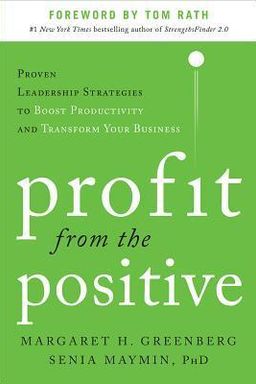
Profit from the Positive cover

Profit from the Positive

by Margaret Greenberg and Senia Maymin

Profit from the Positive reveals how applying positive psychology can revolutionize leadership and boost business productivity. Through practical strategies and real-world examples, learn how small changes can lead to big improvements in team performance and workplace culture.

Profit from the Positive: Turning Psychology into Performance

What if the secret to business success wasn’t about cutting costs, working harder, or analyzing failures, but about amplifying what’s already working? In Profit from the Positive, executive coaches Margaret Greenberg and Senia Maymin propose a radical but research-backed premise: you can boost productivity, engagement, and profitability by applying the science of positive psychology—not motivational slogans or wishful thinking—to the way you lead and manage your teams.

The authors, both graduates of the University of Pennsylvania’s pioneering Master of Applied Positive Psychology (MAPP) program developed by Dr. Martin Seligman, translate over 10,000 academic studies into actionable tools for workplaces. They argue that leaders can no longer rely on fear, control, or unrelenting pressure to drive results. Instead, they can drive exponential growth by understanding what motivates people to perform at their best and by shaping workplaces that cultivate focus, optimism, and meaning.

From Positive Psychology to Positive Business

Positive psychology, as the authors remind us, is not mere positive thinking. It’s an evidence-based field exploring what leads individuals and organizations to thrive. Greenberg and Maymin distinguish it from traditional management science by shifting focus from fixing what’s broken to enhancing what works. In their coaching experience with firms like Aetna, VMware, and MassMutual, they discovered that methods drawn from this field—such as strengths-based feedback, mindful productivity, and emotional contagion awareness—resulted in measurable improvements in revenue and morale.

Think of it this way: if organizations are living systems, negative thinking poisons the bloodstream, but positivity regenerates it. Just as athletes train their mental habits to achieve peak performance, leaders can train organizational habits that promote resilience, creativity, and collaboration.

Three Core Levels of Transformation

The book unfolds through three progressive parts. The first, It’s About the Leader, emphasizes self-mastery. Before you can lead others, Greenberg and Maymin insist, you must manage your own energy, habits, and mindset. Here they introduce four archetypes: the productive leader (managing time and focus), the resilient leader (bouncing back from adversity), the contagious leader (managing emotions to create psychological safety), and the strengths-based leader (focusing on what’s right instead of what’s wrong).

Next, in It’s About the Team, the authors turn to the practices that shape collective culture—how teams hire for fit, engage employees through strengths rather than criticism, transform performance reviews into motivational experiences, and run meetings that energize instead of exhaust. Each chapter begins with what’s not working, connects it to validated psychological research, and ends with hands-on tools that leaders can start using right away.

Finally, Putting It All Together reveals how small, positive deviations—seemingly minor tweaks in language, tone, or focus—can create ripple effects across an organization. Greenberg and Maymin call this the art of the “positive deviant”: someone who quietly disrupts old practices by introducing better ways of working, without expensive programs or top-down mandates.

Why This Matters Now

The timing for this approach couldn’t be more critical. In an era of burnout, constant digital distraction, and widespread disengagement, leaders are searching for sustainable ways to lift morale and performance. According to Gallup, less than 30% of employees feel engaged at work—a crisis that translates to billions in lost productivity. Greenberg and Maymin demonstrate that positivity, intelligently applied, is a solution that costs nothing but changes everything.

Their formula echoes insights from others in the field—Shawn Achor’s The Happiness Advantage and Daniel Pink’s Drive—but grounds them in concrete corporate strategies. Instead of saying “cheer up,” they teach leaders to set habits, design energizing feedback loops, and create systems that reinforce optimism and accountability simultaneously. As they’d put it, “Positive psychology is not about turning lemons into lemonade—it’s about understanding why some people and teams excel, even in the toughest conditions.”

From Research to Real Results

Throughout the book, the authors draw on empirical evidence and case studies—MetLife’s hiring experiment on optimism, Sony Pictures’ productivity renewal program, Zappos’ culture of weirdness, and Aetna’s mindfulness initiatives—to show that positive leadership is not fluffy idealism but strategic advantage. As consultant Greg Tranter puts it in his endorsement, these methods “turn stumbling blocks into stepping stones.”

The question, then, isn’t whether positivity works—it’s whether leaders are courageous enough to use it. Greenberg and Maymin invite you to start small, test the tools, and, as one CEO put it, “be prepared for very little sleep—because once you try it, you’ll see results fast.” This book is your map for leading with science, empathy, and optimism—transforming not only your business but also the way you work and live.


Master the Productive Mindset

The first skill of a positive leader is personal productivity—not measured by hours logged but by the energy, focus, and intention behind your work. Greenberg and Maymin argue that most professionals don’t have a time problem; they have a mental bandwidth problem. Their chapter on the productive leader exposes three culprits: overwork, multitasking, and perfectionism.

From 'Just Do It' to 'Just Plan It'

Drawing on psychologist Peter Gollwitzer’s work on implementation intentions, the authors reveal that people are twice as likely to achieve goals when they plan exactly when and where they’ll act. Instead of diving blindly into tasks, set explicit triggers: “After the 10 a.m. meeting, I’ll spend 30 minutes outlining the report.” This small planning ritual, they found, doubled task completion rates—from 32% to 71%. In a world obsessed with action, planning proves to be the real accelerator.

Trick Yourself into Getting Started

The authors introduce creative hacks to outsmart procrastination, using concepts like the Zeigarnik effect—the psychological pull to finish what’s unfinished. Leaving a report halfway done or writing a summary email in advance can “itch” your brain into action the next morning. Likewise, by creating progress illusions—like filling in the first stamps on a loyalty card—people gain momentum. Their client Tina even begins her to-do lists with completed tasks just to give herself an instant dopamine reward (“ta-da!” she calls it). These micro-tricks help the mind shift from inertia to progress.

Set Habits, Not Just Goals

Habits, they note, are the hidden architecture of sustained productivity. Researchers like MIT’s Ann Graybiel have shown that old habits never truly disappear; they can only be replaced. This insight turns routine into a superpower: you can “outsource” repetitive tasks—checking email, organizing files, planning reports—to your brain’s automatic mode, freeing up cognitive space for strategic thinking. The authors highlight clients who found success by ritualizing critical behaviors, like Peter’s weekly research review or Deborah’s fixed email windows (8 a.m., 11 a.m., 2 p.m., and 6 p.m.). Consistency—not willpower—drives mastery.

Work Less, Accomplish More

One of the boldest claims in the book challenges the cult of busyness. Greenberg and Maymin cite Harvard professor Leslie Perlow’s study at Boston Consulting Group showing that predictable time off actually increased productivity. Teams that unplugged one day a week became more efficient, not less. This “productivity paradox” appears across studies: Aetna’s CEO Mark Bertolini’s mindfulness programs and Sony Pictures’ rest rituals both led to measurable gains in focus and creativity.

By carving out reflection time, you work like a strategist, not a firefighter. The chapter ends with a simple challenge: find one small change—whether a 10-minute plan, a five-minute start, or a single boundary with your phone—that will have the highest positive impact on your performance. It’s less about time management, more about mindset management.


Building Resilience: The Psychological Kickstart

Resilience, the ability to bounce back after setbacks, is the second pillar of positive leadership. Greenberg and Maymin remind us that everyone faces professional failures—lost customers, poor presentations, layoffs—but resilient leaders recover faster and teach their teams to do the same. Their three-step psychological reset combines scientific insights with practical coaching techniques.

Stop Being an Expert—Start Being a Learner

Referencing Stanford psychologist Carol Dweck’s research, the authors contrast the “performance mindset,” which fears mistakes, with the “learning mindset,” which embraces them. Chip Conley of Joie de Vivre Hotels exemplified this when he used Maslow’s hierarchy of needs to reinvent his business after the dot-com crash. By staying curious instead of defensive, he tripled his company’s size. To cultivate this mindset in yourself or your staff, ask questions like “What do you hope to learn from this assignment?” rather than “What if you fail?”

Put on an Explorer’s Hat

When things go wrong, most of us spiral into “Me-Always-Everything” thinking (“It’s my fault, it always happens, and it ruins everything”). Psychologists Karen Reivich and Andrew Shatté coined this framework to describe pessimistic explanatory styles. Greenberg and Maymin flip it to “Not Me-Not Always-Not Everything,” an antidote that restores perspective and energy. They urge readers to experiment with reframing through different lenses—the 30,000-foot view, the 20-year future perspective, or your best friend’s advice—until negativity loses its grip.

Win Debates Against Yourself

The final resilience practice is drawn from cognitive behavioral therapy: disputing. When the inner critic says, “I’m a bad manager,” you build evidence to the contrary: “I’ve coached underperformers, earned team loyalty, and turned around projects.” Their client Carol, devastated after layoffs, regained perspective by listing facts that proved she made the best decision for her company’s survival. This rational self-dialogue transforms despair into grounded confidence.

Together, these tools turn resilience from a reactive trait into a proactive habit. Like resilience expert Nido Qubein says, “It’s okay to get disappointed—but not discouraged.” The resilient leader doesn’t deny stress; she masters the story she tells about it.


Emotional Contagion: Leading Without Control

Ever noticed how your mood affects your team’s day? That’s not intuition—it’s neuroscience. In discussing what they call the contagious leader, Greenberg and Maymin explore how emotions spread like colds across offices. Leaders, perched atop the social ladder, act as emotional thermostats—their energy determines the climate.

The Achoo! Effect

Drawing on Sigal Barsade’s research on emotional contagion, the authors show that even one person’s mood can alter an entire team’s performance. A simple smile from a bank teller increased customer satisfaction scores; a leader’s bad mood decreased coordination in group tasks—even when participants couldn’t see them. The moral: leaders can’t afford “emotional absenteeism.” As Cindi Bigelow of Bigelow Tea puts it, “Leaders cannot afford the luxury of a negative mood.”

Taming Your Oscar the Grouch

When negativity strikes, there are quick psychological resets: label the feeling (“I’m overwhelmed”), breathe deeply, walk, or “fake it till you make it” by smiling. Neuroscience shows that naming emotions calms the amygdala; movement alters physiology; even “embodying” confidence—standing tall with an open stance—changes brain chemistry. The authors share the pen-smile study, where holding a pen between the teeth (mimicking a smile) made cartoons appear funnier than holding it with the lips. Small actions yield big emotional shifts.

Don’t Be a Control Freak

Finally, contagious leaders replace control with trust. Through stories of clients like Mia, a perfectionist designer whose micromanagement stifled initiative, we see how delegating with autonomy restores engagement. Research on “locus of control” confirms this: employees who feel ownership over outcomes work harder and feel less stress. The cure for disengagement often lies in managers checking their own behavior. As one witty employee suggested to his boss, “If I start to take over again, just say ‘Freak off.’”

This chapter reframes leadership as emotional stewardship. The leader’s role isn’t to control every detail—it’s to manage invisible contagions: mood, tone, and trust.


Lead Through Strengths, Not Weaknesses

Traditional leadership focuses on fixing weaknesses; strengths-based leadership asks, “What’s already working, and how can we do more of it?” Greenberg and Maymin argue that people flourish when they operate from their best selves. In the same way athletes train to exploit their natural advantage, great leaders design roles and feedback that amplify talents.

Ask the Right Questions

The authors highlight how companies like Toyota’s NUMMI plant improved processes not by fault-finding but by studying high-performing teams and replicating their behaviors internally. They recommend shifting postmortems into “mining sessions,” focused on replicating internal success stories rather than analyzing failures. One client even replaced SWOT analysis (Strengths, Weaknesses, Opportunities, Threats) with SOAR (Strengths, Opportunities, Aspirations, Results), creating energizing strategy sessions that united teams around growth instead of fear.

Respond to Problems Positively

In the study Greenberg coauthored with Dana Arakawa, managers who calmly brainstormed solutions with employees saw 39% higher project performance. Instead of saying “Don’t come to me without a solution,” leaders should say, “Let’s find a solution together.” Encouraging early transparency builds psychological safety. As one manager told his team, “Finding faults gets us nowhere—finding fixes gets us ahead.”

Know and Model Your Strengths

Before you can lead strengths-based teams, you must know your own strengths. Greenberg and Maymin recommend tools like Gallup’s StrengthsFinder or the VIA Inventory of Strengths. Gallup data shows that employees who use their strengths daily are six times more engaged and produce 17% more sales. Quoting Martin Seligman, they remind leaders that managing weaknesses only prevents failure; leveraging strengths creates excellence.

This approach reframes leadership as amplification, not correction—a philosophy echoing Marcus Buckingham’s Now, Discover Your Strengths. In practice, strengths-based leadership means giving people permission to play to their natural edge.


Hiring and Fit: The Science of Better Teams

When companies make bad hires, it’s rarely about technical incompetence—it’s about poor fit. In their section on hiring, Greenberg and Maymin redefine recruitment as a “fitness test” combining skills, attitude, and cultural chemistry. They blend psychology and organizational science to help leaders choose people who will thrive, not just survive.

Hire for What’s Not on the Resume

Citing Martin Seligman’s experiment at MetLife, the authors explain how optimistic insurance agents outsold their peers by 27%. Emotional intelligence and resilience—traits invisible on paper—predict success far better than credentials. Leaders like Chris Beschler of Richmond, Virginia, agree: “Give me someone with a can-do attitude and I can teach them the phone system.” In short, hire character, train skill.

Dig Into the Past to Predict the Future

Rather than asking hypothetical questions (“What would you do if?”), effective interviewers ask behavioral ones: “Tell me about a time when…” Since past performance is the best predictor of future success, these stories reveal authentic patterns. The authors quote Yale professor Amy Wrzesniewski’s research distinguishing employees who see their work as a job, a career, or a calling. To build commitment, hire people who find meaning in the mission, not just the paycheck.

Culture as Competitive Advantage

Finally, never overlook cultural quirks. Zappos screens candidates for “weirdness,” Google for “Googliness,” Rackspace for empathy. These idiosyncratic filters ensure alignment with core values. As Tony Hsieh put it, “We’re not looking for perfect—just people who make us more ourselves.” This people-first approach turns hiring from a transaction into a strategic act of belonging.

The takeaway: fit isn’t about conformity, it’s about energy. Hire those whose values amplify your culture, and watch performance soar.


Engagement and Flow: Bring Out the Best

Once you’ve hired great people, the challenge shifts to keeping them engaged. Greenberg and Maymin emphasize that you don’t get the most out of people by squeezing them—you help them give their best by aligning strengths, autonomy, and recognition. Their four-part framework for engagement turns psychology into profit.

Make Strengths a Habit, Not a Program

Having employees read a strengths book isn’t enough; you must talk about strengths regularly. This is called job crafting—redefining tasks and roles to better match personal energy. Their client Emann at a regional office used this method over video calls, asking each employee to discuss how a core strength showed up at work and at home, leading to greater ownership and confidence.

Turn Strengths into a Team Sport

Team sessions where members share top strengths can reduce conflict and promote collaboration. One IT leader found that understanding his “discipline” and his team’s “ideation” explained why they clashed—he wanted structure, they wanted brainstorming. Once they laughed about this, productivity soared. Tom Rath and Barry Conchie (in Strengths Based Leadership) confirm: great teams, not great individuals, must be well-rounded.

Find Flow, Not Fire

When employees underperform, it’s often a mismatch of challenge and skill. Using psychologist Mihaly Csikszentmihalyi’s “flow” model, the authors show how leaders can fine-tune assignments. Too difficult and workers feel anxiety; too easy and they feel boredom. The manager’s role is to adjust the challenge until employees hit the sweet spot of engagement. One executive saved a key employee not by firing him—but by giving him more stimulating work.

Give FRE: Frequent Recognition and Encouragement

In a study of IT teams, Greenberg found that managers who offered regular praise and encouragement increased productivity by 42%. Recognition works best when it’s process-focused (“I admire how you analyzed this”) rather than person-focused (“You’re so smart”), building confidence without breeding fragility. Firms like Zappos and Yum! Brands bake FRE into their cultures through peer-to-peer gratitude and public storytelling. As CEO David Novak notes, “Why be stingy with what matters most?”

The insight is simple but profound: positivity fuels engagement, engagement fuels results. You can’t mandate passion—but you can cultivate it.


Performance Conversations that Energize, Not Drain

Most performance reviews, the authors observe, make everyone miserable. Managers dread writing them; employees dread reading them. So Greenberg and Maymin propose a complete overhaul using four evidence-based shifts that transform evaluation into motivation.

Obsess Over Strengths

In studies across 20,000 employees, focusing on strengths during feedback led to a 36% performance boost. The Hanover Insurance Group, after working with Greenberg, redesigned its review process to emphasize leveraging, not fixing, strengths. Weaknesses still matter, but as one HR executive put it, “We treat them as data, not destiny.”

Set Goals That Challenge

Citing researcher Gary Latham, they note that specific, difficult goals create pride and persistence, whereas vague ones (“do your best”) foster mediocrity. The optimal goal pushes but doesn’t break. During learning phases, however, “do your best” reduces fear of failure—so goals should evolve with skill level.

Preview, Don’t Just Review

Performance conversations can also be forward-looking. Inspired by psychologist Laura King’s work on “best possible future” writing, the authors suggest asking employees: “Imagine it’s next year—what achievements are you most proud of?” Then add process visualization, as Shelley Taylor’s UCLA studies show—it’s the practice, not the fantasy, that predicts success.

Chew the Fat, Don’t Chew Them Out

Feedback should feel like conversation, not interrogation. Companies adopting “no surprise” rules—requiring regular coaching throughout the year—report fewer conflicts and higher trust. The case of manager Landon illustrates this: by rephrasing criticism as opportunity (“Imagine how mentoring new colleagues could free your time”), he turned defensiveness into initiative. The mantra: talk early, talk often, talk about growth.

In the authors’ view, the goal of performance reviews isn’t to judge—it’s to recharge motivation. Done right, reviews become catalysts for confidence, not casualties of bureaucracy.


Redesigning Meetings for Energy and Results

Few rituals drain as much corporate energy as meetings. Greenberg and Maymin challenge leaders to stop wasting hours in aimless discussions and turn every meeting into a focused, uplifting exchange. Their triad of tools—Start with a Sizzle, Practice the Peak-End Rule, and Play Your Whole Bench—transforms meetings from time-sinks into creativity engines.

Start with a Sizzle

Psychologist Barbara Fredrickson’s broaden-and-build theory shows that positive emotion expands attention and problem-solving capacity. That’s why kickoff moments matter. High-performing teams, according to researcher Marcial Losada, maintain at least a 3:1 ratio of positive to negative comments. Leaders can achieve this by opening meetings with appreciative questions (“What went well this week?”) or small tokens—a story, a success, even upbeat music. Mood shifts catalyze cognitive shifts.

Practice the Peak-End Rule

Inspired by Nobel laureate Daniel Kahneman, the authors note that people remember experiences based on their emotional peak and their ending. Chip Conley improved morale at Joie de Vivre Hotels by closing every meeting with positive stories of employees delighting guests. Likewise, ending meetings with questions like “What’s one insight you’re taking away?” solidifies shared optimism.

Play Your Whole Bench

In inclusive teams, everyone contributes roughly equally between questions and insights (a 1:1 ratio). Keep an eye on who dominates and who disappears—literally track participation, even in virtual settings. CEO Patricia, one client, increased engagement by explicitly setting the norm that “balanced voices beat loud ones.” Balanced airtime equals balanced thinking.

As simple as these ideas sound, they summarize the book’s entire philosophy: energy is productivity. Meetings that begin, end, and flow around positivity yield higher performance, creativity, and collaboration—without adding a single headcount or dollar of budget.


Becoming a Positive Deviant

The final chapter reveals how to make change stick through subtle disruption. A positive deviant is someone who improves the system from within—not through authority, but through example. Greenberg and Maymin share four strategies to spread positivity quietly but powerfully.

Don’t Resist Resistance

Resistance, they say, is evidence of movement. Instead of fighting skeptics, listen for the pain behind objections and address it. Using the authors’ “FRESH” framework—Fit, Right, Emotions, Science, Habits—you can translate abstract ideas into practical language: fit jobs to strengths, focus on what’s right, manage emotions, cite science, and turn insight into habit.

Start Small

Behavioral research shows progress breeds confidence. So they advise implementing just three micro-actions a week—perhaps gifting small gratitude notes, running one “sizzle” opening, or replacing a negative phrase with a positive one. Over time, these small wins cascade into cultural shifts.

Drop the Lingo

Nothing triggers disengagement faster than jargon. You don’t need to say “positive psychology” to use it. Just practice it—plan better, recognize more, listen longer. Actions speak louder than academic terminology.

Use the Back Door

Finally, the authors advocate for quiet revolution. You don’t need permission to praise, plan, or unplug. Integrate positive tools into daily routines subtly and let outcomes speak for themselves. As Greenberg quips, “You don’t need a PowerPoint—you need proof.”

By embodying these principles, you become what they call a “positive deviant”—an agent of progress whose habits, not position, change the culture. The transformation begins one conversation, one plan, one genuine moment at a time.

Dig Deeper

Get personalized prompts to apply these lessons to your life and deepen your understanding.

Go Deeper

Get the Full Experience

Download Insight Books for AI-powered reflections, quizzes, and more.