
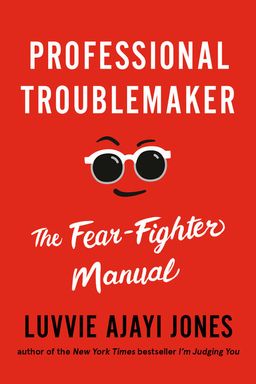
Professional Troublemaker cover

Professional Troublemaker

by Luvvie Ajayi Jones

Professional Troublemaker inspires readers to confront and conquer their fears, encouraging authenticity and boldness in everyday life. Luvvie Ajayi Jones offers empowering insights on honesty, resilience, and kindness, urging us to speak up and live true to ourselves for a more meaningful existence.

Becoming a Professional Troublemaker: Courage as a Daily Practice

What would your life look like if fear wasn’t your dominant voice? That question sits at the heart of Professional Troublemaker: The Fear-Fighter Manual by Luvvie Ajayi Jones. Equal parts memoir, manifesto, and motivational guide, the book challenges readers to define what it means to live courageously in a world that too often rewards silence and conformity. Ajayi—a Nigerian American writer known for her sharp humor and cultural commentary—argues that courage isn’t the absence of fear but the decision to act despite it.

A “professional troublemaker,” she insists, isn’t someone who thrives on chaos or conflict. Instead, it’s a person who speaks the truth even when their voice shakes, who resists systems that demand smallness, and who believes that integrity matters more than comfort. This isn’t rebellion for its own sake; it’s about being a catalyst for betterment—the kind of trouble that propels families, workplaces, and communities forward. Ajayi builds her argument through stories from her own life, from childhood clashes with authority in Nigeria to viral speeches that inspired millions.

Why Courage Matters Now

Ajayi grounds her message in a modern context where fear has become both endemic and invisible. She notes that humans are wired for self-preservation; fear once kept us from leaping into volcanoes or touching open flames. Yet this same mechanism now stops us from asking for raises, calling out harmful systems, or acknowledging truths about ourselves. Fear protects, but it also paralyzes. The book’s central purpose, then, is not to claim that one can be fearless, but to teach readers how to coexist with fear without being ruled by it. As she writes repeatedly, “This book is a middle finger up to fear.”

Drawing from her viral TED Talk “Get Comfortable with Being Uncomfortable,” Ajayi reminds us that courage is the foundation of every virtue—a sentiment inspired by Maya Angelou’s insight that “without courage, you can’t practice any other virtue consistently.” From this foundation, Professional Troublemaker becomes a personal and practical philosophy for action, especially for those whose identities—Black women, immigrants, marginalized voices—make fear an even greater burden to overcome.

The Structure of Fear Fighting: Be, Say, Do

The book is divided into three sections—BE, SAY, and DO—each representing a layer of transformation. “Be” focuses on identity: knowing who you are, honoring where you come from, and refusing to shrink. “Say” centers on voice: telling hard truths, failing publicly, asking for what you deserve, and naming your boundaries. “Do” moves from inner belief and speech to outward action: growing through change, letting go of control, standing up for yourself, and building collective strength through community and heritage.

This tripartite structure echoes the personal development models of other thinkers like Brené Brown or Glennon Doyle, yet Ajayi’s approach is distinctly cultural and comedic. Her writing is infused with Nigerian wit and a deep respect for ancestral wisdom—especially the lessons of her grandmother, Olúfúnmiláyò Fáloyin, a recurring figure who embodies fearless authenticity. Through anecdotes of familial rebellion, professional crossroads, and public missteps, Ajayi makes clear that courage is not innate. It’s taught, practiced, and passed down.

Humor, Honesty, and Heritage

Ajayi’s signature humor keeps the book accessible even as it discusses profound ideas of identity, culture, and justice. She blends internet slang with Yoruba proverbs, pop culture with ancestral storytelling. By inviting readers to “Get a Nigerian friend,” she situates courage in cultural pride and collective belonging. Her message: bravery grows when rooted in community, heritage, and humor.

The book also balances theory with actionable tools. Through exercises like writing your personal oríkì (a Yoruba praise poem that affirms identity) or answering self-reflective prompts on core values, readers are guided to internalize confidence rather than merely perform it. Each section concludes with memorable challenges: dare to be “too much,” dream audaciously, own your dopeness, and draw sharp lines around your boundaries.

Why This Book Feels Urgent

Published in 2021 during a period of global anxiety, Professional Troublemaker speaks directly to what courage looks like amid uncertainty—the pandemic, racial uprisings, career vulnerability, and personal burnout. Ajayi’s message is not naive optimism; it’s grounded resilience. She ends with an epilogue written in COVID lockdowns, acknowledging fear as legitimate while insisting that hiding behind it is optional. It’s a call to action steeped in faith, humor, and self-accountability.

Core Message

You will never stop being afraid. But you can stop letting fear decide who you become, what you say, and how you show up in the world. Courage is a muscle, and every time you use it, it strengthens your capacity to fight fear the next time.

In the chapters that follow, Ajayi shows exactly how to build that muscle: by knowing yourself deeply, daring to dream boldly, speaking unapologetically, building community, and learning to laugh—even when your knees are shaking.


Know Yourself and Whose You Are

Ajayi begins the "BE" section with the simplest yet hardest command: know yourself. Many of us, she notes, fear our full selves—we dim our brilliance or edit our truth to fit in. This self-erasure breeds insecurity and prevents us from taking risks. To fight fear, we must build a stable sense of identity that stands strong even when life gets shaky.

Rooting Identity in Heritage

Ajayi connects this to her Yoruba upbringing, where identity isn’t individualistic but communal. She introduces the concept of an oríkì—a personal praise poem that honors one’s lineage and destiny. Reciting one’s oríkì is an act of self-affirmation, reminding you who you come from and what you’re capable of. She shares her grandmother’s moving oríkì as an example of how ancestral pride sustains courage. If you don’t know your roots, she invites you to craft your own version—whether through affirmations, heritage, or chosen family.

Writing Your Own Mission Statement

Beyond heritage, self-knowledge comes from clarity. Ajayi proposes writing a “life mission statement,” a personal compass based on your values, joys, and what you’re willing to fight for. Her own includes humor (“shea butter” as a core value) and honesty, showing that authenticity doesn’t have to be solemn to be sacred. This written reflection becomes a tool for resilience—a reminder of worth when critics attack or self-doubt grows loud. As she puts it, when the world forgets who you are, your mission statement helps you remember before you remind anyone else.

Belonging Without Shrinking

Knowing yourself also means resisting the temptation to fit into molds that diminish you. Self-awareness allows you to filter praise and criticism alike: neither should define you. It anchors you amidst chaos. Similar to psychologists like Carl Rogers, Ajayi sees self-acceptance as the starting point of all growth—only when you know your own truth can you speak or act from it. Her grandmother’s teaching echoes this idea: courage begins where self-knowledge meets self-worth.

“To know thyself is to write your values in cement even if your goals are in sand.” —Luvvie Ajayi Jones

This chapter reminds you that you can’t fight external fear until you’ve faced the internal one: the fear that you are not enough. Knowing yourself gives you the strength to stand, speak, and dream without apology.


Be Too Much and Take Up Space

Society often tells us we are “too much.” Too loud, too ambitious, too emotional. Ajayi dismantles this framing by arguing that your too-muchness is usually your superpower. She recounts being a Nigerian girl in Chicago who shortened her name and muted her accent to blend in—an early lesson in shrinking. The turning point came in college, where she reclaimed her Naijaness, humor, and unapologetic boldness.

Reframing Judgment as Projection

Ajayi offers a memorable insight: when people say you’re “too something,” they’re revealing their own discomfort, not your flaw. You’re “too loud” for people used to silence, “too confident” for those unsure of themselves. Instead of shrinking, ask whose comfort is being protected and whose brilliance is being dimmed. Her grandmother, Mama Fáloyin—the self-proclaimed “Queen Mother of Team Too Much”—serves as a living parable. From seven-day birthday parties to dramatic public prayers, the elder showed that excess can be holy when it’s rooted in joy and justice.

The Three Tests of Too Muchness

Ajayi proposes three questions to discern whether feedback is worth internalizing: 1) Is this hindering my growth? 2) Is it harming someone else? 3) Is it coming from someone who loves and respects me? If the answers are no, keep shining. Genuine critique can refine you; casual shaming should be compost. (She echoes Don Miguel Ruiz’s Four Agreements here: “Don’t take anything personally.”)

She also addresses the professional stakes—especially for Black women labeled “aggressive” in corporate spaces—and offers empathy for those who must navigate systems where rebellion can cost livelihoods. Her advice: survive first if you must, but never confuse that temporary mask for your true face.

“Your too-muchness is a mirror to their not-enoughness.”

Being too much, Ajayi says, is courage in practice. When you let your volume rise, you tell others that boldness is possible. You become, in her words, “the Youest you that ever Youed.”


Dream Audaciously and Trust the Leap

In one of the book’s most personal chapters, Ajayi explores our fear of dreaming big. We avoid hope, she notes, not because we don’t want more but because we fear disappointment. So we minimize our desires to protect ourselves. Yet every major breakthrough in her life came from risking audacity—from calling herself a writer to saying yes to impossible opportunities.

The Cost of Playing Small

As a first-generation immigrant, Ajayi planned to be Dr. Luvvie, dutiful Nigerian daughter. That dream collapsed with a D in Chemistry. In its ashes, she discovered her passion for writing, though fear delayed her claiming it. Even after her blog won awards and viral acclaim, she refused the title “writer” until she was laid off and finally forced to leap. That leap led to I’m Judging You, a debut book that became a New York Times bestseller and helped her retire her mother—a dream realized because she dared to imagine it.

Audacity as Resistance

Ajayi contrasts her cautiousness with the “audacity of unshackled white men,” referencing entrepreneurs who casually bought a $40 million mountain—a metaphor for privilege-fueled confidence. She urges marginalized readers to borrow some of that gall, not the entitlement but the fearlessness to believe “Why not me?” Dreaming audaciously, she says, is revolutionary for those taught to stay small.

The Map You Create

Ajayi’s story shows that when you lack a blueprint, you might be meant to write one. The dreams you voice give permission to others, and manifested hope multiplies. She ends this section reminding readers: even if you try and fail, you can sleep knowing you dared. But if you never try, you’ll live haunted by “what if.”

“Create the map you didn’t have, so someone behind you won’t get lost.”

Dreaming big is not naive—it’s necessary. The more you stretch your hope, the more space you make for others to rise with you.


Speak the Truth Even When Your Voice Shakes

In the “Say” section, Ajayi turns from inner belief to voice. We fear honesty, she says, because truth invites consequence. Yet silence has consequences too—dishonesty corrodes relationships, workplaces, and cultures. By telling uncomfortable truths, we elevate the collective standard.

The Everyday Practice of Radical Honesty

From childhood, Ajayi’s sharp tongue got her in trouble for “talking back,” but it also fueled her life’s work as a cultural critic. She learned that honesty is a love language: telling someone their haircut is lopsided may sting, but it’s kinder than letting them walk around deceived. In organizations, truth-tellers are invaluable—they prevent fiascos before they happen. Yet honesty, she stresses, should be delivered thoughtfully, with empathy rather than cruelty. “Mean for no reason,” she warns, is not the same as “real.”

Speaking Up in Unjust Systems

Ajayi especially praises Black women as the “moral centers of the universe”—the ones who speak up when silence could destroy the group project of society. Still, she acknowledges the cost of truth-telling in systems that punish dissent. Her advice: if the stakes are survival, pick your battles. But if you have privilege or safety, use it to challenge inequity. Truth must ripple outward, and there is strength in numbers—be the first domino or at least the second.

The Courage Checklist

Before challenging someone, Ajayi uses three questions: Do you mean it? Can you defend it? Can you say it with love? This filter prevents impulsive outbursts while ensuring moral clarity. When all three answers are yes, speak—then release attachment to outcome. Truth-telling doesn’t guarantee comfort, only integrity.

“When you see something not right, not fair, not just—you have a moral obligation to say something.” —John Lewis (quoted by Ajayi)

Our voices are instruments of equity, Ajayi reminds. Whether whisper or shout, a single sentence of truth can echo louder than years of polite silence.


Fail Loudly and Heal Forward

Failure, Ajayi admits, almost muted her forever. When she faced backlash online in 2018 for an ill-judged tweet about a musician, the internet dragged her—an ordeal that caused depression, weight loss, and self-doubt. Yet that public fall became her deepest classroom. She realized failure is not final; it’s feedback.

Redefining Failure as Refinement

Ajayi names the incident’s lessons with brutal honesty: apologize early, give grace to your younger self, and separate your worth from your work. Pedestals, she says, are prisons. Being humbled reminded her that influence requires accountability. Instead of hiding, she sought therapy and returned stronger, writing this very book as her act of redemption.

Grace and Accountability Can Coexist

The magic of “failing loudly” is transparency. When we own our mistakes publicly, we model growth for others. Grace doesn’t mean absence of consequence; it means refusing shame as a destination. Ajayi’s compassion extends to her past self and readers alike: old mistakes were necessary lessons, not moral debts. As she writes, “The person who made thirty-five thousand a year had to exist so the woman who wrote this book could too.”

Facing Fear Through Recovery

Her healing also redefined prayer: she began to ask not for perfection but for fortitude when weapons—whether criticism or self-hate—inevitably formed. By forgiving herself, she reclaimed her own voice. Failing loudly didn’t ruin her; it released her. The only true failure, she concludes, is refusing to learn.

“You are not your worst moment. Your mistakes do not define you; your lessons do.”

In a culture obsessed with canceling, Ajayi’s approach is radical: fail, atone, evolve. Then tell the truth about what that healing taught you.


Draw Lines and Take No Shit

Fear often disguises itself as niceness. Ajayi differentiates between being kind and being nice: kindness is rooted in truth and respect; niceness in fear and performance. Her call to “draw lines” is about reclaiming time, energy, and dignity by teaching people how to treat you.

Boundaries as Self-Preservation

Ajayi’s humor makes boundary-setting accessible. She jokes about not wanting to hug strangers or being tagged in random social posts, but the lesson is serious: boundaries are self-respect in action. You can’t control others’ behavior, only your own clarity. Silence invites trespass; communication prevents resentment. Her grandmother, famously unafraid of confrontation, modeled this by demanding respect even from authority—proof that firmness and love can coexist.

Kindness Over Niceness

The follow-up chapter “Take No Shit” expands this into moral courage. Ajayi rejects the false virtue of the “high road” when it means allowing harm to continue. “When they go low, we go gutter,” she quips, arguing that justice sometimes requires confrontation. The goal isn’t cruelty but accountability. Kindness defends the vulnerable; niceness protects abusers. As she notes, even Jesus flipped tables.

Redefining Strength

Boundaries apply personally and politically. Whether confronting racism or personal disrespect, we betray ourselves when we stay silent for approval. The antidote is discernment: choose peace over people-pleasing, and remember that being disliked is not the same as being wrong. True strength is measured not by how many people call you nice, but by how kindly you treat yourself while resisting injustice.

“You are not required to set yourself on fire to keep other people warm.”

Fear-fighting sometimes looks like saying no, walking away, or flipping the proverbial table. Courage, Ajayi reminds, isn’t just speaking truth to power—it’s refusing to betray yourself in the process.


Build a Squad and Fire Yourself

Ajayi devotes significant space to community, arguing that courage thrives in company. Solitary strength is overrated; even superheroes have allies. In “Build a Squad,” she celebrates friendship as both accountability and armor. In “Fire Yourself,” she extends the metaphor to leadership: know when to stop doing everything alone.

The Five Squads You Need

Borrowing from her own circles, Ajayi defines five types of essential relationships: Day Ones (history keepers), Professional Crew (career allies), Mentors (guides), Play Group (joy creators), and True Blues (core confidants). Each serves a unique function; no one person should fulfill all roles. This prevents relational burnout and nurtures holistic growth. The key, she says, is reciprocity—show up as the friend you seek.

Firing Yourself from Superwoman Syndrome

In parallel, “Fire Yourself” confronts the myth of control. As a Capricorn perfectionist, Ajayi once juggled every task—writing, emails, accounting—until she burned out. Learning to delegate was an act of courage disguised as surrender. To “fire yourself” means releasing the illusion that your worth depends on doing it all. It’s trusting capable hands—friends, colleagues, even fate—to help carry what you cannot.

She illustrates this through her grandmother’s later life: once fiercely independent, she eventually accepted care from her daughter. Releasing control, Ajayi observes, can be its own sacred strength. Faith and teamwork, not solo heroics, sustain longevity.

“Empires of one do not exist. Life is a group project.”

Courage multiplies through connection. Whether delegating at work or leaning on sisters in the trenches, bravery’s truest form is collective. Fire yourself from isolation and let help in—it’s how revolutions and healing alike are sustained.


Fuck Fear: Choosing Courage Daily

The book concludes where it began—with fear itself. Ajayi affirms that everyone is afraid; the goal is to live fully despite it. To “fuck fear” is not recklessness but rebellion against paralysis. She wrote this finale during the COVID-19 pandemic, making it both personal and prophetic.

The Anatomy of Fear

Fear, Ajayi explains, began as survival instinct but has evolved into social restraint. It keeps us “safe” from rejection, embarrassment, and the unknown—costs that pale compared to the regret of inaction. She highlights how communities constantly transmit fear, often in the form of “be careful” warnings that discourage joy and risk. Her remedy: drop the bags of other people’s anxieties. What we carry that isn’t ours weighs us down most.

Courage During Crisis

Writing amid a global lockdown, she refuses toxic positivity or spiritual bypassing. Fear during a pandemic is rational; pretending it away is dangerous. True faith, she argues, faces facts and acts wisely. You can be scared and faithful at the same time. The key is to stay in motion: write, create, love, act, even while trembling. Courage, she insists, “is not fearlessness—it’s full humanity in motion.”

Living Beyond the Cage

Ajayi leaves readers with a vision of legacy. “When I die, I want to be missed,” she writes. To live unafraid means leaving fingerprints of impact—acts of truth, laughter, generosity. Her grandmother’s name, her own writing, and each reader’s bravery are connected threads in a lineage of troublemakers who refused smallness.

“You will never stop being afraid. But you can stop letting fear decide who you become.”

The fearless life, Ajayi concludes, isn’t about absence of fear—it’s about refusal to be ruled by it. Every small act of honesty, every boundary, every leap of faith is a rebellion. That’s what it means to be a professional troublemaker: to fight fear not once, but every single day.

Dig Deeper

Get personalized prompts to apply these lessons to your life and deepen your understanding.

Go Deeper

Get the Full Experience

Download Insight Books for AI-powered reflections, quizzes, and more.