
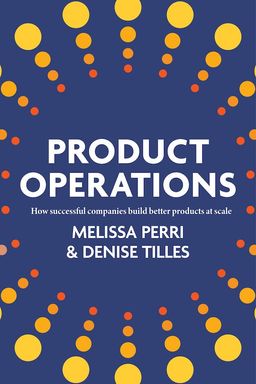
Product Operations cover

Product Operations

by Melissa Perri & Denise Tilles

Product Operations reveals how leading companies build better products by aligning complex processes across teams. With practical frameworks for discovery, development, and iteration, it empowers organizations to innovate efficiently and meet market demands, enhancing both customer satisfaction and business success.

Building Better Products at Scale Through Product Operations

How can you create great products when your team, data, and processes seem to be bursting at the seams? In Product Operations: How Successful Companies Build Better Products at Scale, Melissa Perri and Denise Tilles argue that scaling product organizations successfully requires a new discipline—Product Operations. They contend that this function acts as the connective tissue that allows strategy, data, and people to work in harmony, enabling companies to make smarter, faster decisions while freeing product managers to focus on customer and business outcomes rather than administrative chaos.

Product Operations is, in essence, the product manager for the product management function. It creates the systems, data flows, and processes that guide how product teams work across the organization. Perri and Tilles propose that without this discipline, most growing companies fall into silos, confusion, and inefficiency—the infamous “build trap” where teams deliver features without clear direction or measurable impact.

Why Product Operations Matters

The authors open with a relatable story: Ashley, the newly appointed Chief Product Officer at Pipeline 3K, finds herself drowning in fragmented roadmaps, inconsistent data, and a barrage of board requests. Like many leaders, she’s hired to scale the business but cannot access reliable information to make decisions. Her experience reflects a common reality—growing companies outpace their ability to coordinate people and measure what matters. Product Operations solves these problems by integrating data, insights, and process into a unified framework.

Melissa Perri’s earlier ideas from Escaping the Build Trap reappear as foundations here. She explains that product managers must align their work around outcomes, not outputs. But achieving this alignment at scale requires operational systems—consistent templates, governance, and data visualization—that product operations enables. Denise Tilles adds her firsthand corporate lessons, showing how introducing analytical, research, and process rigor liberates product managers from reactive firefighting.

The Three Pillars of Product Operations

Perri and Tilles structure their book around three pillars that define the role:

  • Business Data and Insights: Connecting product metrics to top- and bottom-line business outcomes through dashboards, instrumentation, and financial context.
  • Customer and Market Insights: Democratizing research, customer feedback, and market analysis so product teams can learn faster and more broadly.
  • Process and Practices: Establishing the company’s product operating model, including governance, planning cadences, and tool enablement.

Together, these pillars provide structure for product management to thrive. For example, at companies like athenahealth and Fidelity Investments (featured in the book’s case studies), Product Operations enabled automation of hundreds of hours of manual work and created clear decision-making flows that boosted speed and confidence. The authors show how Product Operations isn’t bureaucracy—it’s leverage.

Stories That Ground the Theory

The book’s narrative approach—following Ashley and the fictional Pipeline 3K—makes complex frameworks tangible. You’ll watch her implement data dashboards, establish a cadence of roadmap reviews, and hire Rebecca to lead Product Operations. Alongside these fictional developments, real-world stories from Uber, Stripe, Amplitude, Oscar Health, and others illustrate how Product Ops practitioners turn chaos into clarity. Shintaro Matsui at Amplitude used quick wins like a company-wide product newsletter to show early value, while Blake Samic at OpenAI and previously at Uber built teams that bridged global product and local operations.

The Strategic Shift in Modern Product Management

Product Operations is a sign of product management’s evolution. As Perri and Tilles note, sales and marketing have long had operations functions to enhance efficiency; now product does too. This shift addresses the burnout problem plaguing product managers expected to do everything—data analysis, stakeholder alignment, user research, prioritization, and delivery. By establishing dedicated operations support, leaders can ensure consistency without sacrificing agility.

From Concept to Culture

Ultimately, Perri and Tilles argue that Product Operations transforms company culture. It fosters transparency, collaboration, and outcome-oriented thinking. It allows executives to make strategic decisions backed by real-time data, aligns product and business, and turns ad-hoc planning into continuous improvement. Readers learn how to introduce the function, get buy-in, and scale—from a single Product Operations manager to a global organization.

For anyone building or scaling product organizations—whether you’re a CPO, product leader, or struggling manager—Product Operations is both an operational manual and a manifesto. It teaches that operational excellence isn’t about control, but about empowerment: freeing people to do their best, most strategic work with clarity and purpose.


The Evolution and Purpose of Product Operations

Melissa Perri and Denise Tilles explain that Product Operations evolved organically as companies grew and product teams multiplied. Initially, startups thrive on informal alignment—everyone knows what’s happening. But once multiple products, divisions, and stakeholders enter the picture, clarity crumbles. Product Operations emerged to solve the scaling problem of product management. It ensures that insight flows freely and that strategy connects to execution across silos.

The Burnout Problem

Before Product Operations, product managers were stretched thin. They had to be data analysts, project coordinators, diplomats, and researchers all at once. Perri describes how this leads to burnout and inefficiency—top talent leaving because their roles become impossible. With Product Ops in place, these managers can refocus on solving customer problems and driving business outcomes. As the authors note, leaders like Sarah Stolovitch at Kira Systems observed this firsthand: product managers need support structures to stay effective.

Bridging the Gaps Between Teams

Product Operations bridges the gaps between product, engineering, design, sales, and marketing. It’s not a replacement for product management, but an enabler. If you think of product management as the brain, Product Operations is the nervous system—transmitting signals quickly and reliably across the body. It takes inspiration from existing operations functions in sales and marketing, where dedicated professionals optimize information flow and process consistency.

A Discipline Rooted in Enablement

The authors emphasize that Product Ops is not “process for process’s sake.” It exists to enable skilled product managers. A well-run Product Ops function empowers teams to make evidence-based decisions using consistent data and streamlined workflows. For instance, Blake Samic’s implementation at Uber and Stripe created cross-functional visibility that improved launch coordination and reduced surprise issues in rollout phases. Similarly, Christine Itwaru at Pendo framed Product Ops as a “force multiplier” for product teams.

The Organizational Signs You’re Ready

Perri and Tilles offer diagnostic signals that indicate a company needs Product Operations: loss of data access, inconsistent strategic planning, difficulty making decisions at scale, and lack of shared context across teams. The real value appears when Product Ops converts these pain points into clarity—standard dashboards, feedback loops, and governance rituals that connect vision to outcomes. It’s the difference between reactive management and intentional leadership.

Product Operations isn’t a passing trend. It’s a structural response to modern software’s complexity. Every successful scale-up—from Amplitude to Sam’s Club to Fidelity—uses it to translate chaotic growth into sustainable momentum. Once leaders experience its leverage, they rarely go back.


The Three Pillars That Hold Product Operations Together

Central to the book are the three pillars of Product Operations. Each pillar is designed to support a distinct form of leverage—quantitative clarity, qualitative learning, and operational consistency. Together, they form the foundation of how Product Operations transforms organizations from reactive teams into outcome-driven systems.

Pillar 1: Business Data and Insights

This pillar focuses on transforming raw data into strategic insight. Perri shares how athenahealth used Product Ops to automate its software capitalization reporting—a task that previously consumed 400 hours of manual work annually. By blending product metrics with financial context, they created dashboards that revealed where R&D spend delivered the highest ROI. The lesson: data isn’t just numbers; it’s meaning that drives product direction.

Pillar 2: Customer and Market Insights

Without understanding customer behavior, even the most data-rich organizations fail to build products people love. Perri and Tilles emphasize democratizing research—making user insights accessible instead of locked behind specialist gates. Fidelity Investments, for example, established a Research Ops function to enable 300 employees to run their own moderated or unmoderated studies, supported by a central “Lighthouse” research repository. This accelerated learning velocity and reduced bottlenecks between UX researchers and product managers.

Pillar 3: Process and Practices

At scale, process becomes the backbone that keeps teams aligned. Oscar Health’s case study shows this vividly—their product operations team coordinated 65 product managers across 50 scrum teams with an organized annual planning framework. Product Operations there defined cadence, meeting structure, and prioritization frameworks that integrated cross-functional input while maintaining agility. The outcome was smoother planning, faster decisions, and fewer “black box” frustrations between departments.

When implemented together, these pillars ensure the product organization can see reality, learn quickly, and act coherently. As Perri notes, “Each company’s implementation may look different, but the guiding pillars remain the same—data, insights, and process working as one force multiplier.”


Turning Chaos into Clarity with Data

If you’ve ever felt trapped in spreadsheets or spent weeks preparing board decks, you’ll recognize Ashley’s dilemma at Pipeline 3K. She was drowning in inconsistent reports and conflicting metrics. Product Operations provides relief by introducing structured approaches to data collection, visualization, and automation—what Perri calls moving from a “manual baseline” to continuous insight.

Instrumenting the Right Data

Step one is identifying which questions matter for strategy. At athenahealth, teams correlated business metrics like ARR and churn with product engagement, revealing where investments paid off. This kind of cross-functional view requires Product Ops to link CRM, finance, and analytics tools into a business intelligence platform such as Looker or Tableau. Stephanie Leue at Doodle cited how Power BI transformed her decision-making: she could directly watch how product usage affected revenue trends, creating a live flywheel of insight.

Avoiding Data Silos

In Ashley’s story, data existed—but scattered across engineering, finance, and sales. Without integration, it was meaningless. Through Product Operations, Jill and Rose connected these datasets, enabling dashboards that tied usage rates to ROI and engineering time. Suddenly, pipelines of work aligned with business growth. The process turned subjective debates into evidence-based discussions.

Automating for Scale

Manual baselines deliver initial visibility, but automation sustains it. Doodle’s data team achieved a fully connected warehouse within a year—so every product manager could self-serve insights. Automation transforms data from an annual ritual into a daily habit, empowering teams to act swiftly. (Note: This mirrors practices described in Lean Analytics by Alistair Croll and Benjamin Yoskovitz, emphasizing real-time feedback loops over occasional reporting.)

By contextualizing both customer and business data, Product Ops turns information overload into strategic clarity, ensuring every decision traces back to evidence—not guesses or gut feeling.


Scaling Research and Customer Insight for Speed

When companies grow, customer feedback often gets lost in translation. Perri and Tilles demonstrate how Product Operations democratizes research, eliminating bottlenecks so that everyone—from product managers to designers—can hear the customer’s voice.

Streamlining User Research

At Pipeline 3K, Ashley’s team relied on one client for feedback, creating biased decisions. Rebecca’s solution was to systematize access to users through a research repository and tagging process. Fidelity’s “Lighthouse” offers an advanced example: a centralized platform that stores decades of behavioral, market, and usability research accessible to all. Jen Cardello’s Research Ops program trained associates to run their own tests—over 600 studies in three years—freeing researchers to focus on high-impact work.

Cross-Functional Collaboration

Sales and support hold enormous customer insight but often fail to pass it to product. By connecting sales CRM (like Salesforce) and support systems (like Zendesk) to the product feedback loops, Product Operations ensures that team insights flow both ways. Amplitude’s Shintaro Matsui started with a simple monthly newsletter summarizing product updates. That transparency closed the gap between the go-to-market teams and product development—a small but powerful win.

Market Research and Competitive Intelligence

Beyond user research, Product Ops encompasses market sizing and competitive analysis. Using Total Addressable Market (TAM) and Serviceable Obtainable Market (SOM) models, product teams can prioritize opportunities with realistic projections. Ashley applied this at Pipeline 3K to identify which customer segments could yield faster returns. This data-driven foresight replaces executive hunches with strategic bets.

The authors argue that understanding external voices—customers, markets, competitors—becomes a shared responsibility. Product Operations provides the system that translates those voices into actionable insights, turning empathy into execution.


Creating an Operating Model That Scales

Operational excellence isn’t about more meetings—it’s about better rhythm. Melissa Perri and Denise Tilles contend that large companies need a Product Operating Model: a blueprint defining how product strategy transforms into day-to-day work across teams. Without it, even experienced product leaders fall into chaos.

Governance and Cadence

Effective governance means having the right conversations, with the right people, at the right time. Product Ops builds these cadences—Quarterly Business Reviews, Portfolio Roadmap Reviews, and monthly Product demos. At Oscar Health, Clare Hawthorne’s Product Ops team transformed annual planning from a last-minute scramble into a structured, story-driven process that united product, engineering, and leadership. This framework reduced redundant meetings, clarified priorities, and aligned initiatives to business goals.

Just Enough Process

Process shouldn’t suffocate innovation. Simon Hilton, former Director of Product Ops at Willow, compares well-designed process to an API—it should streamline interaction, not dictate behavior. At Pipeline 3K, Rebecca delivered this balance by standardizing templates and communication flows while preserving autonomy for individual teams. Her framework assigned stages—Discovery, Alpha, Beta, GA—so sales and engineering knew exactly what was ready and what wasn’t.

Tool Enablement

Product Ops also governs the tool stack. From roadmapping apps to analytics platforms, it prevents fragmentation and ensures consistency. Perri’s examples of Oscar and Sam’s Club show how rationalizing tools improves collaboration and onboarding. As Froes at OLX Motors described, “Managing the toolkit became part of my responsibility—it gave me control over decisions and budgeting.” Tools, when united under Product Ops, become enablers rather than barriers.

The Product Operating Model creates predictability without rigidity. It’s not about command-and-control—it’s about synchronization, allowing every contributor to understand how their work moves the strategy forward.


Building and Scaling the Product Operations Team

Once leaders see the power of Product Operations, they face the “how” question: how big should the team be, and who should come first? Perri and Tilles guide readers through building the function strategically—from a team of one to a fully staffed discipline serving hundreds of product managers.

Starting Small: The Team of One

Many organizations begin with a single Product Operations manager—often an experienced product manager who loves process and data. Christine Itwaru at Pendo started this way, establishing bidirectional communication between sales and product before expanding her team to eleven. Hugo Froes at OLX Motors advises defining your vision early to avoid becoming a “catch-all” role. This person demonstrates quick wins, centralizes information, and proves value by reducing friction.

Scaling Up: Teams of Several

Once the value is proven, larger organizations can scale by hiring specialists across the three pillars—data analysts, research ops leads, and governance managers. Tim Simmons at Sam’s Club built a Product Ops department supporting 350 product managers and designers. His structure balanced central leadership with embedded experts in each product domain, ensuring agility with consistency.

Embedded vs. Shared Service Models

Blake Samic’s experience at Uber and Stripe offers critical lessons: embedded teams create intimacy with product, while shared services produce scale. Hybrid models, which combine both, often work best—embedding partners in teams while maintaining centralized systems for launches and dashboards. Samic’s “launch calendar” experiment united dozens of teams under one shared view of progress, eventually scaling from a single prototype to a massive global operation.

Building Product Operations is ultimately an exercise in experimentation: start small, deliver impact, learn quickly, and scale deliberately. As Perri and Tilles remind readers, the best teams continually evolve alongside their company’s growth stage, using success metrics tied to speed, clarity, and decision quality—not headcount.


Lessons Learned on Culture, Data, and Agility

In their final section, Perri and Tilles distill lessons from dozens of practitioners worldwide—summarizing what truly matters for long-term success in Product Operations. These lessons focus on leadership, adaptability, and culture.

Executive Support

Without backing from the C-suite, Product Ops cannot thrive. Leaders need to understand how it drives business visibility and alignment. Christine Mullin, COO at Texthelp, advises using Product Ops dashboards to communicate impact: “It’s a tool to optimize resources and drive growth.” Executives who experience the clarity it brings often become vocal advocates.

Culture and Collaboration

Culture counts. Tina Laungani’s onboarding at Segment involved listening to 80 people to map pain points—an approach that built proximity and trust before introducing frameworks. Product Ops succeeds when people feel part of its creation, not subject to it. The authors stress empathy and communication as the heartbeat of long-term adoption.

Data that Drives Action

Product Operations teams must connect product metrics with business impact—usage tied to revenue, retention, and churn. As Joe Peake from Featurespace puts it, “Every decision has to be ROI-based, not emotional.” By integrating product analytics with finance data, teams move from shiny metrics to substantive decisions.

Agility Over Bureaucracy

Finally, agility beats rigidity. Shintaro Matsui’s quarterly reviews of processes and tools at Amplitude exemplify continuous improvement. He asks leaders to rank each practice’s usefulness and doubles down on what adds value while eliminating the rest. This kind of iteration keeps Product Ops responsive and trusted, not feared as bureaucracy.

The book ends with a reminder: Product Operations changes how companies learn. It’s not an add-on—it’s an evolution. When culture supports transparency and experimentation, Product Ops turns every team into a system that learns, adapts, and wins together.

Dig Deeper

Get personalized prompts to apply these lessons to your life and deepen your understanding.

Go Deeper

Get the Full Experience

Download Insight Books for AI-powered reflections, quizzes, and more.