
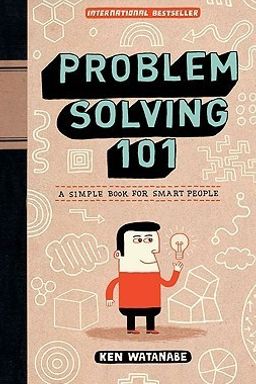
Problem Solving 101 cover

Problem Solving 101

by Ken Watanabe

Problem Solving 101 by Ken Watanabe offers a concise guide to mastering problem-solving skills. Initially aimed at children, its practical strategies are invaluable for anyone seeking to tackle challenges, big or small, and achieve their goals with confidence.

Thinking Like a Problem-Solving Kid

How often do you face problems — big or small — that leave you feeling stuck? From deciding what career path to pursue to figuring out how to improve your grades or manage a team, problems surround daily life. In Problem Solving 101: A Simple Book for Smart People, Ken Watanabe challenges you to view these problems not as stressful barriers but as fun puzzles waiting to be solved. His central argument is simple yet powerful: anyone, regardless of age or background, can become an effective problem solver by using clear thinking tools and a proactive mindset.

Watanabe, a former McKinsey consultant turned educator, wrote this short, story-driven manual originally for children. Unexpectedly, the book became Japan’s number one business bestseller. Why? Because adults, just as much as kids, crave a way to approach their problems with clarity, structure, and creativity. At its heart, Watanabe’s message is about learning how to think — how to diagnose a situation, find its true cause, craft a plan, and act decisively. This simple sequence, applied consistently, turns everyday frustration into possibility.

The Mindset of a Problem Solver

Watanabe insists that problem solving is not just a set of techniques you memorize; it’s a way of seeing the world. Problem-solving kids (a term he uses to describe proactive thinkers) combine curiosity, optimism, and discipline. They enjoy uncovering why things work the way they do and taking responsibility for changing them. They don’t wait for perfect conditions or blame others — they experiment, they reflect, and they keep improving. This attitude echoes the philosophy of kaizen, or continuous improvement, common in Japanese business and productivity culture.

In contrast, Watanabe introduces four archetypes of non-problem solvers: Miss Sigh, who gives up easily; Mr. Critic, who complains without acting; Miss Dreamer, who fantasizes without planning; and Mr. Go-Getter, who acts relentlessly but without thinking. Each character fails to balance analysis and action. A true problem-solving kid, Watanabe stresses, does both: they think deeply before acting and keep adjusting while executing. This balance, applied repeatedly, enables extraordinary growth.

A Four-Step Framework for Every Challenge

The foundation of Watanabe’s method lies in four straightforward steps: (1) understand the current situation, (2) identify the root cause, (3) develop an effective action plan, and (4) execute while modifying as necessary. Simple as it sounds, few people apply these steps rigorously. We jump to conclusions, waste time with irrelevant data, or act before diagnosing the cause. Watanabe’s stories — from rock bands and octopus dreamers to soccer stars — illustrate why disciplined thinking matters more than effort alone.

In the first story, three friends form a band called “The Mushroom Lovers.” When their concerts attract almost no audience, they resist despair and instead learn to act like consultants: identifying potential root causes through surveys, classifying them with logic trees, and testing hypotheses. In the second, John Octopus wants to buy a computer to start his animation career. He learns how to break down goals into smaller, solvable parts — assessing income gaps, prioritizing spending cuts, and testing different paths. In the third, Kiwi, a young soccer prodigy, wrestles with a difficult decision about training in Brazil. Through pros-and-cons grids and criteria evaluations, she learns to challenge her assumptions and make informed choices.

Tools for Clear Thinking

To make his four-step method practical, Watanabe introduces simple visual and logical tools. The logic tree helps you systematically explore causes and solutions. The yes/no tree enables diagnostic thinking by creating clear decision paths. The hypothesis pyramid organizes reasoning and evidence coherently — like the argument structures used in consulting. The problem-solving design plan ensures you research only what matters, preventing data overload. Finally, pros-and-cons grids and criteria-evaluation matrices bring structure to complex decisions.

These tools may sound analytical, but the book’s storytelling makes them surprisingly friendly and intuitive. Each concept is tied to everyday examples — a broken alarm clock, a concert schedule, or a student’s math grades. Watanabe’s pedagogical intent is clear: once kids (and adults) internalize these frameworks, they can approach any problem — academic, business, or personal — logically and creatively.

Why This Matters

At its deepest level, Problem Solving 101 argues for a cultural shift from passive to proactive learning. Watanabe writes that Japan’s education system has long emphasized memorization rather than problem-solving thinking — a challenge shared globally. He advocates for experiential education, where children learn by tackling real, tangible problems and reflecting on their results (echoing Warren Buffett’s early lessons in entrepreneurship). Problem-solving education, he believes, develops leadership, creativity, persistence, and self-awareness — the traits needed not only to succeed personally but also to change communities and the world.

By the time you finish this book, Watanabe doesn’t just want you to be a better thinker; he wants you to proactively shape your environment. Rather than reacting or complaining, you’ll start asking “why” and “how” until solutions become clear. In doing so, you unlock the same power behind innovations from Gandhi to Steve Jobs — turning curiosity and persistence into change that improves both your life and others’.


Becoming a Problem-Solving Kid

Ken Watanabe begins with a central truth: anyone can become a problem solver. You don’t need special talent or lots of resources — you need attitude and structure. The first class of the book introduces the mindset and basic approach, showing how 'problem-solving kids' think differently from others. They enjoy challenges, analyze problems calmly, and take purposeful action without fear of failure.

What Stops Most People

The four non-problem solvers symbolize common human tendencies. Miss Sigh represents defeatism and low self-belief; she gives up before trying. Mr. Critic wastes energy on blame and cynicism, preferring to judge rather than act. Miss Dreamer loves imagination but resists execution. Mr. Go-Getter epitomizes overload — all action, no reflection. If you’ve ever rushed into a project without proper planning or hesitated out of fear, you’ve likely embodied one of these archetypes.

Each character demonstrates a different imbalance between thinking and doing. In contrast, problem-solving kids combine Miss Dreamer’s creativity with Mr. Go-Getter’s initiative, guided by thoughtfulness and feedback loops. They identify root causes before acting and adapt quickly when reality changes. They see problems as opportunities to learn rather than obstacles to avoid.

Evolving Through Feedback

A defining trait of problem-solving kids is their ability to evolve through feedback. Watanabe uses a vivid analogy: three fruit vendors increase sales of watermelons at different monthly growth rates — 1%, 5%, and 10%. Over three years, the differences are astronomical. Cliff, who improves by just 10% per month, ends up selling twenty-two times more watermelons than Alex, who improved by only 1%. The lesson is clear: small, steady improvements compound dramatically over time.

“Problem solving isn’t a talent; it’s a habit.” — Ken Watanabe

By monitoring their actions and reflecting on each outcome, problem-solving kids apply continuous improvement — the same principle behind elite athletes, master artists, and innovative corporations (Toyota’s kaizen culture shares this philosophy). Feedback transforms mistakes into intelligence, preventing stagnation and driving long-term growth.

The Core Framework

Watanabe’s four-step framework for problem solving — understand the situation, identify root causes, plan, and execute with revisions — is the foundation for every chapter. When students notice their math grades slipping, they shouldn’t merely “study harder.” Instead, Watanabe suggests breaking grades into categories: algebra, fractions, geometry. Within the weaker area, pinpoint exactly where confusion lies — maybe trapezoid areas or cylinder volumes. By narrowing down, students create effective, customized plans that address actual causes instead of surface symptoms.

This simplicity hides profound depth. It’s the same analytical structure consultants use for global business problems or leaders for national policies. By teaching children to apply this logic, Watanabe democratizes strategic thinking for everyday life — turning abstract reasoning into practical tools for action. Once you internalize this process, your confidence rises, because no challenge seems too large; it can always be broken into smaller solvable parts.


Finding Root Causes and Creative Solutions

The second major concept in Watanabe’s approach is learning to diagnose problems before acting. Through the story of the rock band 'The Mushroom Lovers,' he demonstrates how clarity beats effort when trying to solve any challenge. Miss Mushroom, Eggplant, and Tofu want to fill their empty concert hall — but instead of guessing, they use structured thinking to uncover why audiences aren’t showing up.

Diagnose Before Acting

Eggplant and Tofu begin by listing all possible causes of low attendance. Some people might not know about the concert; others might know but not care; others might attend once and stop. By organizing these ideas into a logical tree — essentially a visualization of the problem broken down into categories — the duo identifies where to focus. Logic trees clarify relationships and prevent tunnel vision, helping problem solvers map complex issues systematically.

They then form a yes/no tree to turn their logic into questions: Are people aware of the concert? Have they attended before? Do they attend regularly? By surveying classmates, they discover that awareness is not the real issue — only 10% of those aware actually show up. The root cause isn’t advertising; it’s attraction. People either don’t know what kind of music the band plays or can’t attend at the scheduled time.

Testing Hypotheses

Through this exercise, Watanabe introduces the concept of hypothesis testing. You start with a hunch, then gather data to confirm or refute it. In consulting and science alike, hypothesis-driven analysis streamlines research, ensuring you collect only what matters. Instead of drowning in data, you focus your energy where it counts.

Eggplant and Tofu’s surveys reveal insights that change their entire strategy. Once they understand the real causes — schedule conflicts and lack of familiarity — they pivot toward creative solutions. They brainstorm freely using another logic tree, listing all communication channels from posters to radio broadcasts. They then prioritize their ideas using an impact vs. ease matrix, choosing actions both feasible and powerful.

Collaborative Execution

The duo learns that they can amplify implementation by collaborating. When they ask their friend John Octopus to design posters — tapping into his unique talents — an impossible idea becomes easy. Similarly, they optimize their plan: they change concert hours, refresh song lists, and involve humor and storytelling to keep audiences entertained. The result? More than 200 people attend the next concert. Their systematic creativity transforms vague complaints (“no one comes”) into clear results.

This story reflects a recurring lesson in Watanabe’s work: thinking clearly enables smarter action. The Mushroom Lovers succeed not because of luck or emotion but because they treat their problem like scientists — testing, learning, and evolving. In real life, these same methods empower businesses to diagnose why sales wallow or teachers to analyze why students disengage. It’s the discipline of evidence-driven creativity — one that replaces frustration with insight.


From Dreams to Achievements: John Octopus’s Journey

If the Mushroom Lovers teach us how to fix what’s broken, John Octopus teaches us how to achieve what doesn’t yet exist. John dreams of becoming a Hollywood CGI animator and director — but first he must buy a computer. His challenge is financial, not technical, and Watanabe uses this story to show how dreams transform into reality through goal setting and disciplined planning.

Setting Clear Goals

John begins with clarity: instead of vaguely saying “I want a computer,” he defines a precise target — “Buy a $500 used Apple computer within six months without borrowing money.” This specificity gives direction. It forces John to identify gaps between his current savings and his goal. The clearer the goal, the more actionable your plan. Ambiguous goals invite procrastination; precise ones demand response.

Identifying Gaps and Building Hypotheses

After calculating his income and expenses, John realizes he’ll have $252 in six months — short of $500. He must close a $248 gap. Using a logic tree, he divides potential strategies into two categories: increase income or reduce spending. Under each branch, he identifies options such as selling used items, finding better-paying jobs, saving on entertainment, and cutting back purchases. This systematic exploration mirrors professional strategy building — exploring every possibility before choosing the best.

Testing and Revising Plans

John formulates a hypothesis: by switching to a higher-paying job, selling extra items, and cutting unnecessary spending, he can succeed. Then he tests it. His spending analysis reveals surprises — his biggest expenses aren’t CDs but sports drinks and comics. This discovery leads to creative alternatives: preparing homemade drinks and sharing comics with a friend. He cuts monthly spending by two-thirds. For extra funds, he sells unused books and a golf bag from the basement, and creatively multiplies income by walking three dogs at once.

Through continuous adaptation, John hits his goal. His story encapsulates what Watanabe calls the execution equation: Impact = plan effectiveness × quality of execution. A brilliant plan executed poorly fails; a good plan executed persistently succeeds. Like a young Buffett or Jobs, John combines smart analysis with hustle — transforming clever thinking into meaningful progress.

“Dreams become achievable when broken down into smaller, measurable, and testable goals.”

John’s journey teaches an enduring truth: problem solving isn’t just about fixing setbacks — it’s the art of designing a future. By converting big dreams into tangible actions, you turn aspiration into habit. This story mirrors advice from productivity thinkers like James Clear (Atomic Habits): success is built not by one big breakthrough but by incremental, consistent steps refined over time. Watanabe embeds that wisdom in John’s story, making it both inspiring and practical.


Decision Making with Criteria and Evaluation

In the final class of the book, Watanabe focuses on decision-making through Kiwi’s story. Kiwi, a teenage soccer prodigy, must choose between two Brazilian schools — Rio High and Amazon High. Her dilemma shows how emotions, assumptions, and incomplete data can distort choices. Through Kiwi’s evolving reasoning, readers learn how structured evaluation leads to confident, wise decisions.

From First Impressions to Critical Thinking

Kiwi initially chooses Rio High because of its famous website, English-speaking environment, and budget-friendly tuition. But late-night reflection, inspired by an ESPN commentator’s remark, triggers doubt: “A strong team doesn’t always equal a great growth environment.” She realizes she may have valued prestige over learning opportunities. Watanabe illustrates a vital idea: good decision makers challenge their own assumptions and ask better questions.

Using Pros-and-Cons and Criteria Tools

To clarify her options, Kiwi applies two analytical tools: the pros-and-cons list and the criteria-and-evaluation matrix. She lists the advantages and disadvantages of each school, then weights them by importance. Factors like soccer environment, language immersion, and tuition cost reveal trade-offs. These frameworks help anyone facing big decisions — from choosing a career to picking investments — think in terms of priorities rather than impressions.

When researching deeper, Kiwi calls coaches, students, and consultants. She discovers that Amazon, though less prestigious and pricier, offers better player development and total cultural immersion. Rio, by contrast, isolates foreign students and limits game time. Using evidence-based criteria, Kiwi redefines her goal: not fame but growth. This shift reflects expert decision-making principles found in Daniel Kahneman’s Thinking, Fast and Slow — countering bias through structured reasoning.

Turning Information into Action

Even with clear criteria, Kiwi faces a financial constraint. Instead of surrendering, she acts. Her proactive outreach and communication inspire mentorship and opportunity — Nike sponsors her tuition. Watanabe’s conclusion emphasizes that taking action triggers luck: preparation creates opportunity. Kiwi’s story closes the book’s loop, showing that disciplined thinking leads naturally to decisive movement.

“Luck is what happens when preparation meets opportunity.” — Seneca, quoted by Ken Watanabe

By combining reflective questioning with decisive execution, Kiwi reshapes her destiny. Watanabe ends the book with a subtle invitation: you too can shape your world when you think deeply, ask the right questions, and translate insight into effort. Problem solving isn’t only about solutions — it’s about growth, empowerment, and the joy of making things happen.

Dig Deeper

Get personalized prompts to apply these lessons to your life and deepen your understanding.

Go Deeper

Get the Full Experience

Download Insight Books for AI-powered reflections, quizzes, and more.