
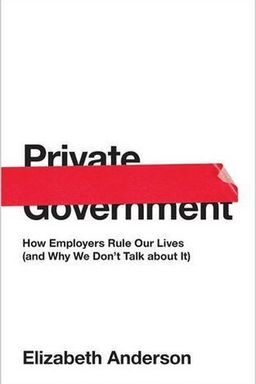
Private Government cover

Private Government

by Elizabeth Anderson

Private Government challenges the illusion of ''free enterprise,'' revealing how modern workplaces resemble authoritarian regimes. Anderson urges readers to question entrenched power structures and consider democratic alternatives for a more equitable and empowering work environment.

How Employers Quietly Rule Our Lives

Have you ever felt that your boss has more control over your life than the government does? In Private Government: How Employers Rule Our Lives (and Why We Don’t Talk About It), philosopher Elizabeth Anderson tackles this provocative question by arguing that most modern workplaces operate as small, unaccountable dictatorships. While we imagine ourselves as free individuals in a capitalist democracy, Anderson reveals that once we clock in, our freedoms often shrink dramatically. She calls this underexamined reality private government—a system where employers wield sweeping authority over workers’ lives inside and sometimes outside the workplace.

Anderson’s core claim is that the ideology of the “free market” blinds us to the domination most workers experience daily. We tend to think of tyranny as something only states can exercise, yet within private firms, employers can dictate everything from speech and appearance to personal behavior off the clock. The book challenges us to reconsider what freedom means when our livelihoods depend on submitting to rules we never helped create and cannot easily question.

From Free Market Dreams to Industrial Realities

To understand how we got here, Anderson traces the evolution of market ideology from its egalitarian origins. Early thinkers like the seventeenth-century Levellers, John Locke, and later Adam Smith viewed market society as a way to dismantle hereditary hierarchies and create a world of “masterless men”—independent artisans, farmers, and traders. They saw economic freedom as political freedom. But this optimistic vision collapsed under the Industrial Revolution. As capital concentrated in large enterprises, workers lost the realistic prospect of self-employment. Factories required centralized authority, and wage labor became the norm. Yet many modern libertarians still cling to eighteenth-century ideals, forgetting that economic independence was once a widespread reality, not a myth.

Anderson argues that what we now call free-market freedom bears little resemblance to the original egalitarian version. Instead of producing a society of equals, capitalism has created hierarchies reminiscent of feudalism—only this time, the lords are corporate executives and managers. And while the state’s power is limited by democratic accountability, the power of employers within their firms remains largely unchecked.

The Workplace as a Private Government

Anderson’s most controversial metaphor comes early: “Most workers in the United States are governed by communist dictatorships in their work lives.” At work, she argues, property rights give the employer ownership of not only the means of production but also, effectively, employees’ time, behavior, and even speech. Think of Walmart’s restrictions on in-store conversation, Apple’s unpaid bag checks, or poultry workers at Tyson denied bathroom breaks. These examples illustrate how management rules mirror authoritarian systems—complete with surveillance, arbitrary punishments, and no due process. Unlike citizens in a democracy, employees rarely have rights to free speech, association, or privacy at work.

“If the U.S. government imposed such regulations on us, we would rightly protest that our constitutional rights were being violated. But American workers have no such rights against their bosses.” — Elizabeth Anderson

Why We Don’t Talk About Workplace Tyranny

How did such systems of private rule become invisible in public debate? Anderson blames ideology: the belief that markets automatically equal freedom. Because workers “freely” agree to their jobs, the story goes, any rules they face are voluntary. This view ignores the high costs of exit for most workers—the risk of poverty, the loss of health insurance, the difficulty of finding another job. To say a worker is free to quit, Anderson quips, is like saying Italians under Mussolini were free to emigrate. Legal doctrines such as at-will employment—allowing firing for almost any reason—solidify this lopsided power structure. Yet in politics, we rarely see employment as a question of government at all.

Rethinking Freedom and Equality

Anderson suggests that we must move beyond the narrow notion of negative liberty—freedom from interference—and embrace republican freedom, the freedom from domination. True liberty means not merely having rights on paper but living without fear of arbitrary control. Just as citizens demanded constitutional protections from the state, so too, she argues, workers deserve protections within private governments. These might take the form of stronger unions, due-process rights, or worker voice mechanisms like Germany’s co-determination model. Without these structures, “freedom of contract” simply legitimizes coercion.

Why It Matters Today

The book invites you to see the workplace not as a marketplace of voluntary exchange but as a political institution shaping millions of lives. It forces you to ask: if we care about democracy in our governments, why tolerate authoritarianism in our jobs? Anderson’s historical sweep—from the Levellers to Lincoln—exposes how myths of economic freedom obscure growing inequalities of power. Her analysis is especially urgent in an age of gig work, surveillance capitalism, and eroding labor protections. “Private Government” is not just a critique of employers; it’s a manifesto for reviving egalitarian values in the one sphere that still operates like a private kingdom—the workplace.


When the Market Was Left

In one of the book’s most illuminating chapters, Anderson reveals a lost history: the market was originally a left-wing idea. Seventeenth- and eighteenth-century radicals such as the Levellers, John Locke, Adam Smith, and later Thomas Paine saw markets as tools of liberation. They wanted to dismantle the oppressive hierarchies of monarchy, aristocracy, and the Church, replacing them with a society of independent producers. Markets were meant to free ordinary people from domination—not, as later neoliberals would argue, to free capital from regulation.

The Egalitarian Roots of Free Markets

During the English Civil War (1642–1651), the Levellers believed that breaking monopolies and abolishing guild restrictions would allow more citizens to become self-reliant “masterless men.” Their enemy wasn’t the state per se, but unaccountable authority—whether from kings, lords, or bishops. When John Lilburne demanded an end to printing and trade monopolies, he echoed the argument that “property” should mean freedom from domination, not freedom to exploit. Locke extended this principle to natural rights: people could own what they produced with their labor, but no one had a right to enslave others or strip them of independent means.

Adam Smith’s Humane Vision

Smith’s Wealth of Nations (1776) often gets misread as a hymn to free enterprise. Anderson reminds us that his real concern was the liberation of workers from feudal “servile dependency.” In feudal England, peasants owed obedience to their feudal lords. The rise of markets meant they could finally sell their labor or goods for payment rather than subsistence. “Hospitality,” Smith quipped, tied men to their masters’ tables. Commerce and contracts, by contrast, allowed them to stand as equals—“the butcher, the brewer, and the baker”—each recognizing the others’ interests. For Smith, markets humanized society by replacing obedience with mutual respect.

Smith’s utopia was a world of small proprietors—yeoman farmers and artisans—where monopolies and hereditary titles had vanished. He thought capitalism would shrink great fortunes, dissolve aristocracies, and distribute power more evenly. As Anderson shows, this belief was not naive but historically grounded: in his time, workshops rarely had more than ten workers. The Levellers’ and Smith’s hope was that economic liberty would lead to moral and political equality.

Thomas Paine and the American Dream

Two centuries before today’s populists invoked Main Street versus Wall Street, Thomas Paine embodied the radical promise of the market. A Quaker craftsman turned revolutionary, Paine saw independent labor as the cornerstone of democracy. In Common Sense, he argued for “a republic of equals” where every man could earn his living without servitude. His later work, Agrarian Justice, proposed one of history’s first social insurance systems—funded by inheritance tax—to protect the elderly and the disabled. Far from laissez-faire dogma, Paine’s plan acknowledged that markets alone could not guarantee independence; a safety net was essential for true freedom.

Anderson uses these thinkers to show that classical “free market liberalism” was not about freeing corporations but freeing people from dependence. Wages were high, land abundant, and self-employment common. The belief that every man could be his own boss wasn’t fantasy—it described early American reality. Lincoln later described this as the “free labor” ideal: a man might work for wages temporarily, save enough to buy his own tools or land, then hire others in turn. That, for him, was the path to a “prosperous system of equals.”

“The hired laborer of yesterday labors on his own account today, and will hire another new beginner to help him tomorrow.” — Abraham Lincoln, 1859

This optimism, however, rested on fragile assumptions: endless land, minimal population, and small-scale enterprise. Anderson shows how dramatically the Industrial Revolution overturned those foundations. By the 1830s, economies of scale replaced independence with dependency. Where Smith saw the butcher, the brewer, and the baker, Karl Marx now saw “the capitalist and the laborer”—the one commanding, the other obeying. The free market had been hijacked from the left to the right, from a movement of liberation to a justification for hierarchy.


The Rise of Private Government

Anderson’s next major argument delivers her most striking insight: the modern firm is a private government. You probably think of your employer as someone you contract with—not a ruler over your life. Yet Anderson insists that when you enter a workplace, you step into a political jurisdiction governed by different rules than the state. Unlike the democratic state, you have no vote or constitutional rights inside. Your boss can check your emails, monitor your bathroom breaks, regulate your political speech, and even fire you for conduct off the job—all legal under “at-will” employment.

Workplace Authoritarianism

To dramatize this, Anderson invites us to imagine a government that assigns everyone a superior to obey; can dictate what we wear, say, and whom we associate with; monitors our private communications; and punishes noncompliance by exile. Now realize, she says, “you already live under such a government—it’s called your job.” Employers function like dictatorships because their power is arbitrary (rules made at will), comprehensive (reaching beyond work hours), and unaccountable (workers cannot appeal or participate in rulemaking).

Her examples are chilling: Walmart forbidding on-the-job small talk as “time theft”; Apple inspecting bags off the clock; and Tyson’s factories where workers have literally urinated on themselves for lack of breaks. Though not every employer exercises its full legal power, the mere fact that they can shows how precarious worker freedom really is. Quitting, Anderson argues, doesn’t solve the problem when nearly every other employer operates the same way.

Why It’s Legal—and Why We Accept It

If such authoritarian control came from the state, it would violate constitutional rights. So why is it tolerated from your boss? Anderson shows that legal doctrines classify firms as “private,” meaning state power doesn’t reach into their internal governance. Yet for workers, these are de facto governments: they issue orders backed by sanctions and control crucial aspects of life. Economists like Ronald Coase defended this structure on grounds of efficiency: complex production requires hierarchies that can’t function by endless negotiation. But efficiency alone doesn’t justify dictatorship. As Anderson notes, the degree of control most employers assert—extending into off-duty speech, politics, and social media—far exceeds what coordination requires.

The Myth of Market Freedom

Libertarian economists often claim workers are free because they can quit. Anderson demolishes this fallacy by comparing it to saying Mussolini wasn’t a dictator because Italians could emigrate. Exit costs—loss of income, career disruption, relocation barriers—make “freedom to leave” largely theoretical for most. The same ideology that limits government interference in business simultaneously grants businesses near-sovereign power over employees. What early liberals called liberation has now become domination.

The result, says Anderson, is political hemiagnosia—a blindness to half our political life. We debate taxes or surveillance but ignore the governance structures where we spend most of our waking hours. By treating the workplace as a purely economic zone, public discourse excludes its political realities. Recognizing the firm as a government doesn’t mean abolishing hierarchy; it means demanding the same accountability we expect from any power that governs others’ lives.


Unmasking the Ideology of Freedom

Why do we still believe we are free at work? Anderson traces this delusion to an ideological confusion about freedom itself. Since the nineteenth century, she argues, thinkers and politicians have equated liberty exclusively with freedom from state coercion—what philosophers call negative liberty. In this view, the state is the only threat to freedom, and markets guarantee choice. But a richer conception of liberty—republican freedom—emphasizes freedom from domination, no matter the source. Being uncoerced isn’t enough; you must also be free from arbitrary rule.

Three Faces of Freedom

Anderson distinguishes three kinds of liberty:

  • Negative freedom—the absence of external interference. It’s freedom “from.”
  • Positive freedom—the ability to act and pursue goals, given real opportunities and resources.
  • Republican freedom—the condition of not being dominated by another’s arbitrary will.

At work, we may have negative freedom to quit but little republican freedom to protest. You can speak your mind to your senator, but not to your supervisor. You can vote out a mayor, not your boss. Anderson links this to philosopher Philip Pettit’s republican theory of liberty: freedom starts where domination ends. By this standard, workplaces that subject employees to unchecked managerial discretion are unfree—even if everyone “consented” to the contract.

Private Property and Public Power

To expose the double standard in libertarian thinking, Anderson turns their own logic against them. They claim property rights safeguard liberty. But every private property right creates a corresponding restriction on others’ freedom. If Lalitha owns a parcel of land, seven billion others lose the liberty to walk there. This doesn’t make private property unjust—but it shows that freedom often depends on regulation. Just as governments limit interference to prevent chaos, they must also limit domination within private regimes. Otherwise, property rights themselves become instruments of unfreedom.

The Forgotten Public Sphere

Before the Industrial Revolution, “government” meant any authority: masters, husbands, priests. Today we restrict it to the state, creating the illusion that the private sphere is free of rule. Yet whenever someone has the power to order and punish you, you live under a government—public or private. This is why Anderson insists that employers are governors and employees their citizens. But unlike civic democracy, most corporations remain oligarchies where subjects lack both voice and standing. Recognizing this is not an attack on capitalism; it’s a call to make liberty real where it matters most—in the institutions that govern everyday life.


Freedom, Dignity, and the Modern Worker

When responding to critics, Anderson deepens her argument by focusing on what it means to live with dignity and autonomy. Her dispute with philosopher Niko Kolodny and economist Tyler Cowen centers on whether workplace hierarchy is inherently oppressive. Kolodny asks: aren’t we all governed—in democracies, too? Why, then, resent being governed by a boss? Anderson replies that the difference lies in accountability. Democratic citizens share rule over one another; workers do not.

Why Subordination Hurts

Subjection to arbitrary authority, she argues, harms both materially and morally. Drawing on real stories, she contrasts the humiliations of Amazon warehouse workers—timed bathroom breaks, heat exhaustion, threats of firing—with NASA astronauts who once fought for self-direction aboard Skylab. When the astronauts revolted against micro-management and NASA backed down, productivity soared. People work better when treated as adults with judgment, not machines under command. This difference captures what Anderson calls a basic human need: the capacity to exercise autonomy.

Workplace domination also erodes standing and esteem—the sense that one’s interests matter. When employers disregard workers’ safety, mock their complaints, or pressure them to falsify injury reports, as documented by OSHA investigations, they send a clear message: your well-being doesn’t count. Such moral injury, Anderson observes, hurts as deeply as physical harm because it denies one’s status as an equal. Echoing Adam Smith’s The Theory of Moral Sentiments, she notes that what enrages us most about insults is “the little account” tyrants make of us.

Efficiency vs. Freedom

Cowen counters that businesses need discretion for efficiency and that most workers accept or even appreciate workplace discipline. Anderson answers that while hierarchy can coordinate complex production, dictatorship is not required for efficiency. Many firms, from universities to German companies with worker representation, show that shared governance and profitability can coexist. What drives authoritarian workplaces, she says, is not efficiency but neglect—laws that grant employers unchecked power by default.

Restoring Equal Standing

True reform, Anderson argues, demands rebalancing respect and autonomy across classes of labor. Higher-paid professionals enjoy dignity precisely because their market value grants them leverage; low-wage workers lack such protection. Abuses—wage theft, harassment, coerced political speech—flourish where labor is cheap and voice silenced. The cure is structural, not individual: exit rights alone are insufficient. Workers need voice inside their governments, just as citizens need representation in theirs. Whether through stronger unions, works councils, or a “bill of rights for workers,” she envisions institutions that make power answerable to those it governs.


Making Work Democratic

If firms are governments, Anderson concludes, it’s time to democratize them. Not necessarily by turning every workplace into a co-op, but by reimagining the constitution of workplace governance. Her goal isn’t to abolish management but to make it public rather than private—accountable, transparent, and fair. She identifies four strategies to secure worker freedom: exit, rule of law, constitutional rights, and voice.

Exit

Freedom to leave a bad job matters, but only if alternatives exist. Non-compete clauses, tied benefits, and visa restrictions trap workers, effectively transforming “choice” into dependency. Anderson points to California’s prohibition on non-compete contracts as evidence that loosening these constraints spurs both innovation and worker mobility. Yet even perfect exit rights can’t guarantee dignity where all firms share the same authoritarian model.

Rule of Law

Under at-will employment, the workplace is ruled by decree rather than law—orders can change daily without notice or appeal. Anderson wants firms bound by a rule of law: clear policies, due process in discipline, and general rules instead of arbitrary commands. Some large companies already mimic legal structures through employee handbooks and grievance procedures; these could serve as models for formal workplace constitutions.

Constitutional Rights

Workers, she insists, deserve certain inalienable rights even when on the job—freedom of speech, privacy, and protection from harassment and discrimination. Anderson highlights the absurdity that states may not monitor your phone calls, but your boss can. Borrowing from European models, she advocates anti-mobbing laws and stronger safeguards for off-duty political participation. A workers’ bill of rights could enshrine baseline dignity across industries.

Voice

Yet the most vital reform is voice—institutionalized participation in workplace decisions. American unions, limited by outdated laws, represent barely 10% of workers. Anderson proposes broader experiments: works councils like those in Germany, joint management boards, and company-level “parliaments” where employees and managers co-govern. These arrangements, far from hampering productivity, often yield stability, lower turnover, and a sense of shared purpose. As she sums up, “If government is necessary, it must be made a public thing—accountable to those it governs.”

Democracy at work, for Anderson, is not utopian but practical. It recognizes that freedom requires not just protection from interference but participation in power. The factory floor, the warehouse, and the office, she insists, should no longer be invisible kingdoms. They are the front lines where a free society must deliver on its promise of equality.

Dig Deeper

Get personalized prompts to apply these lessons to your life and deepen your understanding.

Go Deeper

Get the Full Experience

Download Insight Books for AI-powered reflections, quizzes, and more.