
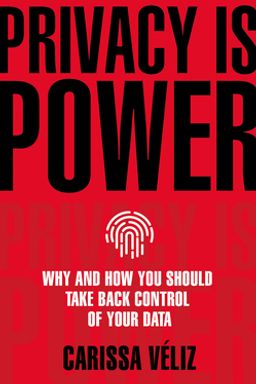
Privacy Is Power cover

Privacy Is Power

by Carissa Veliz

Privacy Is Power by Carissa Veliz reveals the unsettling reality of surveillance capitalism, where personal data is exploited to influence behavior. Discover why protecting your privacy is crucial and learn actionable strategies to defend your digital freedom.

Privacy Is Power: Reclaiming Control in a Surveillance Age

When was the last time you felt truly alone—unwatched, untracked, unrecorded? In Privacy Is Power, Carissa Véliz argues that this increasingly rare feeling isn’t just a personal luxury—it’s the foundation of your freedom. Every decision you make, every belief you form, every secret you keep, depends on having spaces free from surveillance. But today, those spaces have vanished. From your smartphone to your refrigerator, the devices around you are listening, watching, and feeding your life into a global data machine. Véliz contends that the data economy—the system through which governments and corporations collect, analyze, and trade your personal information—has created an unprecedented imbalance of power. Whoever holds your data controls you.

The central argument of Véliz’s book is deceptively simple but profound: privacy isn’t dead, but it’s dying fast—and we must fight to revive it. She insists that personal data is combustible fuel for power, capable of igniting manipulation and authoritarianism when mishandled. To reclaim autonomy and safeguard democracy, we must end the trade in personal data and build a privacy-first society. This isn’t just about protecting your emails or your browsing history; it’s about rebalancing civilization’s moral and political foundations.

The World of Data Vultures

The book opens with a vivid morning routine that feels unsettlingly familiar. You wake up, check your phone, and hundreds of entities instantly know what time you got up, where you slept, and who you spent the night with. Your smartwatch tracks your heartbeat and movement. Your “smart” doorbell records your visitors for Amazon’s employees to analyze. Even brushing your teeth with a Bluetooth toothbrush creates a new data point. By lunchtime, you’ve exposed intimate details about your mood, sex life, health, and habits—and most of this happens passively, without consent.

Through this narrative, Véliz invites you to see the surveillance web that’s invisibly wrapped around daily life. Each chapter exposes how your home, workplace, and even citizenship are embedded in digital systems designed not to serve you, but to serve those who sell your attention and influence. As the author explains, Facebook doesn’t sell your data—it sells the power to shape your behavior. Google doesn’t just show results—it designs the reality you see. As she writes, “You are a pawn in the games data scientists are playing on their screens.”

How We Got Here

Véliz traces this collapse of privacy to three forces: corporate greed, government surveillance, and cultural complacency. First, Silicon Valley discovered that what people voluntarily typed into search engines—fears, desires, ailments—was gold dust. Google, she recounts, transformed from an academic curiosity into an advertising behemoth by monetizing this “data exhaust.” Second, after the September 11th attacks, governments abandoned privacy protection to build mass surveillance systems under the banner of national security. The result was the merger of corporate and state intelligence: companies collected data; governments copied it. Finally, tech leaders like Mark Zuckerberg convinced the public that privacy was obsolete, a relic of the pre-digital age. But while Zuckerberg declared privacy “no longer a social norm,” he quietly bought adjoining houses to shield his own life from prying eyes—a hypocrisy that Véliz unpacks to devastating effect.

Privacy as a Form of Power

At the heart of Privacy Is Power lies a philosophical reframe: privacy isn’t just secrecy—it’s power. Your personal data is the master key to your identity, your vulnerabilities, and your relationships. When others hold that key, they can manipulate you, predict your actions, and decide your future. Véliz builds on thinkers like Michel Foucault and Francis Bacon to argue that knowledge and power are inseparable. In the digital age, whoever knows you best—be it Facebook, Google, or the NSA—can decide what truth means about you. This asymmetry turns citizens into subjects, democracy into surveillance, and autonomy into algorithmic obedience. Protecting privacy, therefore, isn’t a matter of convenience; it’s an act of civic resistance.

Personal Data Is Toxic

Véliz compares personal data to asbestos—durable, cheap, and deadly. Like asbestos, data seems harmless until it poisons everything. Hackers exploit it, companies leak it, governments weaponize it. From the Ashley Madison breach that led to suicides to Equifax’s compromise of millions of Americans’ identities, she shows that data disasters destroy not only individuals but entire institutions. Once personal data exists, it’s a ticking bomb. You can’t retrieve it, you can’t ensure it’s safe, and you can’t predict how it will be used against you or your family decades later.

A Blueprint for Redemption

The book concludes with an urgent manifesto for reclaiming control. Governments must outlaw personalized ads, ban data brokers, and enforce fiduciary duties that compel tech companies to act in users’ interest. Citizens must demand privacy protections, refuse intrusive technologies, and choose alternatives that respect their rights. Collective action, she insists, is key—just as environmental movements curbed pollution, a new privacy movement must detoxify the data economy. “Privacy is the blindfold of justice,” Véliz writes, reminding readers that impartiality, equality, and freedom depend on preserving our ability to decide what parts of ourselves we reveal.

In short, Privacy Is Power is both diagnosis and remedy: it dissects the anatomy of surveillance capitalism and prescribes a cure rooted in moral philosophy and citizen action. It teaches you that protecting privacy isn’t just about saving yourself from identity theft—it’s about saving democracy itself. You are not a product to be mined or sold. You are a citizen, and your privacy is your power.


The Rise of Surveillance Capitalism

Véliz reveals how an innocent technological innovation—the ability to see what people search for online—mutated into the most pervasive surveillance system in history. In the late 1990s, Google’s founders Larry Page and Sergey Brin created PageRank, an algorithm that revolutionized information access. But when investors demanded profit, Google began selling ads based on user data. This was the birth of surveillance capitalism, a term coined by Shoshana Zuboff. Unlike traditional capitalism, which trades goods or services, surveillance capitalism trades in human experience itself. Every search, click, and scroll is converted into behavioral data used to predict—and influence—your future choices.

Corporate Greed Meets Government Fear

What propelled surveillance capitalism from novelty to global system was tragedy. After September 11, 2001, state agencies abandoned privacy reforms. The U.S. Patriot Act transformed surveillance into national policy. Intelligence agencies like the NSA began siphoning data directly from companies through programs like PRISM, accessing emails, photos, and chats from Microsoft, Apple, Facebook, and Google. Even more invasive tools like XKEYSCORE allowed analysts to search nearly any private detail of a person’s life—from keywords typed to locations visited. Rather than curbing corporate overreach, governments partnered with it. As Véliz notes, corporations collected data for profit; states copied that data for power.

We Became the Product

Originally, Google was designed for users—the algorithm improved by learning what information people sought. But once ads entered the equation, incentives flipped. Users were no longer clients; they were the product. Companies realized that precise behavioral prediction gave them the ability to sell influence over your decisions. The data economy turned individuals into objects of analysis—packages to be traded and manipulated. Big Tech’s language sanitized the transaction through euphemisms like “personalization” and “user experience.” As Véliz writes, this is political language designed to make control sound friendly and inevitable.

The Collaboration of Power

Surveillance capitalism thrived because both private and public sectors saw mutual benefit. The NSA relied on AT&T’s infrastructure to intercept global communications. Palantir, a big-data firm partly funded by the CIA, built analytic tools to process intelligence feeds. Tech giants like Amazon and Microsoft provided cloud services used for immigration surveillance and predictive policing. The distinction between government and corporate espionage blurred; privacy protections collapsed under the weight of “security.” According to Véliz, the “digital economy was allowed to run wild because it proved to be a source of power for governments.”

Crisis as Opportunity

Véliz warns that crises—terrorism, pandemics, recessions—create the perfect storm for power grabs. Citing both the post-9/11 surveillance explosion and COVID-19’s digital tracking boom, she argues that fearful societies sacrifice liberty for promises of safety, only to find those measures permanent. “Invulnerability is unattainable,” she reminds us; the pursuit of total security only adds authoritarianism to the list of disasters humanity must endure. The antidote is vigilance: privacy must be defended even in emergencies, because data collected in panic will be misused in peace.


How Privacy Equals Power

Why does privacy matter so much? Véliz’s argument goes beyond moral intuition. She defines privacy as a form of power—a safeguard that prevents domination. Without privacy, others gain the ability to act upon you, influence you, and decide who you are. She contrasts two kinds of power: soft power, which persuades and manipulates, and hard power, which coerces and enforces. Today’s technology exercises both. Facebook seduces through emotional cues and dopamine-driven design; governments impose through facial recognition and mandatory tracking. Both make citizens act against their interests.

Knowledge Is Power

Drawing from Francis Bacon and Michel Foucault, Véliz explains that knowledge doesn’t just serve power—it produces it. When algorithms classify you as anxious, unemployed, or politically radical, those classifications become reality in the eyes of institutions. You may be denied a loan, flagged by authorities, or shown ads manipulating your fears. This asymmetry of knowledge converts autonomy into exposure. “The more others know about you,” she writes, “the more they can anticipate your every move.” Protecting privacy ensures power remains distributed, not concentrated in databases or algorithms.

The Anatomy of Manipulation

Tech’s manipulation machinery runs on behavioral science. Platforms exploit dopamine feedback loops, intermittent rewards, and self-validation triggers. As Tristan Harris (former Google ethicist) similarly notes, social media hijacks attention through addiction engineering. Véliz connects this psychological influence to political control: if your emotions and beliefs can be nudged invisibly, your autonomy is compromised. She warns that the most dangerous power is not brute force but invisible persuasion—a soft coercion that recruits your own will against you.

Autonomy Under Siege

When you lose privacy, you lose self-governance. Google’s former CEO Eric Schmidt once said users want the company to tell them “what they should do next.” To Véliz, this is a confession of authoritarian ambition disguised as convenience. Tech pretends to optimize your life; in reality, it scripts it. Autonomy requires solitude, reflection, and informed choice—the very conditions that surveillance eliminates. Protecting privacy, then, isn’t about paranoia; it’s how we preserve freedom. In her words, “Privacy gives power to the people.” Without it, democracy devolves into digital feudalism, ruled by those who own our data.


Personal Data Is Toxic

Imagine asbestos scattered through every building in the world. It’s durable, useful—and lethal. That’s how Carissa Véliz describes personal data: a toxic material woven into our social infrastructure. Data leaks are inevitable, misuse is rampant, and the harm is irreversible. Like asbestos, data accumulates silently until disaster strikes.

Poisoning Individuals

The consequences of stolen data are deeply human. The Ashley Madison hack exposed millions of users, provoking public shaming, blackmail, and suicides. Identity theft victims like Ramona María Faghiura, arrested for crimes she didn’t commit, live years in legal purgatory. Each example underscores Véliz’s warning: once your data escapes, you can never retrieve it. It becomes a weapon in strangers’ hands, capable of ruining reputations, marriages, and mental health.

Corrupting Institutions

Corporations and governments suffer too. From Cambridge Analytica’s collapse after political manipulation to Equifax’s $700 million settlement, data scandals cost billions and destroy public trust. Yet many organizations have learned nothing. Facebook’s endless privacy breaches show that fines, however large, are still cheaper than reform. “Managing sensitive data,” Véliz writes, “is like managing any other toxic substance: when things go wrong, it can mean the death of a company.”

Threatening Societies

At scale, toxic data menaces democracy and national security. China’s theft of millions of Americans’ records, including from Equifax, illustrates how personal data enables espionage and blackmail. Social media campaigns fueled by stolen information—like Russia’s Facebook operations in 2016—corrode trust and polarize populations. Véliz connects these dots to history: Nazi regimes used population registries to locate Jewish citizens. In the Netherlands, the detailed census work of bureaucrat Jacobus Lentz made genocide efficient; in France, limited data saved lives. “Data kills,” she writes. Privacy isn’t a privilege—it’s protection from tyranny.

The Slow-Acting Poison

Data harms unfold slowly—denied loans, lost jobs, manipulated votes, and eroded civil liberties. Society’s tolerance of these harms stems from their invisibility. You don’t feel data theft like a wound. But it accumulates, reshaping economies and relationships until autonomy, fairness, and safety are poisoned beyond repair. Véliz’s metaphor reminds readers that the cure is not containment but removal: delete unnecessary data, ban its trade, and design systems that minimize collection. Unless we change course, the data economy will become the slowest suicide of democracy.


Reforming the Digital Economy

How do we detoxify the digital world? Véliz’s fifth chapter, “Pulling the Plug,” offers a radical yet practical blueprint. Her resolution is simple: end the trade in personal data. Just as society banned harmful substances and unethical labor practices, we must outlaw personalized advertising, data brokerage, and default data collection. Privacy must become the baseline, not the exception.

Ban Personalized Advertising

Advertising once meant creativity and persuasion. Now, it means surveillance. Through real-time bidding, advertisers access your sexual orientation, income, or political beliefs in microseconds. Véliz condemns this system not only for violating privacy but for warping democracy—targeted ads made Cambridge Analytica’s manipulations possible. She proposes banning personalized ads outright, replacing them with contextual ads that respond to general queries (“searching for shoes” shows shoe ads) rather than behavioral history.

Outlaw Data Brokerage

Data brokers, she argues, are the scavengers of the digital landscape, selling human experiences for pennies. Companies like Equifax, Acxiom, and Experian profit from lists of rape victims, patients with AIDS, or debtors desperate for loans. Buying bank account numbers costs cents. Such trades should be considered ethical violations equivalent to trafficking. “Personal data,” she writes, “should never be something you can buy, sell, or exploit for profit.”

Establish Fiduciary Duties and Cybersecurity Standards

Institutions holding data must act with fiduciary care, like doctors protecting patients—always placing users’ interests above their own profits. Those duties must include strict security requirements: encryption, deletion protocols, and accountability for breaches. The balance of risk must shift so that tech giants, not citizens, pay the price of negligence. Strong fines and new digital regulatory agencies could help enforce the law, similar to how health or safety commissions protect citizens from physical harm.

Delete and Forget

Finally, Véliz calls for systemic forgetting. Constant storage of personal data is unnatural and dangerous. Like Viktor Mayer-Schönberger (author of Delete), she argues that healthy societies need digital oblivion—built-in expiry dates, automatic deletion, and minimal retention. Records of our every click create permanent vulnerability. Forgetting restores resilience. Privacy, she concludes, is not nostalgia—it’s healing. The data economy must be dismantled before it dismantles democracy.


Your Role in the Privacy Revolution

The fight for privacy isn’t only for policymakers—it’s personal. In the final chapter, Véliz turns from diagnosis to empowerment. Every individual can resist surveillance capitalism, she insists, through deliberate, everyday choices. Like recycling or voting, privacy protection is a civic duty. It begins when you refuse to cooperate with the system that exploits you.

Small Acts, Big Impact

Start with awareness. Think twice before sharing photos or accepting cookie prompts. Use secure messaging apps like Signal, privacy-focused browsers like Brave or Firefox, encrypted email services like ProtonMail, and search engines like DuckDuckGo. Block intrusive ads, switch off location tracking, delete unnecessary apps, and regularly clear your digital footprint. Each minor act reduces the data economy’s fuel supply.

Demand Accountability

Véliz encourages you to be vocal. Contact representatives, demand privacy legislation, and review companies critically online. Use rights granted by laws like GDPR to request and erase your data. Privacy movements grow when citizens insist on them. The author highlights how consumers drove reforms in food safety and labor rights—privacy can follow the same path.

Ethical Tech and Professional Responsibility

If you work in technology, your influence is immense. Véliz urges tech workers to refuse unethical design, resist data exploitation, and push for privacy-first innovation. She invokes historical regrets—Alfred Nobel’s dynamite, Robert Propst’s office cubicle, IBM’s machines used by Nazis—as reminders that inventors bear moral responsibility for consequences. “Do not join that list,” she warns. Build tools that liberate, not surveil.

Refuse the Unacceptable

Inspired by resistance heroes like Stéphane Hessel and Martin Luther King Jr., Véliz ends with a rallying cry: indignation is the engine of change. “Do not tolerate having your right to privacy violated,” she writes. Your awareness, choices, and defiance create the pressure for reform. Privacy is political, collective, and transformative. The surveillance economy depends on your cooperation—withdraw it, and the system collapses. In doing so, you’ll restore what Véliz calls “the blindfold of justice”: the power to live freely without being watched.

Dig Deeper

Get personalized prompts to apply these lessons to your life and deepen your understanding.

Go Deeper

Get the Full Experience

Download Insight Books for AI-powered reflections, quizzes, and more.