
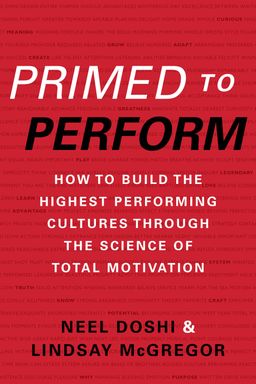
Primed to Perform cover

Primed to Perform

by Neel Doshi and Lindsay McGregor

Primed to Perform reveals the science behind fostering a high-performance culture. By understanding the nuances of motivation, leaders can drive sustainable success and fulfillment. Learn to ignite your team''s potential and transform your organization with the ToMo framework.

Motivation as the Engine of Performance

Why do some teams thrive under pressure while others crumble? In Primed to Perform, authors Neel Doshi and Lindsay McGregor argue that the secret lies not in strategy or structure but in motivation—why people work, not just how. They reveal that your reasons for working drive how well you perform, adapt, and sustain success. The book reconceives performance from a mechanical process to a motivational ecosystem you can measure and manage.

At the core of this framework are three ideas: the Motive Spectrum, the Total Motivation (ToMo) metric, and the balance between tactical and adaptive performance. The authors show how organizations that cultivate the right mixture of motives consistently outperform competitors in creativity, customer experience, and resilience. They illustrate this through case studies from Toyota, Whole Foods, Medallia, and Southwest Airlines—all cultures that outperform by emphasizing meaning, autonomy, and experimentation over pressure and pay.

Six Motives—Three that Drive, Three that Drain

The Motive Spectrum identifies six reasons people work. The direct motives—Play, Purpose, and Potential—energize adaptive performance because they are tightly linked to the work itself. Play means you enjoy the work for its own sake, as in Toyota’s constant tinkering culture. Purpose means you value the outcome—like engineers at Medtronic inspired by seeing their devices save lives. Potential means you see the work as a step toward something personally meaningful, such as leadership growth or mastery.

The indirect motives—Emotional pressure, Economic pressure, and Inertia—pull in the opposite direction. You act from fear, reward, or habit, focusing on external consequences instead of the work. These motives may temporarily increase compliance but erode creativity and judgment. The Dubai “Your Weight in Gold” contest epitomizes this effect: when pay was the only motivator, participants regained lost weight once the contest ended. Intrinsic motives, by contrast, lead to durable behavior change.

From Motivation to Measurement: The ToMo Score

Total Motivation (ToMo) quantifies the health of a culture by capturing how much of each motive people feel at work. Scores combine direct motives (added) and indirect motives (subtracted) into a single number between roughly -100 and +100. High-ToMo organizations—like Southwest Airlines—show strong adaptive capacity and long-term success. ToMo translates the vague concept of culture into data leaders can monitor, diagnose, and improve over time.

Doshi and McGregor stress that ToMo must never become a ranking weapon. Instead, it’s a diagnostic compass—a way to see where play, purpose, and potential are thriving and where pressure-based motives need redesign. It guides leaders to tune systems, not punish people.

Performance Redefined: Tactical and Adaptive

The authors redefine performance as two interdependent forms: tactical performance (doing the plan well) and adaptive performance (diverging from the plan when reality changes). Most organizations measure the former and neglect the latter, even though adaptability determines long-term success. Research shows that when stakes or incentives rise, people’s focus narrows, creativity plummets, and problem-solving suffers—a phenomenon proved by Dan Ariely’s experiments and the Max Planck Institute’s toddler study.

Adaptive organizations balance these forces by designing environments that support experimentation, shared purpose, and reflection. At Southwest Airlines, pilots and crew make real-time customer decisions within a framework of shared principles. At Whole Foods, local teams act autonomously within company identity. These examples show how high ToMo translates strategic intent into everyday adaptability.

The Broader System of Culture

The rest of Primed to Perform builds a playbook for leaders: how to design roles and communities, how to measure motivation, and how to govern culture without crushing spontaneity. The authors explain the dangers of low ToMo—distraction, cancellation, and cobra effects—where badly designed pressure systems lead to ethical lapses or stagnation. They explore the psychology of the blame bias, which causes leaders to punish individuals instead of repairing flawed systems, and they introduce leadership principles—called Fire Starters—that make high-ToMo behaviors contagious.

This framework culminates in an organizational redesign model: create adaptive playgrounds for experimentation, craft strong identity, nurture community, build many career ladders, and fund explicit stewardship of culture through Fire Watchers—a specialized team that maintains high ToMo across the company. The ultimate lesson is that motivation is a system property, not a personal trait.

Core takeaway

When people’s reasons for working are close to the work itself—enjoyment, purpose, growth—they adapt better, learn faster, and perform stronger under uncertainty. Culture is not charisma or perks; it’s the deliberate design of motives within every job, team, and system.


The Motive Spectrum and Total Motivation

The book’s central invention is the Motive Spectrum, a psychological model that maps six reasons why people work. The first three—Play, Purpose, Potential—boost performance because they connect directly to the activity. The latter three—Emotional pressure, Economic pressure, and Inertia—pull people away from the work.

This seemingly simple distinction explains a wide range of outcomes. For instance, Whole Foods’ teams with high play and purpose outperform similar grocery stores, while companies like Dewey & LeBoeuf, whose motives tilted toward money, collapsed when adaptability was needed. Direct motives generate resilience and creativity; indirect motives generate rigidity and blame.

The Total Motivation Formula

Doshi and McGregor combine all six motives into one measurable factor—Total Motivation (ToMo). You can calculate ToMo by adding your team’s play, purpose, and potential scores, then subtracting emotional pressure, economic pressure, and inertia. Statistically, play carries the greatest weight because it reflects true curiosity. Purpose adds meaning linked to impact, and potential captures personal aspiration. Negative motives count against you, with inertia (habit without reason) being most harmful.

Southwest Airlines, for example, routinely scores ToMo above 40—three times that of competitors—and maintains decades-long profitability and customer love. In contrast, Sears’ sales commissions and metrics-driven culture turned ToMo negative, leading to cutthroat competition and ethical violations.

Using ToMo as a Management Tool

You can measure ToMo with a short survey, then compare scores across teams, departments, or locations. When numbers differ, they reveal where the six motives flourish or falter—often pointing not to personal failure but role design, leadership style, or incentives. High scores correspond with innovation, retention, and customer satisfaction. Low scores warn of distraction, turnover, or gaming behavior.

Treat ToMo as a compass guiding you toward better questions: Where does play show up in the work? How visible is purpose? Does potential feel real? When leaders use this metric to diagnose, not punish, they can redesign the environment—jobs, incentives, or identity—to lift ToMo safely and sustainably.

Key principle

Measure what matters to motivation itself, not just outcomes. ToMo makes the invisible engine of culture visible, and it gives you a reliable starting point for lasting improvement.


Balancing Tactical and Adaptive Performance

Organizations are excellent at improving plans but poor at adapting when reality shifts. Doshi and McGregor label these two capacities tactical performance and adaptive performance. Tactical performance is outputs, routines, and measurable consistency. Adaptive performance is learning, experimenting, and problem-solving. You need both—but most management systems favor the first while unintentionally killing the second.

Research from psychology backs this up. When work is driven by direct motives, creativity and adaptability increase by up to 26% in controlled experiments. When pressure or pay dominate attention, performance on complex problems actually declines. Adaptability, therefore, is not a trait but a motive-dependent state.

Designing for Balance

High-performing organizations consciously design for both types of performance. At Toyota, workers have codified procedures for reliability but also tools like the andon cord to trigger experimentation. At Whole Foods, store teams operate autonomously within shared purpose. At Southwest, front-line employees are trusted to solve customers’ problems on the spot. These systems preserve tactical strength while ensuring adaptive flexibility.

Managers can maintain this yin-yang balance by writing goals that combine both demands—for example, focusing not just on market share but on the experiments that will grow that share. Play, purpose, and potential all translate directly into adaptive performance, which complements the logic of tactical reliability.

Cultural equation

Tactical systems create focus; culture powered by motivation fuels flexibility. Without both, you either drift into chaos or calcify into mediocrity.


When Low ToMo Destroys Adaptability

When total motivation drops, adaptability doesn’t merely fade—it collapses in predictable stages. Doshi and McGregor identify three consequences: distraction, cancellation, and the cobra effect. These mechanisms explain why pressure-based cultures often look productive before they fail catastrophically.

Distraction

Under high pressure, people fixate on rewards or fear, losing focus on creative problem-solving. In Dan Ariely’s experiments, participants offered large incentives performed worse on puzzles. In the workplace, salespeople obsessed with monthly targets stop listening to customers. Tactical metrics rise briefly, but adaptive learning declines.

Cancellation

Sustained pressure crowds out intrinsic motives until they vanish. The Max Planck toddler study revealed that when helping was rewarded, children stopped helping once rewards ceased. At work, this manifests as “check-the-box” thinking—compliance without commitment. People stop volunteering insights and retreat to the letter of the rules.

Cobra Effects

Severe performance pressure spawns gaming and manipulation. Call-center representatives hang up early to improve call times; sales teams cram last-minute deals; teachers cheat on standardized tests. The system’s attempt to drive performance ends up destroying trust and adaptability. Tactical data may appear strong as adaptive capacity rots beneath the surface.

Practical implication

Raising the stakes rarely raises performance. The first sign of disengagement under pressure is not rebellion—it’s silence and risk aversion. Fix the environment before you blame the people.


Leadership That Ignites Performance

Most leaders unintentionally suppress motivation. Fire Starters, however, do the opposite—they kindle play, purpose, and potential while minimizing emotional and economic pressure. These leaders create psychological conditions where experimentation feels safe and success feels meaningful.

Four Styles and One Winner

Doshi and McGregor categorize leaders into four types: quid pro quo managers who rely on reward and punishment; hands-off leaders who disengage; enthusiasts who use every tool indiscriminately; and fire starters who selectively grow intrinsic motives. Teams led by fire starters average ToMo scores near 40, versus single digits for other styles.

Behaviors that Drive ToMo

  • Play: Give time to experiment and solve problems independently.
  • Purpose: Show visible customer impact and role-model core values.
  • Potential: Connect day-to-day tasks to personal development and future opportunities.
  • Pressure reduction: Keep goals fair and holistic, replace fear with transparency and friendship.

Fire starters also use adaptive rituals—like weekly huddles asking “What did we learn this week? How did we serve our purpose? What will we learn next?”—to embed reflection and experimentation into the workflow. This small rhythm transforms meetings into engines of motivation.

Leadership multiplier

Motivating leaders don’t just elevate individuals—they multiply adaptability across the system. Culture is, ultimately, leadership behavior multiplied by daily repetition.


Designing Roles as Playgrounds

If motivation fuels performance, then role design is the engine block. The authors urge you to build jobs as playgrounds, not factories. A playground is a space where experimentation is safe and feedback is fast. It contrasts sharply with Taylorism’s “one best way” mentality, which optimized efficiency but suppressed curiosity.

The Five-Step Performance Cycle

Every adaptive role follows a five-step performance cycle: (1) Theory of impact—understand how your actions create results; (2) Inspiration—gather ideas from customers or peers; (3) Prioritization—decide which experiments to run; (4) Performing—test ideas within safe boundaries; and (5) Reflection—learn from outcomes to refine the next cycle. When people experience this loop regularly, ToMo rises dramatically.

At Travelers Insurance, redesigning fragmented typing jobs into end-to-end customer roles cut errors and absenteeism while increasing motivation. At Toyota and Apple, employees rotate across functions to see full value chains. The takeaway: adapt roles to grant ownership, context, and the freedom to learn.

Practical design rule

Change the role before you change the person. Give people a clear theory of impact, space to play, and time to reflect—the rest follows naturally.


Identity and Community as Cultural Glue

High-motivation cultures share more than incentives—they share an identity and a sense of community. Identity provides a “why”; community provides a “who.” Together they create commitment stronger than fear or pay.

Building Identity

Identity has four parts: (1) a clear objective that connects work to purpose, like Rosetta Stone’s mission to preserve endangered languages; (2) a behavioral code that guides gray-area decisions, similar to McKinsey’s professional norms or Apple University’s case teachings; (3) heritage stories grounding the culture; and (4) traditions—regular rituals that synchronize teams, such as the All Blacks’ Haka or Belron’s global Hero awards. When people act in sync, trust rises and resilience strengthens.

Designing Community

Robust community structure follows Dunbar’s layers: confidants (~5), hunting parties (~15), bands (~50), and villages (~150). Effective organizations explicitly design for these scales. Gore-Tex’s 200-person “amoebas” maintain intimacy and experimentation. Amazon’s two-pizza teams echo the 15-person rhythm that maximizes coordination. These structures convert companies from marketplaces into societies of shared citizenship.

Cultural insight

Identity tells people what matters; community tells them they belong. When both are strong, adaptability spreads organically through trust and shared meaning.


Systems for Sustaining Motivation

For motivation to last, it must become a managed system. Primed to Perform outlines structural practices that sustain culture through governance, careers, and fair measurement.

Beyond Compensationism

Incentives can help or harm. The authors call blind faith in pay-for-performance “Compensationism.” It works only when output is objective, quality is visible, and motives remain balanced (as in Safelite’s windshield repair model). In most adaptive work, variable pay breeds pressure and gaming—loan officers approving riskier deals, teachers manipulating test results, or salespeople overselling. The safer path is “learn-to-earn” systems, where compensation rises with demonstrated growth rather than luck.

The Land of a Thousand Ladders

Replace single promotion ladders with multiple advancement routes—managerial, expert, and customer-focused. IBM’s Fellow program and YES Prep’s Teacher Continuum show how clear skill-based rungs reduce pressure and raise ToMo. Many ladders turn competition into craftsmanship.

Calibrating and Governing Performance

Performance calibration aligns adaptive and tactical goals. The process should judge repeatable inputs, not lucky outcomes—mirroring Point72’s shift from returns-only evaluation to process quality. Oversight comes from Fire Watchers: multidisciplinary teams who own adaptive performance, run cultural experiments, and invest 1–5% of compensation budgets into motivation infrastructure. They act as gardeners, pruning systems, not personalities.

Sustaining insight

You can’t blueprint culture once and walk away. Treat it as a living system—measured by ToMo, governed by fire watchers, and renewed through identity and role design.

Dig Deeper

Get personalized prompts to apply these lessons to your life and deepen your understanding.

Go Deeper

Get the Full Experience

Download Insight Books for AI-powered reflections, quizzes, and more.