
Idea 1
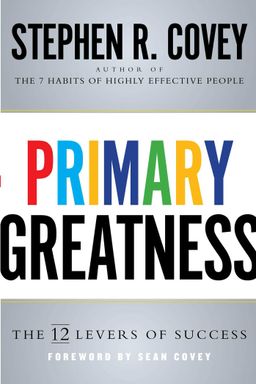
Primary Greatness: Building a Life of Character and Principle
Have you ever wondered why so many talented and successful people—those who achieve fame, wealth, and recognition—still feel hollow inside? In Primary Greatness, Stephen R. Covey argues that true success comes not from the privileges of position or public image (which he calls secondary greatness), but from living by timeless, universal principles of character, integrity, and purpose—what he calls primary greatness. Covey contends that our culture, obsessed with popularity and external accomplishment, has lost its anchor in internal values. But by rediscovering and aligning our lives with enduring principles, we can build the kind of greatness that sustains, inspires, and heals both individuals and institutions.
Covey’s philosophy is grounded in the conviction that natural laws—truths like honesty, fairness, respect, and accountability—govern not only moral life but also effectiveness. You don’t break these laws; you break yourself against them. Drawing on decades of teaching, leadership consulting, and personal experience, he explains that transformation must begin from the inside out. You can’t manipulate outer circumstances for long without eventually changing who you are within.
What Primary Greatness Means
To Covey, primary greatness is about character, conscience, and contribution. Whereas secondary greatness is measured by societal markers—money, reputation, fame—primary greatness is measured by moral authority and inner peace. It grows through humility and courage, through consistent adherence to principles rather than expediency. Covey distinguishes between principles (unchanging natural laws like gravity or honesty) and values (personal preferences that may align—or conflict—with those principles). When our personal values are based on universal principles, we are centered and secure; when they are based on trends, emotion, or ego, we lose direction and integrity.
Covey likens this difference to the contrast between a compass and a clock. The clock measures efficiency—how fast we do things—while the compass establishes direction—what is worth doing. Too many of us, he warns, are governed by the clock: we measure progress by speed and productivity instead of purpose. A principle-centered life uses the compass, asking not only "How efficiently am I moving?" but "Am I pointed toward true north—toward what matters most?"
The Levers of Greatness
Covey organizes the book around twelve high-leverage principles—or “levers”—that can transform your life and work: Integrity, Contribution, Priority, Sacrifice, Service, Responsibility, Loyalty, Reciprocity, Diversity, Learning, Renewal, and Teaching. These levers serve as tools for aligning yourself with timeless truths. As Archimedes famously said, "Give me a lever long enough and I can move the world." Similarly, Covey teaches that pushing on these moral levers can move the boulders blocking true fulfillment and ethical success.
Each lever corresponds to a key aspect of human growth. Integrity integrates humility and courage. Contribution transforms your work into legacy. Priority helps you put “first things first.” Sacrifice binds relationships with reverence. Service reminds us that “the little things are the big things.” Responsibility builds moral authority through accountability and humility. Loyalty demands defending others—even those absent. Reciprocity sows what you reap. Diversity ignites creativity through differences. Learning prevents stagnation. Renewal keeps the body, mind, and spirit sharp. And teaching, Covey’s final lever, multiplies wisdom by passing it on to others. Together, these principles form an inner constitution—a personal moral operating system.
Why These Ideas Matter
In a world plagued by burnout, corruption, and cynicism, Primary Greatness feels like a moral reboot. Covey’s purpose isn’t just self-improvement—it’s self-leadership. He argues that the foundation of leadership is moral authority, not formal power. You can manage people through commands, but you can only lead them through trust and example. He notes that the greatest leaders—like Gandhi, Lincoln, and Mandela—wielded immense influence not because of their titles but because of their integrity and humility. They were guided by their inner compasses.
To practice primary greatness, Covey urges us to explore what he calls our "secret life"—the hidden world of motives, goals, and moral convictions. That’s where true transformation begins. Once we confront and rescript our beliefs, we can move toward principle-centered living. Covey emphasizes practical steps such as affirmations, journaling, reflection, mission statements, weekly planning, and developing conscience and imagination—the four uniquely human endowments that enable change.
Ultimately, Primary Greatness teaches that success isn’t the accumulation of achievements but the cultivation of character. Living with integrity radiates trust, service awakens joy, and wisdom—born of humility—offers spiritual freedom. Covey invites you to stop rearranging the deck chairs on your own sinking ship and instead steer toward true north, guided by conscience and principle. Only then can you experience the deep satisfaction of knowing that your greatness is not borrowed from applause, but grown from the quiet strength of your own soul.