
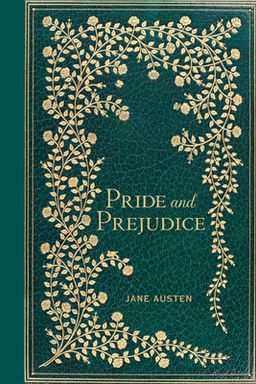
Pride and Prejudice cover

Pride and Prejudice

by Jane Austen

Pride and Prejudice intricately weaves romance with social critique, as Elizabeth Bennet and Mr. Darcy navigate love amidst societal pressures. Jane Austen''s timeless narrative of overcoming pride and prejudice continues to resonate, offering sharp insights into the human condition and the societal norms of Regency England.

Pride, Prejudice, and the Pursuit of Love

What happens when our pride blinds us—and our prejudices misguide us—in love and life? In Pride and Prejudice, Jane Austen masterfully explores this question through the romantic and social entanglements of the Bennet family in early 19th-century England. Austen argues that love, though often shaped by social expectation and economic pressure, can only truly flourish when individuals confront their own biases and learn humility. For Austen, overcoming pride and prejudice isn’t just the key to romance—it’s the foundation of real moral growth.

Her narrative opens with one of literature’s most famous lines—“It is a truth universally acknowledged…”—establishing both her irony and her insight. Beneath its wit lies a serious critique: women’s futures depended overwhelmingly on men’s fortunes, and marriage was often the only viable way to secure stability. Through Elizabeth Bennet and Fitzwilliam Darcy, Austen turns these societal realities into a deeply personal exploration of how moral integrity, self-awareness, and empathy can redefine what it means to find a good match.

Social Satire Meets Romantic Idealism

In a society where women had few choices beyond marriage, Austen used humor as both a shield and a scalpel. Her satire dissects the absurdity of class distinctions, inheritance laws, and social climbing that governed the Regency era. Yet she never abandons emotional realism. The love stories at the novel’s heart—between Lizzy and Darcy, Jane and Bingley—show that authentic affection can survive if it’s grounded in mutual respect rather than wealth or vanity. This balance of social critique and romantic idealism is what gives Pride and Prejudice its enduring power.

(Note: Like contemporaries such as Mary Wollstonecraft, Austen wrote with quiet radicalism—using domestic stories to question broader systems of gender and power.)

The High Stakes of Marriage

Austen’s plot revolves around the Bennet sisters’ need for advantageous marriages—a necessity due to the legal concept of entailment. Because Mr. Bennet has no sons, his estate will be inherited by Mr. Collins, a distant cousin. This makes Mrs. Bennet’s obsession with marrying off her daughters not mere vanity, but survivalist strategy. The humor of her schemes masks the desperation of women whose financial fates hinge entirely on men’s choices.

Lizzy Bennet, however, refuses to marry for money alone. In rejecting Mr. Collins’s pompous proposal—and later, Darcy’s first, prideful one—she risks her security for integrity. Austen thereby redefines success in love: not securing wealth or status, but preserving self-respect while learning empathy.

Pride, Prejudice, and Transformation

Darcy and Elizabeth’s evolving relationship mirrors a moral process. His pride blinds him to social inferiors; her prejudice against his arrogance blinds her to his true character. Only when both confront their flaws—Darcy humbling himself, Elizabeth widening her perspective—do they become equals capable of genuine love. Austen’s deeper message is that emotional maturity is inseparable from moral development.

Austen shows that love is not stumbled upon but built—through introspection, forgiveness, and growth.

Why These Lessons Still Matter

For modern readers, Pride and Prejudice reminds us how much societal norms still shape relationships. Whether through class, culture, or gender expectation, love often wrestles with external pressures. Yet Austen insists that personal character outweighs circumstance. Her characters’ journeys—from blindness to understanding, from pride to partnership—highlight timeless truths about human connection. We still confront versions of the same dilemmas: How much do we let appearances or background determine our judgments? What do we sacrifice when we choose pride over vulnerability?

By the novel’s end, Darcy’s humility and Elizabeth’s insight bring harmony not only to their own lives but to the families and communities around them. In doing so, Austen delivers a subtle but revolutionary proposition: that true love, anchored in equality and respect, can transcend the rigid hierarchies of any age.

Across its pages, Austen invites you to laugh at human folly, examine your biases, and, like her characters, learn that what often stands between us and happiness is not circumstance—but ourselves.


The Social World of Marriage and Money

Marriage in Austen’s world isn’t just about romance—it’s economics, survival, and social negotiation. In Pride and Prejudice, every proposal and rejection carries financial as well as emotional weight. Mr. and Mrs. Bennet’s household, with five unmarried daughters and an entailed estate, is a microcosm of the precarious reality facing middle-class families in Regency England. A woman’s livelihood depended wholly on marrying well, since the law denied her independent property rights. This context fuels Mrs. Bennet’s relentless matchmaking and explains why even the most unappealing suitors must be considered.

Marriage as Security Versus Marriage as Self-Respect

Two characters embody this tension vividly: Charlotte Lucas and Elizabeth Bennet. Charlotte, pragmatic and plain, accepts Mr. Collins not for love but for security. She tells Elizabeth simply that she is not romantic and seeks only a “comfortable home.” By doing so, Charlotte exposes the economic pressures women faced. Elizabeth, conversely, rejects Mr. Collins despite the financial benefits, valuing personal happiness and mutual respect more than an expedient match. Austen uses the contrast to highlight an ethical evolution in women’s choices—marriage as not merely survival but as partnership built on esteem.

The Marriage Market Satirized

Through witty and critical observation, Austen mocks the mercenary approach to marriage. Mrs. Bennet’s excitement over Mr. Bingley’s arrival at Netherfield Park demonstrates this “marriage market” mentality, as does Lady Catherine de Bourgh’s obsession with maintaining class boundaries. Meanwhile, Austen’s humor never fully conceals the pain underlying this system—the limits placed on intelligent, capable women forced to barter affection for security. (In modern sociological terms, Austen was describing a socially sanctioned form of dependency.)

By contrasting marriages of convenience (Charlotte and Collins) with those built on equality and affection (Lizzy and Darcy), Austen exposes the evolving idea of marriage as both a reflection of economic constraint and a potential site of personal freedom. Her critique anticipates later feminist discussions of economic and emotional autonomy (as echoed in Virginia Woolf’s A Room of One’s Own).


Pride and Prejudice as Moral Mirror

Austen didn’t title her novel Pride and Prejudice for poetic effect—it’s the axis on which every character turns. Darcy’s pride stems from social rank and inherited privilege; Elizabeth’s prejudice arises from wounded vanity and misjudgment. Both learn that pride and prejudice are not moral absolutes but forms of misunderstanding—obstacles that cloud true perception. Each must undergo self-correction before love can arise.

Darcy’s Journey from Arrogance to Awareness

We first meet Darcy as the embodiment of aristocratic pride. His early insult—calling Elizabeth “tolerable but not handsome enough to tempt me”—crystallizes his disdain for social inferiors. Yet his love for Elizabeth triggers transformation. After her rejection, he begins reflecting on his faults, admitting later that pride had blinded him. His charitable works, particularly arranging the Lydia-Wickham marriage at great personal cost, demonstrate his growth from self-satisfaction to selflessness.

Elizabeth’s Path to Insight

Elizabeth’s prejudice—rooted in emotional pride—leads her to believe Wickham’s lies and misread Darcy’s actions. Her awakening begins upon reading Darcy’s explanatory letter, when she realizes, “Till this moment, I never knew myself.” This moment of self-revelation parallels moral awakening: recognizing that truth is often obscured by our egos. Through Elizabeth, Austen dramatizes how self-knowledge and humility are conditions for love.

In Austen’s universe, love isn’t a lightning strike of passion—it’s an act of moral clarity.


Reputation and the Fragility of Respectability

One scandal threatens to undo everything the Bennet family stands for: Lydia’s elopement with Wickham. In a society where female virtue equals family reputation, her impulsive act nearly destroys her sisters’ futures. Austen uses this crisis to critique how moral worth was socially constructed—and how women bore disproportionate consequences for social missteps. Even innocent sisters like Jane and Elizabeth are tainted by association.

Public Shame, Private Consequence

In Regency England, reputation wasn’t personal—it was collective. Lydia’s behavior jeopardizes her entire family’s marriage prospects and social acceptance. The rush to conceal her transgression underscores the fragility of women’s social standing. Austen contrasts this with Darcy’s quiet intervention—paying Wickham’s debts and arranging the marriage—to show true honor lies not in adhering to conventions, but in compassionate responsibility.

A Critique of Double Standards

Wickham escapes with his reputation barely bruised; Lydia is branded for life. Through this imbalance, Austen exposes a gendered hypocrisy that remains recognizable today. While Lydia’s folly seems comedic at first, Austen transforms it into a moral lesson on empathy and proportion—what separates judgment from compassion.

(Note: Literary critics often compare this episode to Hardy’s Tess of the D’Urbervilles, another narrative where female ruin becomes society’s obsession, revealing enduring patriarchal double standards.)


The Economics of Women’s Choices

Behind the witty dialogue and ballroom flirtations lies a sobering economic truth: marriage was often the only path to stability for genteel women. Through characters like Charlotte Lucas and the Bingley sisters, Austen shows the limited range of “choices” available to women whose education and social conditioning confined them to domestic roles. Even the intelligent Elizabeth depends on marriage for long-term security, despite her independence of mind.

Entailment and Economic Dependence

Entailment, which ensures Mr. Bennet’s estate passes to a male heir, embodies systemic injustice. The Bennet daughters’ futures hinge on finding husbands. That legal structure forces emotional compromises. By portraying Mrs. Bennet as both ridiculous and desperate, Austen captures the contradiction women faced: mocked for being obsessed with marriage, yet punished if they failed to secure one.

Love Amid Constraint

Even amid restriction, Austen imagines emotional authenticity. Her heroines—especially Elizabeth—demand affection grounded in moral compatibility. Through this, Austen pioneers an early version of “romantic realism”: recognizing social forces without surrendering to them. Her subtle message is that personal integrity can coexist with practicality, even in unjust systems.


Character as Destiny: Moral Growth and Redemption

Every major character’s outcome reflects their inner moral compass. Mr. Collins’s pompous flattery earns him a lifeless marriage; Lydia’s impulsiveness yields lifelong instability; Jane’s gentleness secures Bingley’s affection; Elizabeth’s courage wins Darcy’s respect. Austen uses outcomes as moral mirrors—rewarding self-awareness, punishing vanity, and celebrating growth. The novel’s social fabric becomes a moral landscape, where virtue, not fortune, ultimately determines fate.

Forgiveness and Self-Knowledge

Darcy’s transformation culminates in humility—helping the Bennets despite their earlier rejection of him. Elizabeth’s final acceptance of Darcy isn’t just romantic; it’s ethical. She learns to judge less by first impressions and more by integrity. In their union, Austen completes her moral argument: love is sustainable only when built upon mutual respect and self-knowledge. That lesson resonates as strongly in today’s relationships as it did in Austen’s parlors.

For Austen, happiness is not accidental—it’s earned through humility, empathy, and moral growth.

Dig Deeper

Get personalized prompts to apply these lessons to your life and deepen your understanding.

Go Deeper

Get the Full Experience

Download Insight Books for AI-powered reflections, quizzes, and more.