
Idea 1
The Psychology of Price and Value
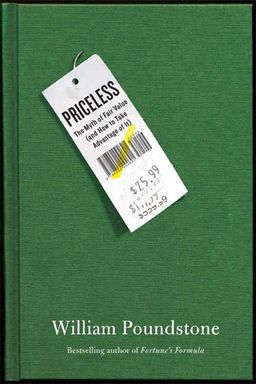
Why do you pay $3 for coffee without blinking but balk at a $3 service fee online? In Priceless, William Poundstone argues that you are not a rational calculator of value. Your sense of price and fairness emerges from psychological shortcuts—anchoring, adaptation, framing, and social norms—rather than from arithmetic. The book connects behaviorist psychology, marketing strategy, and economic theory to explain how sellers manipulate perception and how you can resist.
From sensation to number: psychophysics meets economics
Human perception evolved to detect contrasts, not absolutes. You notice changes more than you measure fixed magnitudes. Early psychophysicists like Weber, Fechner, and S. S. Stevens discovered that sensory response follows proportional, power-law patterns. Poundstone extends this idea to money. When prices shift, you react to the relative difference—10% off, half-price, 50% more—rather than computing true quantitative value. Companies exploit this ratio sensitivity to make small packaging changes, nine-ending prices, and rebates feel like big bargains.
Anchoring and arbitrariness
Anchoring turns meaningless numbers into mental magnets. Kahneman and Tversky’s classic U.N. wheel experiment showed that random numerical anchors drastically shift estimates even when irrelevant. Dan Ariely’s MIT auction found that writing down the last two digits of your Social Security number influenced bids for wine bottles. Poundstone calls this combination of irrational adjustment and internal consistency “coherent arbitrariness”: your preferences form a stable pattern but remain anchored to arbitrary starting points. Sellers know this and plant anchors everywhere—price tags, decoys, premium models, and reference prices—to make ordinary prices look sensible.
Risk, fairness, and framing
Prospect theory deepens this picture. You interpret outcomes relative to a reference point and weigh losses more heavily than equivalent gains. Kahneman and Tversky’s experiments show that the pain of losing $100 outweighs the joy of gaining $100. This asymmetry explains rebate popularity and the power of zero: a free offer feels qualitatively better than a cheap one because it eliminates loss entirely. Sellers frame gains and losses to play on these sensitivities, and buyers irrationally reject rational deals if they seem unfair (as shown by ultimatum and dictator games).
The social and emotional brain behind money
Pricing activates both cognitive and emotional circuits. Alan Sanfey’s ultimatum-game MRI study revealed insula activation (disgust and pain) when offers seemed unfair. Hormones like testosterone and oxytocin change generosity or rejection rates, suggesting that your decisions involve biology as well as logic. Priming experiments (Mandel & Johnson; Mullainathan & Shafir) show how images, wording, or even background colors shift price sensitivity and fairness judgments without conscious awareness.
Markets as collective psychology
Even financial markets display coherent arbitrariness. Shiller’s P/E data and Fisher’s “money illusion” prove that investors and workers anchor on nominal numbers instead of real ones. Graham’s “Mr. Market” metaphor describes price swings as mood swings. When an anchor establishes a convention—like Jerry Seinfeld’s $5 million-per-episode number—it cascades across industries. Collective anchoring fuels bubbles, salary trends, and art prices detached from intrinsic value.
Persuasion and resistance
Poundstone closes the loop by showing how behavioral price engineering operates in retail, negotiation, and digital commerce. Consultants such as Simon-Kucher design nonlinear tariffs, bundles, rebates, loyalty programs, and charm pricing to capitalize on these biases. The antidotes: re-anchor deliberately, convert relative to absolute comparisons, and focus on total costs. Whether you’re buying concert seats, choosing phone plans, or setting wages, the lesson is the same: price is never just a number—it’s a story told to your mind’s shortcuts.
Key insight
Prices do not measure objective worth; they trigger perceptual and emotional patterns shaped by context, memory, and human limits. Understanding the psychology beneath price turns numbers back into choices.