
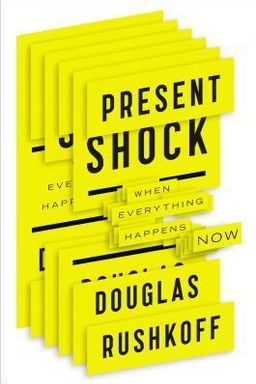
Present Shock cover

Present Shock

by Douglas Rushkoff

Present Shock delves into the chaos of our digital age, where rapid technological changes reshape our perception of time, identity, and culture. Discover how to reclaim your future in a world obsessed with the present.

Living in the Short Forever

Why does life today feel both accelerated and flattened? In Present Shock, Douglas Rushkoff argues that our dominant experience of time has collapsed into a perpetual present—a condition he calls presentism. The book extends Alvin Toffler’s “future shock” into a world where the future no longer overwhelms us with change; instead, it has been replaced by an ever-refreshing “now.” You live not just faster but without narrative continuity—cut off from history, projection, and reflection.

Rushkoff structures his argument around five forms of temporal distortion that shape psychology, economy, and culture: narrative collapse, digiphrenia (split identities), overwinding (compressed timescales), fractalnoia (pattern-overload), and apocalypto (the hunger for ending). He then turns toward possible antidotes—play, pacing, and participatory design—to restore human agency in the short forever.

The core claim

Presentism is more than speed. It’s a cultural reorientation where value and meaning are measured by what happens right now. Markets trade on microsecond data, media cycles never stop, and personal identity is defined by active feeds instead of coherent life arcs. You see it every time you refresh notifications or react to world events without context. What counts is not enduring significance but immediate signal intensity.

How we got here

Rushkoff traces this change through technology and institutional evolution. The shift from calendar-based planning to clock-based labor already mechanized time in the industrial age. Digital technology then fragmented it further: bits don’t flow, they flicker on and off. Algorithms operate in nanoseconds while humans struggle to maintain attention. Events like 9/11 intensified the focus on impermanence—people began valuing presence over progress. Meanwhile, networked devices built perpetual connectivity that rewards response over reflection.

In finance, investors abandoned long-range analysis for algorithmic trades. In politics, leaders answered to 24-hour media loops rather than sustained agendas. In daily life, the smartphone made you continually available to work, friends, and brands. Each domain shifted toward immediate feedback as success metric.

Cultural consequences

The collapse of temporal depth affects how stories work, how people think, and how communities cohere. Without linear narrative, entertainment turns self-referential; without separation between roles, identity fragments; without pacing, both bodies and economies overheat. Rushkoff proposes that what we experience as anxiety or distraction are actually symptoms of living in a compressed temporality—a world optimized for machines rather than for biological and social rhythm.

Interestingly, presentism dismantles some restrictive myths along the way. By discarding teleological promises (“suffer now for salvation later”), many find liberation in action-based authenticity. Yet the supposed mindfulness of the now often becomes fractured attention instead of deep presence. Rushkoff presents this as a paradox: we have achieved permanent immediacy but lost meaningful immediacy.

The book’s structure and invitation

Each thematic chapter explores a mode of temporal stress: narrative collapse shows cultural digestion without sequence; digiphrenia dissects mental overload from digital multiplicity; overwinding warns of short-term compression that undermines long-range systems; fractalnoia explains the obsessive search for patterns; and apocalypto reveals the craving for closure amid chaos. Finally, Rushkoff suggests partial cures—games, commons-based organizations, and biological pacing—to realign human time.

The fundamental insight

Digital culture didn’t just speed life up—it redefined what counts as reality. In a world coded for constant presence, your task isn’t to resist technology but to reprogram it around human rhythms. The challenge is not to live without machines, but to ensure they serve rather than consume your attention and time.

Rushkoff’s argument culminates in a call for conscious design: organize time deliberately, restore narrative when needed, and anchor technological participation in human-scale pacing. Presentism can liberate you—if you reclaim the choice of when and how you inhabit the now.


Narrative Collapse and the Search for Meaning

Rushkoff argues that traditional, linear storytelling—the way societies conveyed moral lessons—has unraveled. From Aristotle’s arc to Campbell’s hero’s journey, stories once moved audiences through tension and resolution. But in the era of swipes, remotes, and web tabs, you don’t stay captive long enough for that arc to unfold. The result is narrative collapse: a shift toward simultaneous reference, immediate recognition, and shared patterning.

From suspense to simultaneity

Modern audiences skip ads, fast-forward, and remix. Television adjusted—shows like The Simpsons or Community replaced storylines with self-referential jokes. Films like Pulp Fiction shattered chronology; reality TV turned editing itself into spectacle. Thus, the collective arena that once allowed storytellers to lead long reflections has given way to fleeting bursts of recognition. You read signs rather than follow arcs.

In politics, this mirrors movements too: the Tea Party desires quick resolution, winners and losers, while Occupy rejects endings entirely, preferring perpetual conversation. Both express discomfort with deferred meaning. Narrative unity became optional; shared presence replaced shared plot.

Games as replacement myth

Rushkoff finds hope in games and role-playing. Participatory systems distribute authorship—the player or participant becomes co-creator. Infinite games (per James Carse) seek continuity, not winners. Platforms from Dungeons & Dragons to World of Warcraft demonstrate that meaning can persist through shared action instead of structured narrative. Educational or therapeutic applications of interactive worlds further show that play nurtures recovery and connection where linear stories fail.

Takeaway

The collapse of narrative isn't just decay; it’s an opportunity to redefine meaning through participation. In the short forever, learning to play—not merely watch—becomes essential to sustaining coherence and agency.

To thrive in presentism, Rushkoff suggests you turn from predetermined endings toward living systems of communication. Storytelling may fragment, but story-making can continue—through collaboration, improvisation, and continuous engagement.


Distributed Selves: The Strain of Digiphrenia

In the digital now, you occupy multiple places simultaneously—apps, feeds, GPS, calendars—all calling you as if each was your primary self. Rushkoff calls this mental fracture digiphrenia, the confusion born from trying to behave like a distributed computer network when your mind is singular. Your digital clones act without coordination, generating anxiety, missed signals, and burnout.

The human problem with duplication

Unlike analog copies, digital replicas are perfect. When you post, stream, or sync, every copy seems authentic. Thus colleagues, friends, and bots each expect simultaneous attention. Drone pilots, Rushkoff notes, epitomize the split—fighting remote wars by day and returning home by night—experiencing cognitive dissonance that exceeds ordinary stress.

Hyperavailability follows: you feel obliged to respond instantly to every ping. Context collapse merges work, family, and play in one inbox. Behind this lies an economic engine—advertisers and social platforms monetize presence. Clay Shirky labels it “filter failure”: information isn’t scarce, attention is. And when your responsiveness defines your perceived value, perpetual partial attention becomes the default.

Reprogramming your rhythms

Rushkoff suggests taking back timing. Treat technology as servant, not master: batch emails, disable nonessential alerts, and mark deep-work periods as sacred. Let machines manage chronos—clock time—while you reclaim kairos, the felt moment suitable for real creation. By redefining how and when you respond, you coax coherence from fragmentation.

Key insight

The distributed network can multitask; the human mind cannot. When you imitate your devices instead of directing them, you lose agency. Reclaim coordination as a design choice, not a burden.

Digiphrenia turns everyone into many at once. The cure is rhythmic design—establishing humane limits and restoring the sanity that biological timing evolved to preserve.


The Technology of Time

Rushkoff reminds you that time is not natural—it’s engineered. Each major medium reshapes how society measures, shares, and lives it. Oral societies lived in cyclical rhythm; the written word introduced history and progress; clocks instituted precision and labor discipline; digital code made time discrete, atomized into event sequences.

Clock time and digital pulses

Medieval clockworks enabled monasteries to schedule prayer, then factories to schedule shifts. Taylor’s scientific management turned moments into productivity units. Digital time changed again—computers operate in pulses, not flow. Your phone doesn’t merely track appointments; it triggers actions. That shift from observing time to executing code redefines temporal control.

Chronos vs. Kairos

Rushkoff distinguishes chronos—measured, quantitative time—from kairos—qualitative, opportune moments. Digital systems obsess over chronos, expecting perpetual readiness. Yet creativity, intimacy, and learning require kairos: the rhythm of human timing. The challenge is to synchronize technology with biology, not override it.

Lesson

Understanding time as a technology lets you redesign it. Use clocks for coordination, but retain calendars for memory and code for automation—each tool in its rightful temporal domain.

In a culture of constant ticking, your sanity depends on restoring cycles, pauses, and elasticity—human tempo within mechanical systems.


Overwinding and Temporal Compression

Overwinding occurs whenever long timescales are squeezed into the short present. You make today responsible for what only patience could achieve—whether in finance, productivity, or culture. Rushkoff illustrates this through compressed sports seasons, hyperfast trading, and debt-driven economies that borrow from tomorrow to sustain today.

Money as time

Interest-bearing currency turns money into a temporal engine: it pulls future value into immediate circulation. Adjustable-rate mortgages, derivatives, and credit swaps did precisely that—collapsing years of expectation into instant leverage. When those expectations failed, the temporal bottleneck triggered crises. Black Friday’s extended hours or 24/7 production mirror the same collapse—compressing recovery, rest, and planning into relentless now.

Spring-loading vs. overwinding

Rushkoff contrasts healthy preparation (spring-loading) with destructive compression (overwinding). The Shaare Zadek field hospital exemplifies spring-loading: years of work folded into portable systems that deploy instantly. Overwinding, by contrast, keeps tension constant—like economies demanding infinite growth or retailers cannibalizing holidays for sales. The solution isn’t slower time but properly matched timescale: let the present move when the system is primed, not perpetually strained.

Core idea

Compression feels efficient but kills adaptation. Resilience arises from temporal diversity—the coexistence of short, middle, and long rhythms across society.

Matching your tools to appropriate timeframes—daily flow, generational stewardship, long-term vision—restores sustainable balance in a world addicted to immediacy.


Pattern-Seeking and Fractalnoia

When sequential sense-making collapses, you look for patterns everywhere. Rushkoff’s term fractalnoia captures the mix of systems thinking and paranoia arising from excessive connectivity. Without narrative chains, coincidences masquerade as cause. The fractal metaphor—self-similarity at every scale—tempts you to believe that economics, weather, and consciousness all follow identical geometries.

The science and the seduction

Fractal mathematics (Benoit Mandelbrot) explains irregular geometry, but transferred to social interpretation, it can mislead. Markets using Elliott Waves or conspiracists mapping HAARP weather plots both demonstrate the blurry line between insight and illusion. The pattern feels true because it’s recursive and visual—yet correlation doesn’t equal causation.

Healthy systems thinking

Rushkoff doesn’t reject complexity studies (Hayek’s catallaxy, Santa Fe Institute models). He warns that without human judgment, pattern-seeking becomes deterministic aesthetics. True systems mindfulness requires plural evidence, empirical testing, and social empathy. Value networks improve understanding; lone prophets amplify noise.

Guideline

When meaning emerges from pattern, ask: does it serve insight or control? Fractal recognition teaches you linkage but must be balanced by humility—patterns illuminate only when you remain critical.

Fractalnoia is the narrative substitute of the short forever. Train yourself to test patterns, invite dissent, and prefer probabilistic maps over totalizing models. In a world of simultaneous signals, skeptical interpretation is survival.


Apocalypto: Craving the End

When nothing seems to progress, the fantasy of an ultimate ending becomes comforting. Rushkoff calls this impulse apocalypto: your psychological need for closure in a culture without long horizons. From zombie films to singularity forecasts, you seek a final chapter that restores structure.

End-time entertainment and bunkers

Postapocalyptic stories like *The Walking Dead* or silo-bunker investments serve the same craving: safety through certainty. Zombie moral clarity—kill or perish—replaces the nuanced ethics of open time. Likewise, preppers’ underground shelters rewrite fear into narrative completion: crisis equals meaning regained.

Singularity dreams

Technological transcendence, from Terence McKenna’s Omega Point to Ray Kurzweil’s singularity, resurrects religious eschatology. These aren’t annihilation fantasies but metamorphic ends—the point where complexity consumes chronology. Rushkoff warns that even optimistic tech rapture recycles absolutism: a comforting but false final act.

Wisdom to apply

Apocalypto reveals what’s missing: communal sense of long-term continuity. Rather than escape into endings, work to rebuild sustainable systems that accept uncertainty as permanent.

The thirst for closure hides anxiety about openness. Choosing resilience over resolution empowers agency—living narratives instead of dying myths.


Commons, Feedback, and Human-Scale Design

Facing overwhelming information loops, Rushkoff ends with pragmatic designs for resilience. Three strategies emerge: commons-based exchange, spring-loading preparation, and empathetic coordination. These reconnect time and community against the noise of endless feedback.

Commons and local currency

The Volos experiment in Greece—where citizens trade with Local Alternative Units (tems)—shows temporal decentralization. Exchange becomes immediate social activity rather than deferred debt, fostering cooperation and reducing dependence on volatile macro systems.

Spring-loading versus management panic

Good organizations preload experience for quick deployment. Disney’s customer-service innovations or Shaare Zadek’s portable hospitals embody readiness without overwinding. Valve’s bossless structure teaches adaptive alignment; its openness contrasts with GM’s failed crowdsourcing, which promised dialogue without structural support.

Empathy and cooperation

Repeated interactions—Robert Axelrod’s “shadow of the future”—encourage collaboration. Rushkoff expands that logic: empathy stretches temporal perspective. Michael Moritz’s founder-centered investment style and participatory decision-making illustrate how understanding others’ timescales builds sustained trust.

Concluding view

Resilience comes from designing institutions that remember and respond: commons that preserve collective time, structures that empower immediate yet responsible action, and cultures that value empathy over algorithmic reaction.

Rushkoff’s final vision reframes presence as stewardship: live now, but build systems that let the present coexist with future possibility.

Dig Deeper

Get personalized prompts to apply these lessons to your life and deepen your understanding.

Go Deeper

Get the Full Experience

Download Insight Books for AI-powered reflections, quizzes, and more.