
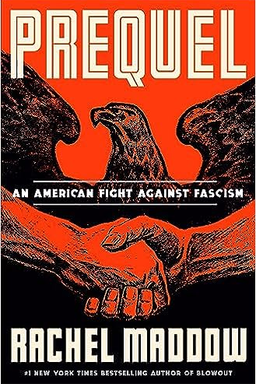
Prequel cover

Prequel

by Rachel Maddow

In ''Prequel: An American Fight Against Fascism,'' Rachel Maddow delves into a hidden chapter of U.S. history-a Nazi-funded movement to dismantle democracy in the 1930s. This gripping narrative demonstrates how ordinary citizens thwarted these threats, providing crucial lessons for protecting democracy today.

Seeds of Fascism in American Soil

You might assume fascism was a foreign contagion that never truly entered America. But what you see through this book is that authoritarianism found organic hosts within American culture—intellectuals, propagandists, isolationists, and financiers—all who treated Nazi ideas not as alien but as usable tools. The narrative takes you from eccentric poets and senators to spies, journalists, and prosecutors who fought to expose the infiltration. This isn’t a story just about fringe extremists; it’s about how respectable people and legitimate institutions served as bridges for fascist influence.

Culture as conduit

It starts in literature and art—with figures like George Sylvester Viereck, Lawrence Dennis, and Philip Johnson—who turned aesthetic experimentation into entry points for foreign ideology. You meet a poet who interviewed Kaiser Wilhelm II and used that prestige to sanitize propaganda; a Harvard diplomat who advocated planned authoritarianism; and an architect who admired the spectacle of Hitler’s rallies. Together they show how taste, intellect, and design can be corrupted into instruments of power. (Note: Similar patterns appear in Europe’s fascist avant-garde movements, where art and architecture justified state control.)

Politics and paramilitary preparation

From culture the book moves to muscle: the Silver Shirts, Christian Front, and America First fighters who trained, bought weapons, and threatened violence. Huey Long in Louisiana and General George Van Horn Moseley in Washington both illustrate how traditional institutions—statehouses and army ranks—gave extremists legitimacy. Leon Lewis’s undercover agents documented bomb plots and caches of ammunition; yet early law enforcement largely ignored them. The moral: fascism grows in the gaps where law meets indifference.

Propaganda infrastructure and congressional complicity

The middle chapters expose a machine almost corporate in precision. Viereck operated publishing houses and mail committees funded with German embassy money. Senators like Ernest Lundeen and representatives like Hamilton Fish allowed their names and franking privileges to mail German-composed material to teachers, clergy, and doctors. Ghostwritten speeches entered the Congressional Record, printed at discounted rates, and circulated as 'official' government communication. You see how a democracy’s administrative tools—printing subsidies and free postage—became part of a hostile influence system. (Comparison: Later Cold War information operations would mimic these same bureaucratic channels.)

Citizen investigators and exposure

When institutions hesitated, citizens filled the void. Henry Hoke traced addressing machines; Dillard Stokes followed mail trucks and photographed storeroom bags labeled 'Cong. Fish. Attention Mr. Hill'; Leon Lewis built an undercover network inside L.A. Nazi circles. Journalists and civic spies forced evidence into daylight. Their discoveries pushed the Dies Committee toward reluctant hearings and helped prosecutors design sedition indictments. They represent what democratic defense looks like from below—diligent, voluntary, and often dangerous.

Institutional failure and suppression

The climax of the book—the Great Sedition Trial—shows how even overwhelming documentation can collapse under politics. Chaos in the courtroom, a judge’s sudden death, and executive interference ended the case. O. John Rogge’s later Nuremberg-based report, full of corroborating German files naming American collaborators, was suppressed by President Truman and Attorney General Tom Clark for fear of public turmoil. The message is chilling: democracies can expose their own weaknesses but may lack the will to confront them fully.

Core takeaway

This book teaches you to recognize infiltration not in overt ideology but in charismatic people, cultural prestige, administrative loopholes, and civic laziness. Fascism doesn’t import itself—it piggybacks on native institutions until it looks homegrown.

By weaving these threads—art, propaganda, espionage, journalism, and political failure—the author delivers a panoramic lesson: defending democracy isn’t just about rejecting foreign power; it’s about maintaining domestic vigilance against the seductive blend of eloquence, aesthetics, and administrative convenience that makes subversion seem normal.


Charisma and Cultural Conversion

You watch fascism take root through personalities rather than armies. George Sylvester Viereck, Lawrence Dennis, and Philip Johnson begin as intellectual or artistic celebrities, yet their magnetism becomes a tool for soft conquest. They illustrate that authoritarian ideas spread best when disguised as culture and intellect.

The poet as propagandist

Viereck transforms from literary aesthete to paid agent of Berlin. His magazine The Fatherland and later Viereck's American Weekly camouflage propaganda as cultured journalism. He ghostwrites speeches for congressmen, distributes Nazi pamphlets, and integrates foreign money into domestic publishing. His story proves that fame and networks can launder ideology effectively.

Intellectual theory and aesthetics

Lawrence Dennis publishes theoretical defenses of fascism—arguing that democracy is inefficient and technocracy inevitable. Philip Johnson brings visual allure: mass rallies, podiums, and uniforms mimic Nazi power staged as art. Their activities translate authoritarianism into American idioms of professionalism, spectacle, and design. (Note: This blend echoes Walter Benjamin’s warning that aesthetics can weaponize politics by glorifying submission.)

Populism turned authoritarian

Huey Long’s transformation in Louisiana—constructing a machine of patronage and private militias—shows how grassroots democracy evolves toward absolutism. When idealism and charisma meet unchecked control, the boundary between reform and tyranny collapses. Dennis and Johnson admire Long not for policy but for his effectiveness in command.

Charisma converts ideas into institutions. When fame fuses with grievance, propaganda looks like leadership instead of manipulation.

Together these figures teach you that intellectual and cultural elites can normalize authoritarianism not through overt advocacy but through taste, logic, and sophistication. Once ideas acquire prestige, they move faster than any manifesto.


Propaganda Architecture in America

The book unveils a bureaucratic engine of persuasion—how Nazi Germany used American intermediaries and institutions to circulate propaganda disguised as civic education. This system was vast, deliberate, and leveraged official privileges for efficiency.

Front organizations

Groups like the German Library of Information and the American Fellowship Forum funded magazines, lectures, and pamphlets targeting teachers, clergy, and professionals. Millions of copies flowed under neutral titles such as Facts in Review. American collaborators provided domestic credibility, making the foreign origin nearly invisible.

Congressional laundering

Viereck ghostwrote for senators like Ernest Lundeen. These speeches entered the Congressional Record, printed cheaply, and mailed with free franking—using taxpayer-funded logistics to deliver German-crafted messages to American homes. Evidence from journalists like Dillard Stokes confirmed storage rooms filled with mailbags tagged to congressional offices. Henry Hoke traced their addressing machines, connecting propaganda flows to the Steuben Society and other sympathetic groups.

Precision targeting

The Nazi Foreign Office compiled demographic lists—teachers, clergy, physicians—ensuring propaganda reached authoritative voices who could multiply its impact. This wasn’t random; it was early data-driven marketing. (Parenthetical comparison: the operation functions much like modern algorithmic targeting, using social influence rather than explicit coercion.)

Key realization

Influence succeeds when foreign speech adopts domestic forms—official stationary, congressional signatures, or local voices. Propaganda’s power lies in its disguise of legitimacy.

Understanding this machinery shows you that authoritarian infiltration isn’t brute censorship—it’s administrative mimicry. The message rides inside trusted systems until discovery forces a confrontation between freedom of expression and managed deception.


Paramilitary Faith and Violence

Parallel to the propaganda web ran the armed underbelly—the Silver Shirts, Christian Front, and other militias that prepared physically for domestic conflict. This side of the narrative reveals how rhetoric mutates into readiness for violence.

William Dudley Pelley’s fusion of mysticism and militarism

Pelley merged occult ideas with militant racism. His followers wore silver uniforms, took titles, and trained under military drills. Their magazine, Silver Legion Ranger, mixed spiritual salvation with antisemitic fury. They stockpiled arms and practiced intimidation rituals—proof that belief can mobilize violence when wrapped in sacred imagery.

Father Coughlin and the Christian Front

Coughlin’s radio pulpits converted mass grievance into armed cells. John F. Cassidy organized training and bomb making under the slogan of defending Christian America. FBI informant Denis Healy documented live-fire exercises and stolen military equipment. Yet public sympathies and juror prejudice undermined convictions. The Brooklyn trial’s acquittals proved that community bias can protect conspirators.

Networking of threat

Deatherage, Moseley, and other ex-officers envisioned nationwide military divisions. Henry Allen’s briefcase exposed written plans for slaughter and bombings. Leon Lewis’s spies confirmed stockpiles and identified cross-group cooperation. Explosions like the Hercules Powder incident revealed how sabotage fears merged with propaganda panic.

Lesson in vigilance

Uniforms and rituals are operational tools—creating cohesion, secrecy, and readiness. Religion and nationalism become armor when authorities and juries sympathize instead of prosecute.

The book’s portrayal of these groups reminds you that spiritual rhetoric and armed organization often grow together. Charismatic religion sanctifies violence, making fascism not just ideological but devotional.


Citizen Investigation and Institutional Blindness

You come to appreciate how ordinary individuals protected the republic when official organizations looked away. Henry Hoke, Leon Lewis, Dillard Stokes, and others merge tradecraft with moral urgency to reveal conspiracies hidden behind bureaucracy.

Private citizens as detectives

Hoke used direct-mail forensics to detect foreign targeting in hundreds of thousands of envelopes. Lewis built an espionage ring of veterans and linguists to penetrate Bund meetings and Nazi sympathizers in California. Stokes converted journalism into surveillance—photographing mailbags, tracing delivery trucks, and linking deposits to congressional aides. These independent actors assemble pieces that officials later use reluctantly.

Official inertia and compromise

The FBI under Hoover ignored fascists while obsessing about communists. The Postal Service declared mail propaganda 'not illegal.' Congressional hearings prioritized spectacle over substance. Eventually prosecutors William Maloney and O. John Rogge pursued cases, but political pressure from senators like Burton Wheeler stifled action. The result was an incomplete reckoning.

Democracy survives on volunteerism. When institutions prefer caution, truth depends on the persistence of ordinary professionals willing to investigate what officials won’t.

Their example teaches you civic vigilance: the boundary between freedom and exploitation depends on whether citizens treat evidence as duty rather than curiosity.


Trials, Suppression, and the Fragile Reckoning

The end of the story moves from revelation to repression. Prosecutors assemble vast documentation, but courts and politics unravel accountability, proving that democratic justice can be self-defeating when overwhelmed by spectacle and fear.

The Great Sedition Trial

William Maloney’s indictments in 1942 and Rogge’s enlarged trial in 1944 sought to expose a national conspiracy uniting propagandists and paramilitaries. But the proceedings collapse into chaos: defendants perform Nazi salutes, misuse legal motions, and mock authority. Judge Edward Eicher’s death seals a mistrial. Press coverage focuses more on antics than crimes, leaving public fatigue and confusion.

Rogge’s Nuremberg revelations

Rogge later gathers German Foreign Office files confirming American collaborators, drafted into a 396-page Official German Report. Instead of publication, Truman’s administration suppresses it, firing Rogge after pressure from Senator Wheeler. The report remains buried until Rogge publishes it years later, unheralded. The suppression reveals how postwar politics prized reconciliation over disclosure.

The cost of forgetting

When institutions silence evidence, future generations inherit myths instead of accountability. The book ends as both record and warning—evidence existed but was neutralized by political discretion.

Truth in democracy competes with convenience. Exposure requires courage not just to investigate but to publish what power prefers to forget.

The aftermath places responsibility on readers: you must see suppression as complicity and transparency as defense. Only remembrance completes justice.

Dig Deeper

Get personalized prompts to apply these lessons to your life and deepen your understanding.

Go Deeper

Get the Full Experience

Download Insight Books for AI-powered reflections, quizzes, and more.