
Idea 1
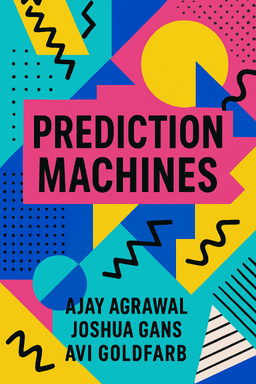
Prediction Machines: The Economics of Artificial Intelligence
How can you cut through the endless hype around artificial intelligence and actually understand what it means for your business—and for the world? In Prediction Machines: The Simple Economics of Artificial Intelligence, economists Ajay Agrawal, Joshua Gans, and Avi Goldfarb give us a radically clear lens to view AI’s impact: it’s not about robots taking over, but about cheap prediction reshaping how decisions are made.
The authors argue that AI doesn’t give us true intelligence—it gives us one component of it: prediction. Prediction fills in missing information, whether about the future, the present, or the past. Once we see AI as a form of inexpensive prediction, its economic implications become surprisingly simple, even elegant. When the price of something fundamental drops—in this case, prediction—its use proliferates and transforms industries. Just as cheap arithmetic led to computing power and cheap light reshaped human civilization, cheap prediction is transforming work, strategy, and society.
Understanding the Core Argument: Prediction as the Foundation of AI
Agrawal and his coauthors bridge economics and technology. They emphasize that the main breakthrough in modern AI isn’t mystical intuition—it’s machine learning, which drastically improves prediction. Every AI system, whether Alexa identifying your spoken words, Google Translate mastering linguistic fluency, or a credit card company spotting fraud, depends on prediction. When machines predict better and more cheaply than humans, the economics around decisions shift.
Economically, when prediction becomes cheaper, its complementary tasks—like judgment, data collection, and action—become more valuable. Conversely, human prediction becomes less valuable. This ripple of changing value underlies the key transformations in industries everywhere. The authors use Amazon as a thought experiment: if predictions about customer demand become accurate enough, Amazon could move from its current “shop-then-ship” model to a “ship-then-shop” model, sending goods before customers even order them. That shift wouldn’t just tweak operations—it would redefine Amazon’s entire strategy.
Cutting Through AI Hype with Economics
Where many books focus on AI’s technical mechanics, Agrawal, Gans, and Goldfarb explain the economics of AI. Just as past innovations—electricity, computing, and the internet—became transformative by making fundamental inputs cheaper, AI’s power lies in making prediction cheap. Once prediction is inexpensive, businesses will use it everywhere: in logistics, healthcare, hiring, banking, legal processes, and even romantic matchmaking. Crucially, though, each use involves trade-offs: more automation means less human control; more data means less privacy; faster decisions can mean lower accuracy.
Economics provides a framework to evaluate those trade-offs. By treating AI’s advances as a drop in prediction costs, rather than as mystical intelligence, leaders can make clearer choices. This reframing lets them quantify benefits and costs, anticipate changes in strategy, and recognize when AI shifts not just operations but organizational boundaries—who does what, and where human judgment still matters.
Why This Framework Matters to You
If you’re a business leader or policymaker, the book’s lens can help you decide where AI adds genuine value versus where the hype misleads. The authors call this focus “Prediction Machines” because prediction sits at the core of decision-making: what will happen next, how should we act, and what payoff results from that action. Understanding AI as a tool to improve prediction—not replace thinking—grounds conversations about automation, jobs, and ethics in economic reality.
The book unfolds in a layered structure: it starts with the basics of prediction and why it’s considered intelligence, moves into how data drives prediction, then shows how prediction changes labor and decision-making in organizations. Later sections address tools and workflow impacts, strategic transformations at the C-suite level, and finally AI’s broader societal consequences, from inequality to privacy dilemmas to international competition.
In short, Prediction Machines transforms the abstract buzz around AI into practicable economics. It invites you to see AI not as mind or magic, but as a new kind of engine—a prediction engine—that, like past revolutions, will make some things cheaper, some more valuable, and force society to rebalance around new trade-offs. Whether you lead a company, manage a team, or shape public policy, understanding AI through this economic lens isn’t optional; it’s essential for navigating the next era of technological change.