
Idea 1
The Power of Pre‑Suasion
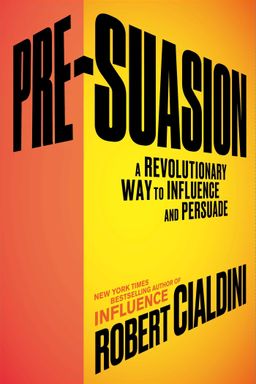
Why do some messages get accepted before they are even delivered? Robert Cialdini argues that the answer lies not in the words themselves, but in the moment before they are spoken. In Pre‑Suasion, he expands his earlier work on influence to show how you can shape attention and associations in advance so that when you finally ask for agreement, the ground is already prepared. The true craft of persuasion begins earlier than most people think.
Setting the stage before the request
Cialdini coins the term pre‑suasion to describe the art of arranging for your audience to be receptive before you make your case. The most effective persuaders, he says, resemble gardeners more than debaters: they prepare the soil of attention so the message can take root. A “privileged moment” arises when attention is focused on just the right concept—trust, helpfulness, adventure—so that your eventual request aligns naturally with the listener’s mental frame.
Classic experiments illustrate how trivial cues can flip outcomes. When people were asked, “Do you consider yourself a helpful person?” before a survey request, rates of compliance nearly tripled. A Toronto consultant increased acceptance of a $75,000 fee merely by joking, “I’m not going to charge you a million.” What people focus on just before deciding changes what they see as reasonable.
Attention, importance, and causality
Pre‑suasion relies on a crucial psychological fact: what you notice feels important and causal. Kahneman called this the focusing illusion—“nothing in life is as important as you think it is while you are thinking about it.” Cialdini adds that attention not only magnifies importance, it creates causal stories around the object of focus. News coverage, camera angles, or web design can shift perceived responsibility and value simply by highlighting different elements.
You can harness this by placing desired ideas—safety, generosity, innovation—at the center of attention just before people evaluate choices. But awareness cuts both ways: if you are the decision maker, be wary of salience masquerading as substance.
Commanding and holding attention
Cialdini distinguishes two forms of attentional control: attractors that grab attention automatically (sex, threat, novelty) and magnetizers that keep it (personal relevance, unfinished tasks, mystery). A romantic prime like Valentine Street can double helping rates in romantic contexts, while fear primes drive affiliation-seeking behavior. Novelty draws us in, yet too much fragmentation reduces retention. Once you have attention, magnetizers sustain focus: a self-relevant question (“How would this affect you?”), a cliffhanger, or a mystery keeps minds engaged long enough for persuasion to operate.
Associations: the hidden engine
Mental associations are the machinery of pre‑suasion. Words, images, and physical environments evoke linked networks that shape what people perceive as relevant or true. The concept “thinking is linking” underlies experiments showing that slight linguistic shifts—“attack” versus “approach,” or crime as a “beast” versus a “virus”—steer problem-solving toward very different directions. You can also plant your own triggers through if/when‑then plans: linking cues (“When I see the supermarket candy, I’ll remember my health goal”) to chosen reactions pre‑suades yourself for better choices.
Unity and ethical use
Eventually Cialdini extends pre‑suasion to identity itself. The seventh principle of unity goes beyond liking or similarity: it is the sense that “you and I are of the same.” Shared names, origins, or rituals create powerful bonds that yield trust and compliance. From Chiune Sugihara’s humanitarian acts to Warren Buffett’s family-toned shareholder letters, unity turns persuasion into belonging. Yet this power demands integrity. Throughout the book, Cialdini warns that deceptive pre‑suasion corrodes both relationships and organizations; ethical influence aligns interests rather than manipulates them.
Across experiments, anecdotes, and organizational lessons, the thread runs consistent: Whoever controls attention controls the terms of assent. Pre‑suasion is about shaping that control responsibly—framing the context, building associations, and creating unity so that the ultimate act of persuasion feels natural, inevitable, and mutually beneficial.