
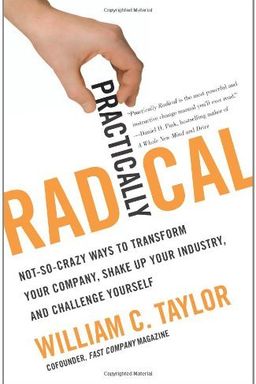
Practically Radical cover

Practically Radical

by William C Taylor

Practically Radical is a transformative guide for business leaders eager to stand out in today''s fast-paced market. Packed with insights from leading companies, it challenges conventional methods and encourages innovative thinking to redefine competition, excel in unique areas, and foster a human connection with customers.

Seeing Differently to Change Deeply

What if transformation did not begin with a bold vision but with a shift in how you see? Across the book’s many examples—from Dean Esserman’s police reform to Zappos’s radical empathy and IBM’s Innovation Jam—the author argues that lasting change begins with perspective. You cannot reinvent a business or culture if you keep seeing it through yesterday’s lens. The real skill of innovators is learning to see familiar systems as if for the first time, to uncover sources of renewal hidden in plain sight.

The lens shift that unlocks transformation

The book introduces the idea of “vuja dé”—the opposite of déjà vu. Instead of recognizing the new as familiar, you recognize the familiar as new. This discipline reawakens curiosity in expert environments and turns routine into discovery. It’s how Esserman reframed policing as community service and how TBWA unearthed Pedigree’s forgotten soul by digging into its brand attic. Seeing differently becomes the trigger for doing differently.

(Note: IDEO’s Tom Kelley popularized this mindset as an antidote to habitual expertise; this book expands it into a system of continuous re-perception.)

Cross-pollination and looking everywhere

Once you see freshly, you can look more widely. Many breakthroughs emerge when you borrow proven ideas from distant fields—Toyota’s lean principles redefined hospital workflow; Ferrari pit crews inspired safer surgeries; Four Seasons taught automakers hospitality rituals. The author calls this technique “lift and shift.” It’s deliberate, translation-driven copying: find what works elsewhere and adapt it thoughtfully to your context. When everyone copies competitors, sameness reigns; when you borrow across boundaries, novelty blooms.

Mining history for renewal

Transformation isn’t only future-focused; it often begins with rediscovering your past. The book’s section “Past as Prologue” explains how founders’ instincts hide enduring advantages. When Pedigree reconnected to its breeder heritage, and when Nicolas Hayek restored Omega’s craft identity to reinvent Swiss watches, both used history not as nostalgia but as competitive asset. Leaders should ask Drucker’s double question: “Would we enter this business today—and what made us great originally that could make us great again?”

Emotion and urgency as engines of action

Why do even great ideas stall? Because people don’t feel a reason to act. Change demands urgency, and stories create it. Donald Berwick’s IHI campaigns used vivid narratives—preventable deaths, saved lives—to convert abstract metrics into moral imperatives. Swedish reformers invented “Esther” to humanize system redesign. These stories made reform emotionally unavoidable. (Note: This echoes John Kotter’s thesis that 70% of change efforts fail from lack of urgency.) Emotion isn’t soft; it’s operational fuel.

From shared emotion to collective intelligence

The book’s later chapters expand from individual vision to collective genius. It describes how leaders harness creativity both inside—Rite-Solutions’ “Mutual Fun” turning employees into idea investors—and outside—Netflix’s open Prize, Threadless’s crowdsourced art, Abele’s submarine search. These platforms prove that participation beats prediction. Smart organizations don’t just solicit input; they design mechanisms that elevate ideas democratically and absorb results efficiently.

Leadership as humbition

Guiding this system demands a new posture: humbition—humility plus ambition. Jane Harper coined it, and leaders like Sam Palmisano (IBM) embody it by creating enabling frameworks rather than dictating visions. Humbitious leaders learn constantly, admit limits, rotate authority, and turn learning into teaching. The Orpheus Chamber Orchestra, operating without a conductor through rotational leadership, becomes an elegant metaphor for humbition in motion.

The book’s promise

Seen together, these concepts form a progression: see freshly (vuja dé), look widely (cross-pollination), reconnect with roots (past as prologue), ignite urgency (stories), build distinctiveness (be the most of something), start new (blank-sheet thinking), and lead humbitiously. The overall message is practical optimism: anyone can change if they learn to see, feel, and lead differently. Transformation is not about charisma—it’s about disciplined curiosity and emotional coherence.


Vuja Dé and the Practice of Fresh Sight

You can’t change what you can’t see. Vuja dé—a deliberate reversal of déjà vu—teaches you to view familiar situations as if for the first time. It’s about exiting cognitive autopilot to reopen your field of vision. When you stop treating routines as fixed, you reveal blind spots and design unconventional but practical fixes.

How to practice seeing anew

The author describes concrete mechanisms: run “Disruption Days” filled with audacious what-if questions; mine your brand attic to uncover lost assets; invite outsiders such as artists or social workers into daily operations; and prototype small, reality-based experiments that invert assumptions. Each practice forces you to notice differently—turning perception into innovation.

Real-world illustrations

Dean Esserman’s open-door policing in Providence is vivid proof. By inviting civic outsiders—prosecutors, social workers, ex-gang members—into police command meetings, he exposed old habits to fresh perspectives. Crime dropped sharply because the department learned to see policing through citizens’ eyes. Similarly, TBWA helped Pedigree see itself not as just dog food, but as a movement “for the love of dogs.” Rediscovering forgotten origins produced cultural renewal and social advocacy. Nicolas Hayek used the same idea to rebuild Swiss watchmaking through national pride and craftsmanship.

Core insight

What you see defines what you can change. By re-perceiving the ordinary, you create extraordinary options.

Vuja dé is simple but not easy—it requires humility to question your own expertise and discipline to sustain curiosity. Practiced regularly, it becomes the foundation for all other forms of transformation in the book.


Borrowing Brilliance from Everywhere

Insight often lives next door. Many game-changing innovations arise when you import mature methods from unrelated industries. The book’s message is pragmatic: stop benchmarking competitors and start learning from strangers. When you “lift and shift” practices, you bypass conventional thinking and accelerate learning.

Cross-industry translation

Virginia Mason Medical Center learned from Toyota’s production system to reduce waste and errors; Great Ormond Street Hospital borrowed Ferrari’s pit crew coordination to streamline surgical handoffs; Lexus used Four Seasons’ hospitality rituals and Apple’s experiential retail cues to design premium customer experiences. Drawing from fields where a discipline is already world-class gives you refined methods without decade-long trial and error.

How to do it deliberately

The author suggests five steps: target a constraint you care about, identify analog industries that solve similar constraints, send cross-functional teams for immersion, prototype adaptations rapidly, and iterate until the foreign logic fits your culture. Donald Berwick at IHI exemplified this, merging manufacturing quality systems with social-movement tactics to improve hospital care across thousands of institutions.

Guiding principle

Innovation accelerates when you stop reinventing perfectly good wheels—borrow them, translate them, and adjust the axle.

Cross-pollination transforms not just processes but mindsets. It teaches humility and curiosity—seeing others’ expertise as raw material for your own growth.


Emotion, Urgency, and Distinction

Data moves minds; emotion moves action. This section connects urgency, story, and emotional design as intertwined levers for transformation. Without urgency, plans drift; without emotion, urgency decays. The author shows how you can use human stories to turn abstract initiatives into moral and operational imperatives.

Stories as urgency generators

Berwick’s IHI 100,000 Lives Campaign proved the method: combine real patient stories with numeric goals and short timelines. Similarly, the Swedish “Esther” project personified systemic failure through one elderly patient, creating shared emotional focus. Ron Noble at Interpol used hypothetical terrorism stories to mobilize governments to act. Each case shows how story transforms fear into purposeful speed.

Emotion as designed infrastructure

DaVita, led by Kent Thiry, operationalized empathy through rituals—Reality 101, Adopt-A-Center, and graduation ceremonies—so that compassion became measurable behavior, not sentiment. Zappos followed suit, embedding emotional care into customer interactions and internal culture. Gallup’s research confirms the economic payoff: emotionally engaged customers produce meaningful profit lifts.

From urgency to identity

Once people feel urgency, the next step is giving them a distinctive emotional anchor. Being “the most of something”—most caring, most joyful, most convenient—creates focus and resilience. Zappos did this through extreme service commitment; Umpqua Bank did it by turning banking into community art space; Ryanair and 37signals did it through unapologetic simplicity or frugality. Distinction rooted in emotion creates customer attachment and internal coherence.

Key idea

Emotion is not an accessory—it’s the system that turns mission into momentum and converts audiences into allies.

Only when people both understand a strategy and feel it do they execute it with conviction. That emotional coherence distinguishes imitators from originals.


Starting from Scratch and Thinking Effectually

Sometimes the best way to innovate is to act as if nothing exists. “Blank-sheet” or “crumple-it-up” thinking releases organizations from inherited constraints. The author pairs this with Saras Sarasvathy’s effectual reasoning: start from what you have, involve others, and let goals emerge through action instead of prediction.

Crumple-it-up in practice

Humana’s playful pilots, MGM Grand’s future-back restaurant design, and Henry Ford Hospital’s hospitality-inspired lodge model exemplify blank-sheet thinking. Leaders created experimental teams—small, autonomous, fast—and gave them freedom to prototype “as if starting over.” The MGM exercise forced radical transparency of trade-offs, surfacing resource needs and talent gaps quickly.

Effectual reasoning principles

Effectual leaders begin with means (skills, networks, reputation) rather than forecasts. They test ideas through affordable loss, partner widely, and treat surprises as learning fuel. Ryanair’s cost innovations or 37signals’ deliberate simplicity show this ethos—reconfigure existing assets rather than bet on predictions. When you act effectually, uncertainty becomes creative raw material.

Lesson

Start with means, not dreams. Build with what you have, test what you can afford to lose, and let collaboration shape what success looks like.

Together, these frames recast innovation from prediction to iteration. They let big institutions behave like creative startups and help startups behave like disciplined learners.


Leading with Humbition and Collective Genius

The book culminates in a vision of leadership built around humbition—ambitious humility—and collective genius. In complex environments, no one mind is sufficient. Your task as leader is to create the conditions where many minds add up to more than one.

Distributed intelligence inside and out

Internally, Rite-Solutions’ Mutual Fun market shows how systems can let employees vote with virtual money on promising ideas, democratizing innovation. Externally, Threadless, Netflix, and Fluevog illustrate how companies can build open platforms to tap creative energy worldwide. John Abele’s crowdsourced sub search proves that outsiders will help if given meaningful purpose.

Humbition as everyday practice

Jane Harper’s term humbition captures leaders who mix bold aspiration with humility to listen, learn, and credit others. IBM’s Innovation Jam and Orpheus Chamber Orchestra show humbition in structure: leadership rotated, ideas filtered democratically, responsibility widely shared. Humbitious leaders teach while learning, reject ideas without humiliating contributors, and design organizations that make excellence collective rather than heroic.

Enduring insight

In the era of networks, genius is not a trait—it’s a system. Humbition turns listening into leverage and converts collaboration into speed.

By embracing humbition and open collaboration, you replace brittle hierarchy with fluid intelligence. Organizations that internalize these habits learn faster, adapt longer, and grow deeper.


Five Rules of Practical Transformation

The final synthesis turns lessons into five operational rules. These summarize how innovators in the book—from Tony Hsieh to Gamal Aziz—translate aspiration into design and daily action.

1. Don’t settle for pretty good

Distinctiveness beats adequacy. Zappos built entire systems around customer obsession; London Drugs focused intensely on regional depth. Choose an edge and go all in.

2. Be broadly unique

Being unique doesn’t mean narrow. Zappos used service excellence to expand beyond shoes; a strong identity gives you room to explore adjacent opportunities without losing soul.

3. Care more than rivals

Empathy and caring are teachable. DaVita engineered rituals of caring; you can implement relational metrics that reinforce values daily.

4. Engage customer emotions

Move customers through levels of engagement—from confidence to pride to passion. Life Time Fitness used social programs and community design to turn exercise into lifestyle identity.

5. Start new anywhere

Innovation doesn’t require startup status. MGM’s working-backward approach shows incumbents can apply blank-sheet logic internally. Starting new is a mindset, not a corporate type.

Summary insight

Transformation is built from disciplined distinctiveness and sustained empathy. When you connect emotional truth, originality, and learning, change stops being episodic—it becomes your system.

Taken together, these five rules translate the book’s entire philosophy—seeing afresh, caring deeply, learning widely—into durable operating logic for anyone leading change.

Dig Deeper

Get personalized prompts to apply these lessons to your life and deepen your understanding.

Go Deeper

Get the Full Experience

Download Insight Books for AI-powered reflections, quizzes, and more.