
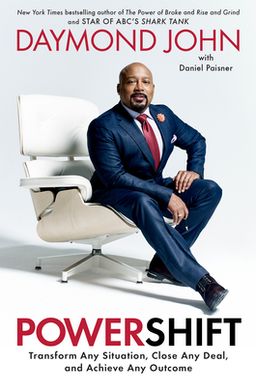
Powershift cover

Powershift

by Daymond John with Daniel Paisner

Powershift by Daymond John offers a transformative guide to achieving success by leveraging influence, strategic relationships, and personal branding. Drawing on his entrepreneurial journey, John provides practical insights and actionable strategies to help readers navigate challenges, build powerful connections, and create impactful change in their personal and professional lives.

Mastering the Powershift: Turning Influence into Lasting Impact

Ever feel like you’re working hard but not moving forward—like someone else is controlling the levers of your career or relationships? In Powershift, entrepreneur and Shark Tank investor Daymond John argues that you can take back control of your life by learning to shift power in your favor. But this isn’t about dominance or manipulation—it’s about mastering three core skills that allow you to create opportunity: building influence, negotiating from strength, and nurturing relationships. Combined, these three gears act like an engine that lets you reinvent yourself and your career, again and again, just as John has done from hustling in Queens to running FUBU to becoming a global business icon.

John argues that real change—what he calls a “powershift”—isn’t about asking for permission but about crafting influence that makes people want to align with your goals. You may not always control external factors, but you can always control how others perceive you, how you show up in negotiation, and how you treat people when no one is watching. That’s the unseen foundation of lasting power. As he puts it, “You can’t delegate relationships.”

The Three Gears of Every Powershift

The book’s core argument revolves around a cyclical journey, not a one-time tactic. John divides the powershift process into three interlocking gears: Influence, where you build credibility and a personal brand; Negotiation, where you turn that influence into concrete wins; and Relationships, where you sustain those wins and multiply their impact. These gears feed one another: strong relationships lead to better negotiations, which amplify your influence. He compares this system to a three-legged stool—remove any leg and your entire power structure collapses.

Each section of the book digs deep into these gears using vivid stories—from his early days with FUBU to lessons learned through Shark Tank and interviews with icons like Mark Cuban, Bethenny Frankel, and Pitbull. These stories illustrate that power, when done right, comes from service, preparation, and authenticity.

From Hustle to Humanity

John opens with his own crisis: being diagnosed with thyroid cancer, a moment that forced him to reconsider what really mattered. Power wasn’t about net worth anymore; it was about how many people he could lift up. That revelation shaped his philosophy that hustling “for us, by us” doesn’t stop with fashion—it’s a universal mindset of creating change that uplifts communities. Every negotiation, every pitch, every relationship becomes a chance to serve rather than to take.

He uses examples like rapper Pitbull’s education initiatives and athlete Lindsey Vonn’s foundation for girls to show that power without generosity is hollow. True powershifters, he insists, leave their “campsite cleaner than they found it.” This metaphor—borrowed from camping etiquette—captures the essence of his philosophy: give more value than you take, and your influence will naturally expand.

Why Powershifting Matters Now

We’re living, John notes, in a freelance era where careers move as fast as algorithms. With remote work, side hustles, and job-hopping becoming the norm, traditional corporate ladders don’t guarantee advancement anymore. The people who thrive are those who create their own leverage—who know how to tell their story, make a fair deal, and maintain trust across transitions. Powershifting is not just a business strategy; it’s a survival skill in a world that rewards adaptability over loyalty.

Throughout the book, John mixes practical frameworks with moving stories: how FUBU’s growth taught him hard lessons about arrogance and humility; how his collaboration with Samsung’s textile team turned skepticism into success; how Mark Cuban built a culture of respect within the Dallas Mavericks; and how even Shark Tank deals succeed only when both parties win. Each reinforces a single truth—lasting power depends on integrity.

The Promise of the Powershift

By the end of Powershift, you’re left with a roadmap for transforming your own trajectory. John invites readers to master three lifelong habits: build influence by standing for something and telling your story clearly; negotiate in ways that create “win–win” outcomes instead of zero-sum victories; and bank relationship capital by consistently overdelivering and acting with integrity, even when there’s no reward in sight. These are not just entrepreneurial skills—they are human ones.

Ultimately, John’s credo can be summed up in the phrase borrowed from Spike Lee, who once wrote him a simple note: “I see you.” That’s the heart of powershifting—earning the respect, trust, and goodwill that make others genuinely see your value. Once you do, you hold the power to shape your own destiny while uplifting everyone around you.


Define Your Why and Motivation for Light

John believes that the greatest barrier to success isn’t talent or opportunity—it’s lack of clarity. Too many people chase goals they don’t understand because they haven’t defined why they’re chasing them. He calls this principle “motivation for light,” a term he borrowed from film production that describes the reason behind every light source in a scene. In life, your light—your energy—must also have a purpose.

Finding Your Why

The key is knowing what really drives you. John reflects on his own transformation from hustling just for money to realizing his deeper purpose: empowerment. FUBU wasn’t just a clothing brand; its name—“For Us, By Us”—was about community identity and representation. Likewise, he discovered that every meaningful powershift begins when you tie your goals to something larger than personal gain. (Simon Sinek popularized a similar argument in Start with Why.)

John advises readers to test their intentions by writing their own obituary—a thought experiment that forces you to confront what legacy you want to leave. The exercise clarifies purpose: Do you want to be remembered for wealth, impact, relationships, or courage? Once you define this, your daily actions acquire direction.

Goals, Grit, and Visualization

John attributes much of his success to writing down specific, measurable goals and reading them aloud daily. Inspired by Napoleon Hill’s Think and Grow Rich, he keeps lists of short- and long-term targets covering personal, financial, and professional areas. He doesn't set vague goals like “make more money,” but concrete ones—complete with dollar amounts and deadlines. Research cited in the book backs him up: written goals make people 42% more likely to succeed.

He also emphasizes visualization—seeing your goal as if it has already been achieved. When he wrote down “FUBU: a billion-dollar brand,” he visualized that outcome years before it happened. Similarly, Olympic skier Lindsey Vonn, one of John’s featured examples, built her career by envisioning each race before competing and setting a “ten-year plan” with her father that mapped every milestone toward the Olympics. Her success, like John’s, was no accident—it was engineered by clarity and discipline.

The Power of Determination

Another example comes from veteran-turned-entrepreneur Charlynda Scales, who founded Mutt’s Sauce using her late grandfather’s secret recipe. Unsure how fast to pursue entrepreneurship while serving in the Air Force, her mentor told her to “move at the speed of determination.” That line, John says, encapsulates powershifting—it’s not about speed, but steady purpose. Within a few years, Scales grew Mutt’s Sauce from a hobby into a six-figure business, selling in Kroger stores. Her success flowed directly from understanding why she was doing it—to honor her grandfather’s legacy and serve her community.

Practical Reflection

John invites readers to conduct “mirror talk,” literally asking themselves tough questions out loud: What do I want? What’s stopping me? Who can help me? Answering honestly transforms vague hope into action. He insists that success starts not with external validation but with internal accountability. When you know your why, every other part of the powershift—negotiation and relationships—falls into alignment. Purpose is the foundation upon which influence is built.


Build Influence by Standing for Something

Influence, for John, is the first gear of a powershift. It’s not popularity or manipulation—it’s earned credibility. You build it by defining what you stand for and living that story so consistently that others can summarize you in a single phrase. He points out that we remember Abraham Lincoln as “Honest Abe” and Muhammad Ali as “The Greatest” because they embodied values that were unmistakable. The same logic applies to your personal brand.

From Item to Lifestyle

John outlines a four-stage model of influence drawn from his branding background: item, label, brand, and lifestyle. An item is generic; a label carries minor recognition; a brand creates emotional connection; and a lifestyle becomes part of the customer’s identity. FUBU climbed this ladder organically, starting as handmade hats sold on Queens sidewalks until it evolved into a global lifestyle symbol for hip-hop culture. The key was authenticity—they didn’t invent a story; they lived it.

John challenges readers to develop a similar trajectory in their personal lives. Define your essence (“hardworking,” “creative,” “fearless”), act in accordance with it, and let others experience that story through your actions. Like Evel Knievel—who went from unknown daredevil to American icon by performing jaw-dropping stunts in the same red-white-and-blue jumpsuit—you must make your identity recognizable and repeatable until it becomes your lifestyle.

Authenticity and Evolution

Influence is meaningless without authenticity. John warns against “faking it” online—followers can smell inauthenticity a mile away. Instead, he encourages transparency and continuous reinvention, much like how Kris Jenner and the Kardashian family built influence by showing their real selves on camera, flaws included. Their authenticity created one of the most successful lifestyle brands in television history. Similarly, John stresses the importance of evolving your story over time. Influence grows when your brand remains true to core values but flexible to new opportunities (as Oprah Winfrey’s and Bill Gates’s careers demonstrate).

Practical Application

To apply this idea, John offers actionable guidance: drink your own Kool-Aid (believe in what you sell), stay on brand, find allies, be patient with the slow build, and stay transparent. Influence takes years but compounds like interest—each honest interaction strengthens your credibility. As he reminds readers, “Your word is your bond—and your reputation is your currency.”


Negotiate with Purpose and Preparation

In the second gear of the powershift, John turns to negotiation—the art of converting influence into opportunity. Success in deal-making comes from preparation, perception, and mutual value, not slick talking. “If you can’t be a good friend to yourself,” he notes, “you can’t be a good partner to me.”

Do Your Homework

Thorough preparation is non-negotiable. John draws lessons from Shark Tank entrepreneurs who bombed because they didn’t know their numbers or even what each Shark preferred to invest in. By contrast, the founders of Bombas Socks aced their pitch because they researched every episode, anticipated potential questions, and rehearsed for weeks. When they sought a $200,000 investment, they not only nailed their valuation but showed deep social purpose: donating a pair of socks to the homeless for every pair sold. Their deal with John became Shark Tank’s most profitable partnership—proof that doing the homework pays literal dividends.

Set the Tone

Negotiation begins the moment you enter a room. John, drawing from experience on Shark Tank and in high-stakes business meetings, argues that body language accounts for 93% of communication. Every gesture—handshake, tone, clothing—tells a story. He likens it to reading a scene: Mark Cuban’s relaxed posture signals engagement; a closed notebook indicates disinterest. Learning to read and project cues is as critical as your pitch itself. (Researcher Albert Mehrabian’s classic study on communication supports this view.)

Play to Win–Win

John rejects zero-sum thinking. He emphasizes “win–win” deals that build trust and longevity. Citing the emotional Shark Tank story of the Cup Board Pro—pitched by the children of a firefighter who died from 9/11-related cancer—John recalls how every Shark invested together and donated their profits to charity. The result was not only $1 million in sales overnight but enduring goodwill. True power, he writes, comes from “dealing from strength to strength”—ensuring both sides walk away better off.

Make the First Move

Unlike traditional wisdom that says “wait for the other side to speak first,” John argues you should set the opening terms. Anchoring the conversation, he says, also anchors perception of your value. Entrepreneur and artist Pitbull is his case study: growing up in Miami’s rough neighborhoods, Pitbull learned to make the first move, hustling mixtapes directly into hands. When he later pivoted into global music by fusing Latin and pop beats, he again acted first—redefining the industry before rivals could. According to Harvard research John cites, first movers in negotiation consistently achieve better economic outcomes.

Preparation, presentation, and principle—that’s John’s three-step formula. When you enter any bargaining scenario with clarity on your value, empathy for others, and an intent to leave every table with trust intact, you don’t just negotiate deals—you negotiate respect.


Add Value Without Expectation

In the relationship phase of his powershift model, John insists that success depends on generosity—giving more than you take without calculating return. He cites Mark Cuban’s mantra, “Work like someone is working 24 hours a day to take it away from you,” but rephrases it as “Work like someone is working 24 hours a day to make a better impression than you.” Power, then, is about overdelivering value while expecting nothing back.

Overdeliver as Culture

John compares giving to leaving your campsite cleaner than you found it: whether in business or life, add value that outlasts the transaction itself. He practices this by giving away free content online—not as a marketing ploy but as gratitude to his supporters. This ethic extends to his rule of thumb: add three times the value you extract before asking for anything. Promote others, show up early, help peers before requesting help—these small acts compound into powerful relationship capital.

Authenticity and Reciprocity

He warns against “one-way street” personalities—people who only reach out when they need something. Instead, be the kind of partner everyone is glad to hear from. Life, he reminds us, is “too short to screw people over.” Pitbull’s SLAM! charter schools and Lindsey Vonn’s foundation show how doing good without expectation circles back as loyalty and legacy. As wooden coach John Wooden said, “The true test of a man’s character is what he does when no one is watching.”

Serve the Long Game

Generosity is also strategic. In relationships, John urges a long-term lens: ask not “What’s in it for me?” but “What can I add?” Every overdelivered promise becomes relational equity you can draw on later. Treat interactions like investments with compounding interest rooted in integrity. As he writes, “Be good to your word and your word will be good to you.”

This principle applies equally to modern digital work. John celebrates freelancers like Crystal Volinchak, a remote project manager who became indispensable by always communicating clearly, meeting deadlines early, and delivering extra without being asked. In a gig economy where trust is rare, such behavior shifts the power back to you—because reliability is the new currency.


Bank and Protect Relationship Capital

Relationship capital—the goodwill you’ve built through consistent fairness and authenticity—is your most valuable asset. John calls it “the glue that holds every powershift together.” Money, fame, or momentum may fade, but your network of trusted human connections endures if you nurture it.

Treat Relationships as Currency

John likens relationships to a bank account. Deposits are favors, kindness, and reliability. Withdrawals are requests or mistakes. Like real savings, relationship capital must grow before being spent. He shares his practice of sending handwritten thank-you notes after speeches—small investments that pay long-term dividends. Likewise, he treats everyone with dignity, from executives to janitors, echoing his mother’s lesson to “respect hard work in any form.”

Use Social Media Responsibly

Online presence, he warns, is part of relationship management. Followers voluntarily enter a “social contract” with you; misuse that trust with exaggerations or toxic behavior, and your capital drains fast. Olympic skier Lindsey Vonn exemplifies balance by segmenting her Instagram—using one account for fans, and others for her dogs and foundation work—honoring each audience’s expectations. Transparency builds lasting loyalty.

Case Study: Steph Korey and Away

Entrepreneur Steph Korey of the luggage brand Away turned her prior experience at Warby Parker and Casper into relational leverage. When courting investors, she positioned herself not as a petitioner but as a partner offering a compelling opportunity. Her credibility and trustworthiness opened doors money alone could not. By maintaining dialogue with customers and constantly integrating feedback, her company reached a $1.4 billion valuation—proof that relationship capital scales.

Five Rules for Relationship ROI

  • Grow deeper, not wider—quality over quantity builds stronger bonds.
  • Systemize outreach—track your network and schedule reconnections.
  • Research people thoroughly before meeting them to personalize each interaction.
  • Protect your network—don’t exploit contacts with premature asks.
  • Communicate in others’ preferred mode—call the phone guy, email the reader, text the traveler.

Relationship capital multiplies when you respect time, deliver consistency, and invest even when immediate gain isn’t visible. In the end, John argues, it’s not what you know but who trusts you that defines your power.


The Courage to See and Be Seen

In his closing story, John tells of receiving a handwritten note years ago from filmmaker Spike Lee after FUBU appeared in People magazine. The note simply read, “I see you.” Those three words, John says, embodied true empowerment: one successful creator acknowledging another. Decades later, when he congratulated Spike at the Oscars and repeated those words back, the cycle of recognition came full circle.

Recognition and Responsibility

For John, that exchange captures the spirit of powershifting. Real power isn’t about domination—it’s about visibility with integrity. When you see others—truly recognize their humanity—you create alignment and possibility. When others see you for who you authentically are, your influence becomes sustainable. “I see you” becomes both validation and accountability: a reminder that your actions are noticed and they matter.

The Powershift Play

John concludes that mastering influence, negotiation, and relationships together is like playing three-level chess. You can’t just win one layer. Influence without integrity collapses; negotiation without empathy alienates; relationships without purpose stagnate. When all three move in harmony, you can—like John, like Spike Lee—transform any situation, close any deal, and achieve any outcome. The true powershift is internal first: to live as if you already have the power, then use it to elevate others.

Ultimately, Powershift is less a business manual than a personal manifesto. It challenges you to build your character, not just your career, and to shift from hustling for survival to leading with service. Or, as Bruce Lee’s epigraph reminds readers, “There are no limits; only plateaus, and you must go beyond them.”

Dig Deeper

Get personalized prompts to apply these lessons to your life and deepen your understanding.

Go Deeper

Get the Full Experience

Download Insight Books for AI-powered reflections, quizzes, and more.