
Idea 1
Powerful Communication for Difficult People
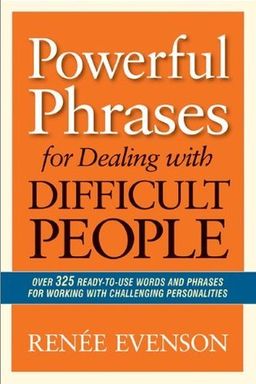
How do you keep your cool when faced with someone who’s argumentative, stubborn, or just downright difficult at work? In Powerful Phrases for Dealing with Difficult People, Renée Evenson argues that your ability to respond—not react—to workplace conflict can define your professional success as much as your technical skills. She contends that mastering communication isn’t just about what you say, but also how, when, and even why you say it.
Evenson’s core argument is simple: you can’t choose your coworkers, but you can choose your words. The secret lies in developing what she calls “powerful phrases”—assertive, empathetic, and constructive statements paired with equally powerful actions. These phrases help you defuse tension, clarify misunderstandings, and transform awkward confrontations into productive conversations. In short, she teaches you how to replace emotional impulse with reasoned dialogue.
Why It Matters
Workplaces are filled with clashing personalities—the gossip who undermines trust, the bully who thrives on control, or the boss who won’t communicate. Ignoring conflict, as Evenson warns, only makes it worse. Problems fester until they boil over, damaging relationships and reputations. She emphasizes that avoiding people doesn’t avoid problems—effective communication does. Those who can resolve conflict calmly are often promoted faster than technically superior peers because they make workplaces healthier and more efficient.
What This Book Offers
Across its six parts, Evenson builds a toolkit for conflict management. Part 1 explores how thoughtful phrasing shapes outcomes—teaching you to use “I” statements instead of “you” accusations, as seen in her scenario between Kate and Emma. Part 2 reveals the role of body language, tone, and assertiveness. Part 3 introduces a five-step model to handle any disagreement, from thinking first to agreeing on a resolution. Later sections focus on specific types of people—coworkers, bosses, and even yourself when you cause the problem.
The guidance is extremely practical: more than 325 ready-to-use phrases are woven into scenarios that show both the wrong way (a reactive, emotional conversation) and the right way (a calm, structured exchange). By comparing these models, you learn to recognize verbal patterns that either ignite or extinguish tension. Evenson’s examples make you feel as if you’re eavesdropping on real workplace exchanges—from passive-aggressive bosses to overbearing team members.
The Heart of Effective Communication
The essence of Evenson’s philosophy is respect blended with clarity. “Begin with ‘I,’” she writes, because “you” puts others on the defensive. Instead of saying, “You always interrupt me,” she shows how to say, “I felt thrown off when you spoke while I was presenting.” Shifting from accusation to self-expression keeps doors open rather than slammed shut. Similarly, showing understanding (“I realize you didn’t do it on purpose”) builds cooperation rather than hostility.
Her approach balances empathy with assertiveness—a combination that transforms power dynamics without hostility. Like Dale Carnegie’s advice to “win friends and influence people” through empathy, Evenson’s framework extends that logic to difficult workplace personalities, arguing that mutual respect doesn’t mean weakness but tact. You can stand your ground while still valuing someone else’s perspective.
Why These Ideas Work
Evenson’s methods are grounded in both psychology and business communication. Constructive phrasing builds cognitive empathy—the ability to recognize another person’s point of view without surrendering your own. Similarly, her emphasis on nonverbal alignment (tone, posture, facial expressions) reflects research on how subtle cues shape trust and perception. When verbal and nonverbal signals match, communication becomes credible.
Ultimately, Evenson wants you to stop reacting automatically and start responding intentionally. By pairing language with body awareness, she helps you become what she calls “a person who connects successfully with others.” Whether you’re dealing with a micromanaging boss, a gossiping colleague, or your own mistakes, this skill turns workplace chaos into collaboration.
Where It Leads
By the end, Powerful Phrases for Dealing with Difficult People feels less like a scriptbook and more like a mindset for professional grace under pressure. It teaches that resolution isn’t about winning—it’s about maintaining relationships and respect. In Evenson’s view, verbal skill equals emotional intelligence. When you can calmly say, “Let’s talk this through,” instead of, “You’re wrong again,” you turn confrontation into connection. That, she assures, is the real power behind every phrase you speak.