
Idea 1
Power, Consciousness, and the Measure of Truth
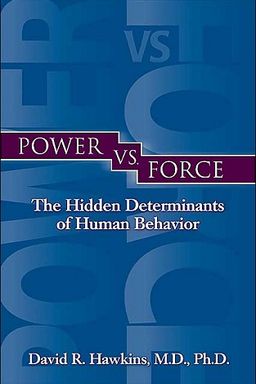
What determines whether a person, idea or society thrives? In Power vs. Force, David R. Hawkins argues that every action, emotion and belief operates within measurable fields of consciousness — invisible energy patterns that shape life’s outcomes. His bold claim is that truth and integrity create power, while deception and coercion create force. The distinction is not metaphorical; it has physical and psychological correlates that can be detected using the body’s own responses.
Hawkins integrates kinesiology, psychology, spirituality and systems theory to create what he calls a map of consciousness: a logarithmic scale from 1 to 1,000 that quantifies human awareness. It becomes both a diagnostic tool and a moral compass. At its core lies a startling assertion — consciousness is a universal database containing absolute truth, and the human body can access it through simple tests.
The heart of Hawkins' argument
The book’s main thesis revolves around the difference between Power and Force. Power arises from truth, love, and integrity — it uplifts and endures. Force comes from fear, pride and aggression — it coerces and collapses. Through a century of political, cultural and personal examples, Hawkins demonstrates how civilizations dominated by force degrade, while those aligned with power flourish. Gandhi versus Hitler, nurturing leadership versus tyranny, service-oriented business versus exploitation — each pairing illustrates how consciousness level determines success or failure.
At the pivot of this scale is Courage (200) — the dividing line between destructive and life-supporting states. Below 200 lie Shame, Guilt, Apathy, Fear, Desire and Anger — energies fueled by survival anxiety and control. Above 200, you encounter Reason, Love, Joy and Peace — progressively expansive states where creativity, cooperation and healing emerge. Few people or institutions consistently live above 500 (Love), yet the few who do uplift millions below them.
Linking science, mysticism and daily life
Hawkins blends insights from nonlinear dynamics, Jungian psychology and quantum physics. He borrows terms like attractors, M-fields and morphogenetic fields (from Rupert Sheldrake) to explain how patterns of intention organize matter, society and thought. Just as weather systems are held in invisible atmospheric attractors, human behavior clusters around attractors of consciousness. When a collective field shifts — as when Roger Bannister broke the four-minute mile or when the Wright brothers proved flight possible — a new pattern becomes available to everyone.
According to Hawkins, these attractor fields can be measured via kinesiology — a muscle test that detects how the body responds to truth or falsehood. The muscle weakens when exposed to destructive stimuli (like deceit, hatred, artificial sweeteners) and strengthens in the presence of beneficial ones (like honesty, love, or vitamin C). He asserts that this binary reaction is a direct reflection of alignment with or resistance to the universal consciousness field.
The body as an instrument of truth
The kinesiology test is deceptively simple: one person extends an arm while another applies gentle pressure. If the subject holds a truthful or life-supporting thought, the arm remains strong; if not, it weakens. Hawkins and predecessors like Dr. George Goodheart and Dr. John Diamond used this method clinically and experimentally across thousands of trials. Hawkins then applied it to calibrate statements, books, and world leaders on his scale of consciousness. The results, he claims, are replicable across cultures and free of personal bias when done correctly.
With this, Hawkins constructs not merely a diagnostic technique but a philosophy: reality is not subjective opinion but measurable truth embedded in consciousness. By aligning with higher attractors — through integrity, compassion and service — you access greater power and clarity. The implications extend from medicine to politics, from art to commerce.
The map as a tool for evolution
The calibration scale serves as both mirror and roadmap. It shows where you stand and what inner qualities you must cultivate to evolve. Reason (400) brings scientific achievement but also limitation if divorced from compassion. Love (500) transcends logic and heals. Joy (540) and Peace (600) reflect surrender to life rather than domination over it. Enlightenment (700–1000) represents complete self-transcendence — the field inhabited by Jesus, the Buddha, and other avatars.
In Hawkins’ view, to raise consciousness individually is to contribute to global healing. The more people calibrate above 200, the more the collective field stabilizes toward cooperation and peace. Thus, the book is not just metaphysics; it’s a call to ethical responsibility. Every thought feeds into the field, strengthening or weakening humanity’s shared attractor. (Note: Hawkins’ method remains controversial, but its ethical and spiritual resonances parallel perennial philosophies — from the Bhagavad Gita to Jung’s integration of the self.)
Core message
Life operates in a hierarchy of truth. When you live from power — integrity, courage, and love — your influence multiplies. When you live from force — fear, pride, and deceit — you exhaust both yourself and society. Calibrating your life toward higher attractors is, for Hawkins, both a measurable process and the essence of spiritual growth.
By the end of the book, you see consciousness not as a private mental state but as an interactive field. Truth can be tested. Love has quantifiable strength. And small choices — in politics, art, business, or healing — ripple outward through unseen attractor patterns that decide the fate of civilizations. This union of science, ethics and spirituality is Hawkins’ lasting contribution: the possibility of objective truth within subjective life.