
Idea 1
Mitochondria and the Energetic Revolution of Life
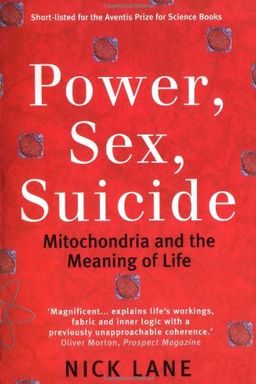
Why does complex life exist at all? The book argues that the answer lies in a microscopic partnership forged nearly two billion years ago between two kinds of cells—an archaeal host and a bacterial symbiont—that gave rise to mitochondria. These tiny endosymbionts transformed the energy economy of life, enabling the leap from bacterial simplicity to eukaryotic complexity. To understand humans, ageing, and even the evolution of sexes, you must begin with mitochondria.
The ancient merger that changed everything
Nearly two billion years ago, an archaeal microbe and an alpha-proteobacterium formed an unlikely alliance. Bill Martin and Miklós Müller's hydrogen hypothesis suggests that hydrogen metabolism provided the bridge: the bacterium produced hydrogen as a waste product, while the archaeal host consumed it. Over time, the bacterium was engulfed and evolved into the mitochondrion. This partnership created the first eukaryotic cell—a chimera whose dual ancestry explains why eukaryotic genes are split between archaeal information systems and bacterial metabolism.
The mitochondrial endosymbiosis was a one-off. If it hadn't happened, complex multicellular life as we know it—plants, animals, fungi—might never have evolved. This merger was not a gradual improvement but a sudden energetic revolution, reshaping life's possibilities.
Chemiosmosis: the power principle
To grasp how mitochondria made complexity possible, you need Peter Mitchell’s radical insight of chemiosmosis. Instead of a chemical intermediate linking food oxidation to ATP production, Mitchell proposed a physical one: a proton gradient across a membrane. Electron flow through mitochondrial complexes pumps protons out of the matrix, and when those protons stream back through ATP synthase, the enzyme spins like a turbine to make ATP. This mechanism operates in bacteria, chloroplasts, and your own cells—proof of its universality.
By enclosing their own proton-pumping membranes, mitochondria turned energy production inward. Eukaryotic cells could now internalize respiration, multiplying energy-producing surfaces inside their cytoplasm without being limited by external geometry. The outcome was a vast, controllable internal power supply—thousands of mitochondria per cell—capable of sustaining large genomes and elaborate architectures.
The energetic bottleneck and its release
Bacteria, despite their staggering biochemical diversity, remained small. With respiration tied to their outer membranes, their energy scales with surface area while their internal demand scales with volume. This mismatch explains why bacteria rarely evolve complex, multicellular forms. Mitochondria broke this rule by internalizing energy generation, freeing cells from the surface-area constraint. The host cell’s genome could now expand, regulatory networks could flourish, and multicellularity became energetically affordable.
The symbiosis also created a dual-genome system: mitochondria kept a few crucial genes for local control while transferring thousands to the nucleus. This genomic division of labor demanded precise coordination—but it also set the stage for innovations in sex, inheritance, and ageing.
From energy to evolution, sex, and death
Once mitochondria took root, their influence spread beyond metabolism. They became arbiters of life and death (through apoptosis), drove sexual reproduction’s asymmetries (only maternal mitochondria persist), and linked energy flow to ageing. Their proton gradients even shaped macroevolutionary trends: warm-bloodedness, metabolic scaling, and lifespan all reflect mitochondrial design. Throughout the book, you see mitochondria not as passive relics but as dynamic governors of life’s most intimate processes.
Core message
Mitochondria are both fossils of an ancient endosymbiosis and engines of living complexity. By merging bacterial energy production with archaeal information systems, they created the first truly complex cells—and the energetic foundation upon which evolution built everything from sex to consciousness.